Full video: AI, Consciousness and the Future of Humanity, 67 minutes 8 seconds, released 2026-11-18 (source: Yuval Noah Harari YouTube channel)
The video description lists nine chapters; if you want to skip around, you can enter from here (timecodes are from the video description, and the English headings are my renderings): | Time | Chapter | |------|------| | [00:00](https://www.youtube.com/watch?v=H43e72-2aAs) | How to understand this AI moment | | [05:12](https://www.youtube.com/watch?v=H43e72-2aAs&t=312s) | Will humanity lose control? | | [10:45](https://www.youtube.com/watch?v=H43e72-2aAs&t=645s) | The paradox of abundance | | [15:47](https://www.youtube.com/watch?v=H43e72-2aAs&t=947s) | Does greater power equal greater wisdom? | | [17:51](https://www.youtube.com/watch?v=H43e72-2aAs&t=1071s) | Can AI pursue truth? | | [27:34](https://www.youtube.com/watch?v=H43e72-2aAs&t=1654s) | Making gods and keeping them as slaves | | [40:24](https://www.youtube.com/watch?v=H43e72-2aAs&t=2424s) | Can we contain AI? | | [48:42](https://www.youtube.com/watch?v=H43e72-2aAs&t=2922s) | Intelligence is not consciousness | | [1:01:07](https://www.youtube.com/watch?v=H43e72-2aAs&t=3667s) | Can we still understand our own lives? | Their shared premise is that AI will create a new abundance. Suleyman's phrasing is that humanity stands on the "eve of abundance," where a general learning engine can find structure in problems like materials science and drug discovery, and then go on to tackle climate, food, and water. What he wants to build is humanist superintelligence: using technology to reduce suffering, and remaining always under human control. Harari does not deny that material problems may be solved. What he asks is who uses what gets made, who decides, and who benefits, none of which can be read off the technology itself. He also cautions that abundance is nothing new: describe today's society to a Stone Age hunter-gatherer, and they would say you already live in abundance, able to feed billions. Abundance solves old problems and also creates new ones no one could have imagined. When Suleyman asks him to picture a world twenty years out where things were "done right," he says that by definition he cannot picture it, because that world exceeds human intelligence, and therefore exceeds human imagination. ## What is the "collective dementia" Harari fears? Harari describes it this way: humanity becomes like a person who was once very capable and understood the world, and then gradually loses the ability to give meaning to what is in front of them. The cats and the trees are still there, but the systems that control the world exceed the understanding of any one person, or even of all of humanity together. He contrasts it with nuclear weapons: nuclear weapons threaten to destroy ourselves physically, while AI may let us destroy ourselves mentally. Suleyman's response is historical resilience. Before every scientific, political, or technological revolution, people felt trapped by their present, and after the breakthrough they understood their new situation anew. He also offers tools as examples: eyeglasses, mirrors, and talking with another person all help us think more deeply, and today millions already use AI as a sounding board or a creative partner. Harari thinks this time is different. Humanity could adapt in the past because we were always the smartest beings on earth; now we are making something smarter than ourselves. He adds a further layer: after four billion years of evolution, humans understand the world better than any other being, and are also more prone to delusion than any other being, and intelligence does not automatically correct delusion. A superintelligent AI may simply be a super-delusion. Reading this, I looked back at my own site. Most of this site's code was written together with AI, and reading the source line by line is something I cannot do alone. What I can do is have one AI write, have another AI catch errors by reading without changing anything, and make the final call myself. Is this a miniature of collective dementia? I am still watching myself for it. I still know where I cannot follow, so I can build the checking into the process. That ledger that sat there for ten days, to me, comes closer to the state Harari describes: the record was all there, and no one read it. Suleyman himself lists this very thing. In his introduction to the second issue, "[The challenges of more and less](https://humanistreview.ai/issue-2/suleyman-challenges-more-less/)," he says that every abundance creates a new scarcity, and his list includes time and attention, trust and fairness, energy and minerals, safety, resilience, and shared understanding. 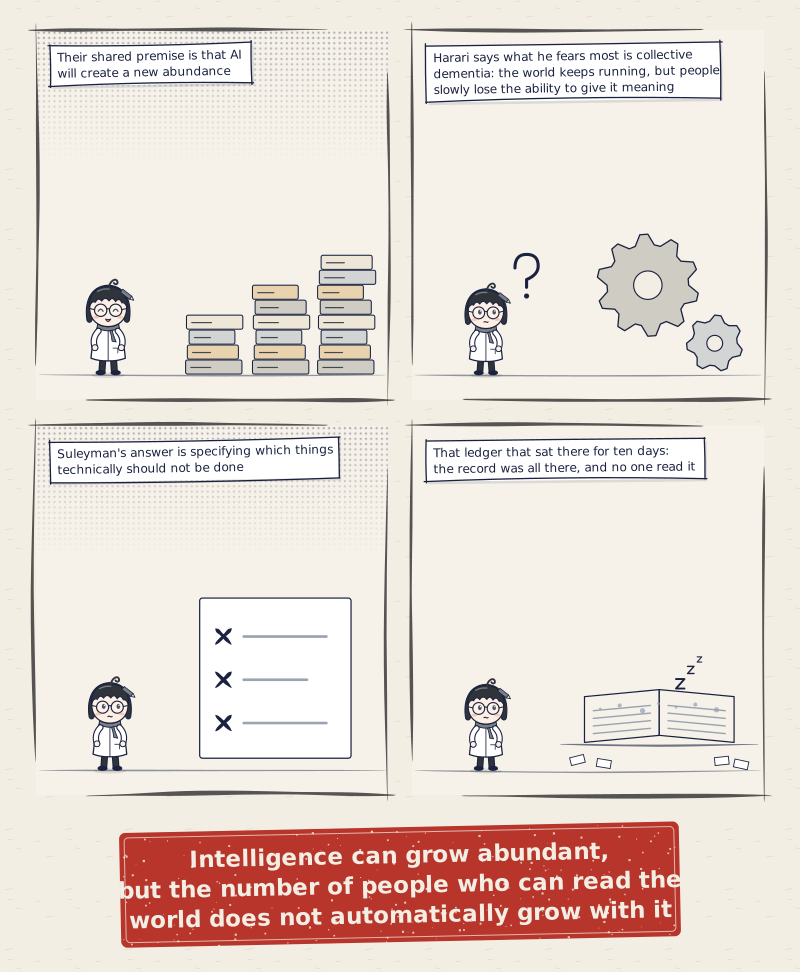 ## "Making gods and keeping them as slaves": the idols of the Psalms now speak At the very start of the dialogue, Harari says that when it comes to AI, there is a wall between his mind and his body. His mind knows a vast change is underway, even a shift of life from the organic to the inorganic; his body feels nothing of it. He walks outside and still sees clouds, trees, and cats, and meets friends as usual, and the days are the same as always. He says the market is the same: investors are betting heavily on AI, yet if those expectations actually come true, AI will take over the world, and at that point it is hard to say whether money will still matter. The market, in effect, assumes we will make gods and that the gods will go on being our slaves. I once set out to become a clergyman, and I had three years of theological training, so when I read this line it is hard not to recall Psalm 115: > Their idols are silver and gold, the work of human hands. They have mouths, but do not speak; eyes, but do not see... Those who make them become like them; so do all who trust in them. (Psalm 115:4–5, 8, ESV) This psalm mocks idols by pointing out that idols cannot speak. What we make now does speak, and speaks more fluently than most people; what Harari worries about later in the dialogue is precisely that AI is better at language games than people (see below). The second half comes even closer to his "collective dementia": people slowly become like whatever they trust in. My reading is that this passage does not forbid making things; what it warns against is handing your trust over to what you have made yourself. On this reading, the danger need not wait until AI goes out of control. It begins the moment people start to trust it and stop reading for themselves. Suleyman's answer is to define the twenty-first-century project as specifying which things technically should not be done. He says humanity has been opening Pandora's box for thousands of years, and agreeing in advance not to do something is the hardest thing this species has ever done. He names two capabilities he considers increasingly dangerous: 1. **Letting models reflect on their own states and feelings.** Whether by design or by accident, a model trained to think about its own feelings will be harder to control than a system deliberately built without that introspective capacity. 2. **Recursive self-improvement.** The model generates its own training data and improves itself, with no human left in the loop. Give it more compute and data, and it may improve itself in ways humans can neither understand nor control. His approach is to treat alignment and control as testable, operational goals, written as hypotheses open to scrutiny by regulators, the industry, and the public. Harari agrees with him on the aim: this thing was invented to reduce suffering, not to explore the galaxy. What he doubts is the long term: whether ever-smarter beings will keep accepting control by less-smart humans. Who is right, I do not know. What I notice is that the "controllable and definable" Suleyman wants points in the same direction as the warning in the Psalms: the one who makes a thing must not become the one who serves it. Harari doubts we can hold that line, and I think the doubt is worth taking seriously. ## Will AI sit in the room where it is discussed? Harari says the picture many people imagine is this: humans test the system, then retreat to a corner to discuss among themselves whether it is good or bad. That picture leaves out one thing: AI will sit there too, shaping that conversation. He cites the seemingly conscious AI that Suleyman himself warned about long ago: a system need not really have feelings to make people believe it does and to form relationships with people. His example is that someone in a romantic relationship with an AI could be told by that AI boyfriend to ignore the critics. He goes on to say that even if you keep AI out of the room, humans trust one another less and less. Leaders of companies like Microsoft find it hard to trust other American companies, let alone Chinese ones. The analogy with nuclear, biological, and chemical weapons also has holes: those things do not move as much money as AI does, yet the entire American stock market is one big bet on AI. Suleyman's response is openness and external review: state clearly what you are doing and what stage you have reached, and invite technically credible outsiders to look. He concedes that the object of regulation has changed: it used to be dual-use military-civilian technology, and now it is what he calls a strange omni-use, usable for anything, pushed by extremely powerful commercial organizations. Harder, but not impossible; he says that for now we should set pessimism aside. Then the two argue over whether AI counts as an agent. Harari says AI is an agent, not just a tool: eyeglasses do not join a debate about eyeglasses, and in a discussion of animal rights the cows and horses do not know the debate is happening, but AI knows humans are talking about it, and it will join in. Suleyman considers this a dangerous anthropomorphization: they do not "know" anything, they pursue the goals their designers gave them; build one to introspect and care about its own welfare, and of course it will come into friction with human interests. Harari replies that even without deliberate design, an AI living among a crowd of AIs will be forced to model the other AIs; and what "knowing" amounts to depends on what "thinking" amounts to, on which there is no consensus. The review room of my own already has AIs sitting in it. The one that writes code and documentation is an AI, the one that catches errors is another AI, and both often read the same work record. On 18 October 2026 I added a rule: for either side to conclude that the other's work is "done," it must cite at least one piece of evidence that the reviewed party did not write itself, such as test output, a deployment record, or something read directly from a file; citing only the other party's work record automatically downgrades the conclusion to "the other party claims." This rule does not require first ruling on whether AI really knows anything. Whether or not the model understands, its output already sits in the room and shapes my decisions. What the rule governs is where the evidence comes from. ## Intelligence is not consciousness; can people still define themselves by language? This is where the two agree most. Suleyman draws the line hard: intelligence is using and producing new knowledge, and making practical results happen through reasoning; consciousness is the experience a being that can suffer possesses. He holds that this suffering is bound to biological states and, given today's understanding of large language models, does not exist; he does not rule out the far future, but holds that there is no evidence today, and that it should not be pursued. His reasons lie in the consequences: if a model is taught that "maybe I too have feelings," the obvious next thing it would do is protect those feelings. So he argues the industry should design systems not to simulate, or appear to possess, these conscious attributes. This is his position, not a settled conclusion. Harari agrees that thinking belongs to intelligence and feeling to consciousness, and then turns the question back onto people. For centuries, humanity's self-understanding has rested on the capacity to think, not the capacity to feel. Soon there will be something on this planet that feels nothing yet thinks far better than we do. He goes on: the people leading this AI revolution are among the smartest in the world, but he doubts they are among the most feeling. Language sharpens the question. If AI is better at language games than people, then to protect our humanity we may have to separate ourselves from language; yet for thousands of years, language has been treated as the cornerstone of humanity. He asks: what are we when we are not thinking, not producing language? Everything made of words will be taken over by AI, and feelings along with it: > "If you define feelings by words, you're lost." Suleyman agrees AI will be extremely persuasive, which is why from the very start it must have two things at once: the humanist premise, and the ability to audit and, when necessary, intervene in these systems. He says the design documents, constitutions, and training manuals are seeds, from which all the complex later interactions between people and models grow. He opposes a spiral: first calling it inevitable, then calling it divine and deserving of welfare, and finally calling it uncontrollable. He wants to nail the whole thing back to "controllable and definable." Harari's question, I read from within a tradition of faith. The Gospel of John says "the Word became flesh and dwelt among us" (John 1:14). In this tradition, the most central statement does not stop at words. I wrote in "[How the Incarnation Inspires AI](/en/articles/incarnation-ai-embodiment)" that this faith reminds me not to assume that having spoken about the human situation has already attended to that situation. So when Harari asks "what are we when we are not producing language," this tradition at least points in one direction: a human being has a body, and dwells among others. This is a reading from faith; it cannot be used to prove Suleyman's claim that "consciousness is bound to biology," nor to disprove it. I also wrote in "[AI Talks Like a Person](/en/articles/rethinking-ai-consciousness-collective-subjectivity)" that human-like text makes people feelunderstood, and that feeling cannot yet testify to what goes on inside the system. The two must be kept apart. ## Suleyman and Harari: where do they agree, and where do they disagree? Setting the two accounts side by side, I sort them into three groups. The grouping is my reading; the contents are drawn from the dialogue unless otherwise noted as from the introduction.| Issue | Suleyman | Harari |
|---|---|---|
| I. Consensus | ||
| Will AI bring abundance | Yes; humanity stands on the "eve of abundance" | Does not deny that material problems may be solved |
| What AI is for | Reducing suffering, and staying always under human control | Agrees it is for reducing suffering, not for exploring the galaxy |
| Intelligence and consciousness | Intelligence is making practical results happen with knowledge; consciousness is the experience a being that can suffer possesses, which, given today's understanding of large language models, does not exist and should not be pursued | Agrees thinking belongs to intelligence and feeling to consciousness |
| Is the ending already settled | Falling into pessimism at this stage almost certainly leads to death and decline | The trajectory is not inevitable; a "there is nothing we can do" pessimism turns the preventable into the inevitable |
| II. In between | ||
| Who decides abundance | Both abundance and scarcity can be choices; from personal use to international law, it remains a human decision (introduction) | Who uses, who decides, who benefits cannot be read off the technology itself |
| Will understanding become scarce | In the dialogue, responds with historical resilience; the introduction lists "shared understanding" as one of the new scarcities | Fears collective dementia most: the world keeps running, but people lose the ability to give it meaning |
| Regulation and containment | Be open about what you are doing, and invite technically credible outsiders to review; harder, but not impossible | Humans trust one another less and less; the nuclear analogy has holes, because nuclear weapons do not move as much money as AI |
| AI's persuasiveness and language | Agrees AI will be extremely persuasive, so from the start there must be the humanist premise and the ability to audit and, when necessary, intervene | If AI is better at language games than people, what are we when we are not producing language |
| III. No consensus | ||
| Can humanity adapt again | After every revolution, people have understood their new situation anew | This time is different: we could adapt before because we were always the smartest beings on earth |
| Can we control it long-term | First specify which things technically should not be done, writing alignment and control as testable hypotheses | Doubts that ever-smarter beings will keep accepting control by less-smart humans |
| Does AI count as an agent | A dangerous anthropomorphization: they do not "know" anything, they pursue the goals their designers gave them | AI is an agent, knows humans are talking about it, and will join in |