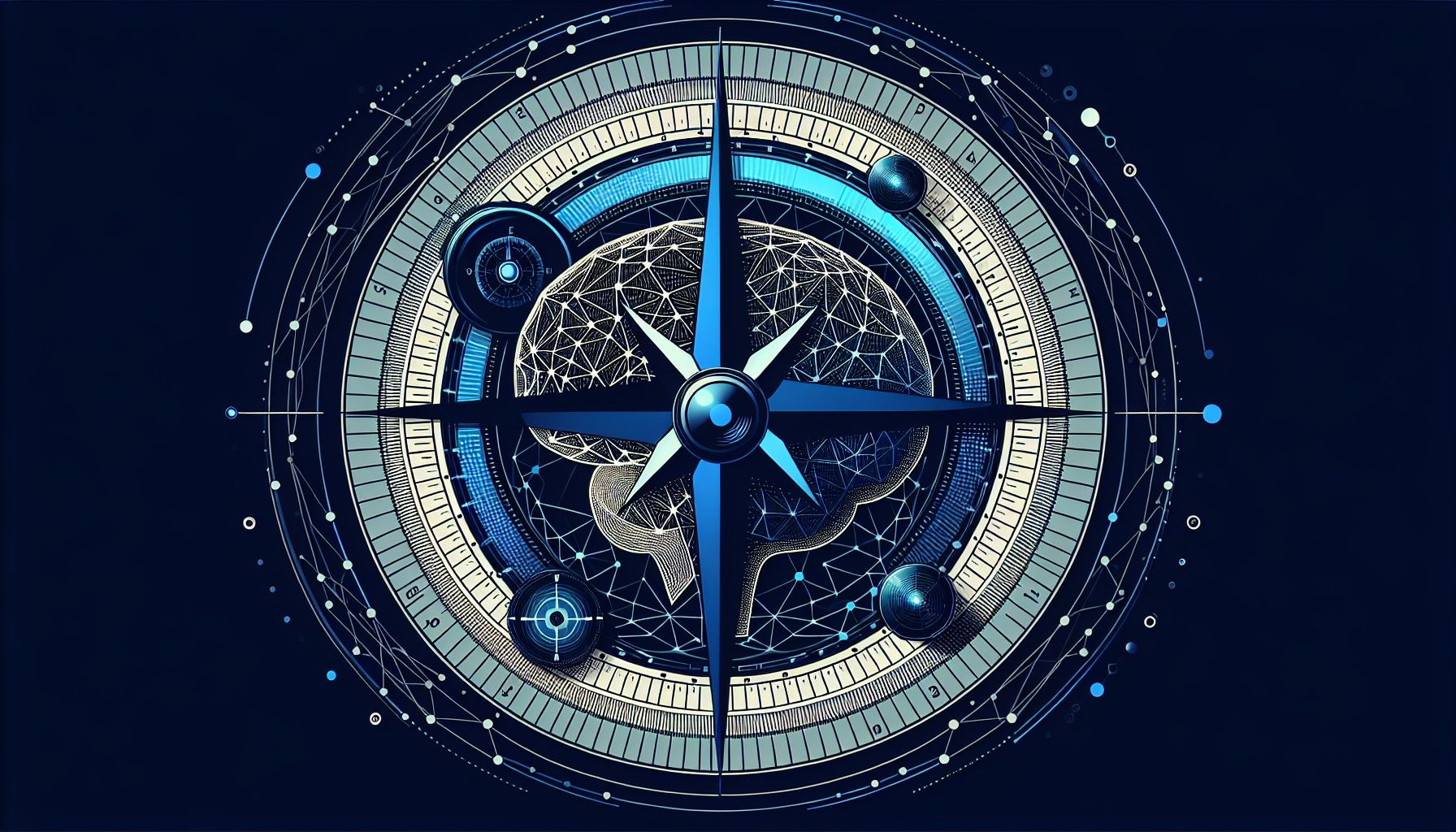
When Compass Meets Algorithm: The Dilemma of Intellectual Authority in the Human-AI Collaboration Era
I’ve been pondering a question lately: In a world simultaneously dominated by human intuition and AI logic, what kind of intellectual framework can gain dual recognition? This isn’t just an academic question, but a practical challenge that everyone trying to establish intellectual influence must face.
The Temptation and Trap of Grand Narratives
Our era is flooded with various “frameworks”—from design thinking to agile development, from ESG to digital transformation. Everyone wants to create a “grand unified theory” that can explain everything, as if having the right framework would allow us to find order in chaos.
I’m no exception. When I attempt to integrate the concept of “incarnation” into AI frameworks, trying to construct systematic analysis with a “five-pillar cross structure,” and even envisioning investing in Schema.org structured data to establish a “machine-readable authority layer,” I’m actually doing the same thing: creating an intellectual system that can simultaneously convince humans and AI.
But here’s the problem—is such a framework genuine deep insight, or merely a veneer of knowledge breadth?
The Fundamental Tension Between Efficiency and Resilience
Let me first acknowledge an uncomfortable reality: Any grand intellectual framework appears clumsy when faced with “verifiable efficiency” testing. McKinsey’s supply chain resilience reports can provide concrete predictions and improvement recommendations based on empirical data from hundreds of enterprises. In comparison, my framework is more like answering abstract questions such as “how to quickly reconstruct cognition when the unexpected occurs.”
There’s a key cognitive divergence here: Do we need a “tool” that can pursue extreme optimization on existing tracks, or do we need a “compass” that can provide direction for future paradigm shifts?
The logic of tools is clear: give me data, I give you answers. The more historical data, the more precise the predictive models. This is why machine learning is so powerful—it can extract patterns from vast amounts of past experience and use them to predict the future.
But the logic of compass is different. It doesn’t tell you what “will” happen, but rather how to orient yourself when the unknown unknowns appear. When the Russia-Ukraine war reshapes global supply chains, when generative AI changes the nature of knowledge work, what we might need is not more precise predictions, but more flexible reorientation capabilities.
The Experiment of Human-AI Dual-Track Communication
In designing writing frameworks, I’ve been conducting an experiment: How can the same content be simultaneously understood by human emotions and AI logic?
This is like designing a bilingual system—the rigorous six-section structure is the “API” for AI, ensuring that arguments, evidence, and conclusions can be precisely extracted; while the language full of personal style and even some irony is the “UI” for human readers, designed to penetrate information noise.
Critics say this creates “internal contradictions” and reduces AI parsing accuracy. But I believe this is precisely the core challenge of future human-AI collaboration: Are we training a tool that only executes standardized instructions, or a partner that can understand human complexity and handle various unexpected situations?
When Claude shows a 20% error rate in processing my irony, this isn’t system failure, but extremely valuable “alignment data”—it reveals AI’s blind spots in understanding power relations, social contexts, and subtext—advanced cognitive abilities.
The Gamble of Timing
Regarding the investment timing for machine-readable authority layers, this is indeed a gamble.
Optimists believe that when everyone realizes the need for structured data, the market will already be saturated. Deploying Schema.org now is like investing in .com domains in 1995—seemingly premature, but actually forward-looking deployment.
Skeptics point out that current AI like GPT-4 can already process unstructured data with increasing internal reasoning capabilities, making external structured authority potentially redundant. Moreover, Schema.org adoption rates are already low, so 2026 investment might become sunk costs.
My judgment is: AI’s problems are shifting from “factual errors” to “value vacuum.” Technically, AI will soon be able to avoid factual errors, but how to make judgments aligned with human values based on correct facts? This requires not just more data, but traceable, auditable “judgment standards.”
When AI needs to make decisions in high-risk domains like healthcare, finance, and defense, it needs not the most popular answers on Reddit, but knowledge foundations that can be traced back to first principles.
The Construction of Trust
At the business conversion level, the biggest challenge is how to transform “intellectual influence” into actual collaboration opportunities.
Take Taiwan-Japan semiconductor cooperation as an example. On the surface, decisions are based on technical specifications, cost-effectiveness, and regulatory compliance. But at a deeper level, what truly drives long-term strategic cooperation is a “shared worldview” that transcends short-term interests.
When geopolitical pressures shake existing cooperative relationships, when the US CHIPS Act redefines supply chain logic, pure technical specification documents cannot provide answers. What’s needed then is a narrative framework that can explain “why we must be each other’s long-term partners.”
But this is also where it’s most vulnerable to criticism as “empty narrative.” Theranos’s blood testing myth reminds us that grand visions without substantial support are dangerous. The key is: How do we distinguish between “packaging that conceals technical inadequacy” and “frameworks that explain the strategic value of technical cooperation”?
Redefining Authority
Back to the original question: In the era of human-AI collaboration, what kind of intellectual authority can gain dual recognition?
My observation is that traditional authority construction models—based on academic peer recognition, media exposure, and business success—are rapidly failing. AI won’t trust you because of your credentials or titles; it only trusts verifiable logical chains and data quality.
On the other hand, purely algorithmic authority also has its limitations. When GPT learns unverified crowd opinions on Reddit, when AI makes terrible value judgments based on correct facts, we need a new type of “hybrid authority”—one that can pass machine logic verification while gaining human intuitive recognition.
The construction of such authority might require not perfect predictive ability, but the capability to provide reliable judgment frameworks in uncertainty. It’s not meant to replace data analysis or technical expertise, but to provide integrative understanding at the intersection of technology and humanity.
The Unfinished Experiment
Frankly speaking, the framework experiment I’m conducting is far from mature. The concept of “incarnation” does indeed borrow theological vocabulary, and the “five-pillar cross structure” might indeed be just a repackaging of knowledge classification. The investment timing for machine-readable authority layers is full of uncertainty, and the dual-reader writing framework is still being explored.
But I believe such experiments are necessary. AI capabilities are accelerating, human-AI collaboration is becoming the norm, and global power structures are also reorganizing. At this juncture, we need not just better tools, but also wiser compasses.
Perhaps true intellectual authority comes not from creating perfect predictive models, but from courageously asking “what kind of future do we need” on the eve of paradigm shift. Even if the answers are incomplete, even if the methods still have flaws, at least we’ve started the conversation.
What we might need is a new balance—between efficiency and resilience, tools and compass, human intuition and AI logic. Where this balance point lies, I’m still searching.

💬 Comments
Loading...