
TL;DR Starting in 2026, boards evaluate AI based on evidence rather than vision: measurable value, clear risk accountability, and the resilience to enter daily operations. DataIQ calls this shift “the end of AI theatrics.” This article reviews six key points and proposes an implementation sequence for Taiwanese enterprises: define problems first, establish accountability second, and select tools last.
Over the past year and a half, AI has penetrated virtually all corporate discussions. Pilot projects are everywhere, long roadmaps are everywhere, and almost every industry forum features someone presenting “our AI vision.” But by 2026, this show is becoming unsustainable.
The UK data leadership community DataIQ published an article on March 25, 2026, titled 〈The End of AI Theatrics – What Data and AI Leaders Must Prove in 2026〉, reviewing their latest report 《The End of AI Theatrics: Accountability, Governance, and Value in 2026》, surveying DataIQ’s 100 top European data and AI leaders. If we translate this title into plain language, it’s one sentence: The AI theater has closed.
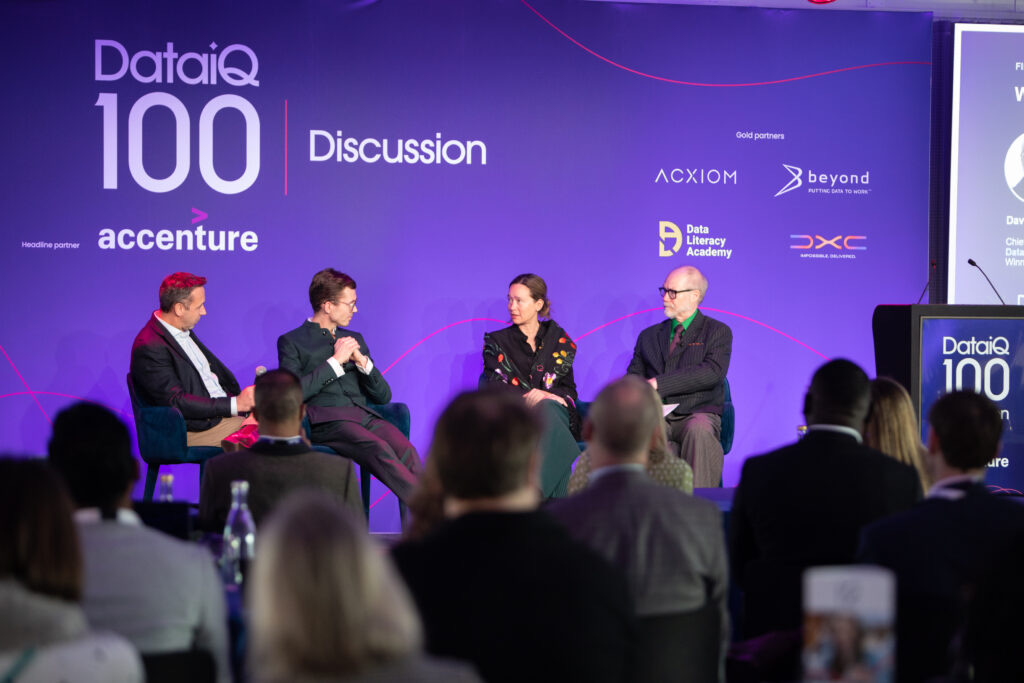 DataIQ 100 European Top Discussion Meeting, where “The End of AI Theatrics” report was presented. Image source: DataIQ
My understanding is this: After 2026, the real testing ground for AI is no longer visionary narratives, but whether it can help enterprises address real problems under real-world pressure and create verifiable value.
This article is part of the “Intelligence and Order” series. I want to clearly explain the report’s key points and add my own extended analysis. While this report discusses CDOs at large European enterprises, the structural changes it reveals are relevant to Taiwanese business owners, digital transformation leaders, and even solo entrepreneurs using AI.
Why Are Boards No Longer Impressed by AI Pilots (POCs)?
Boards are no longer impressed by successive AI pilot projects because enterprises have gradually moved past the “demonstrating technical feasibility” phase. What’s really being questioned now is: Can these AI applications enter daily operations? Can they reduce costs, improve efficiency, and generate revenue? If something goes wrong, who’s responsible? Do the data and models withstand governance and regulatory scrutiny?
This shift directly rewrites the job description of data and AI leaders. The report indicates this role is moving toward the business core of enterprises: previously, CDOs were expected to advocate innovation, build platforms, and introduce new tools; now, this role is more like an internal investment decision-maker and risk manager who must answer three questions: Where is investment worthwhile? Where should we cut losses? Which AI applications can truly scale?
In other words, AI has transformed from “a technology department project” into enterprise-level capability, affecting revenue, costs, compliance, brand trust, and operational stability. Decision-makers must make difficult judgments between investment, loss-cutting, and expansion while avoiding creating new operational, reputational, and regulatory risks.
Why Do We Say “No Governance, No Scalability”?
Because governance is no longer just back-office support—it’s a prerequisite for AI scalability. This is the clearest theme throughout the report: accountability is replacing ambition as the core test of AI leadership.
Previously, when enterprises discussed AI, they liked to talk about vision, speed, and innovation culture. What’s really being tested now is data quality, data lineage, accountability, model explainability, and access controls. These things were often treated as administrative chores before, but now they determine whether AI can leave the laboratory and enter daily operations and scaled applications.
Making AI projects look good in demos isn’t actually difficult. But if they’re to enter an enterprise’s main processes, they must answer a series of unglamorous but critically fatal questions: Who’s responsible? Where does the data come from? Who bears responsibility for errors? Can it be traced? How are regulatory risks controlled? Without answers to these questions, even the most impressive AI pilots can only remain in the laboratory.
Why Does the “Translation Capability” of FDEs (Forward Deployed Engineers) Replace Pure AI Vision Narratives?
Because once AI enters enterprises, the biggest bottleneck is often not model capability, but whether organizations can understand, absorb, and transform their work methods. This role of translating technology into on-ground decisions is very much like the FDE (Forward Deployed Engineer) concept Palantir has popularized in recent years: it’s not simply responsible for making models stronger, but deeply engaging with clients’ real scenarios to translate abstract technical capabilities into processes, systems, and decisions that can solve specific problems.
The report’s second key observation: AI leaders can’t just convince senior management that “AI is important”—they must translate between technical teams, legal, compliance, operations units, and boards. Translation here isn’t language conversion, but transforming complex technical options into trade-offs enterprises can understand: clarifying uncertainties and separating real opportunities from market hype.
Technical teams speak models, legal speaks risks, operations speaks processes, and boards speak ROI. Someone needs to connect these four languages into a single executable action map. The report’s assessment of modern CDO responsibilities echoes this: their scope now spans strategy, governance, analytics, AI, data products, engineering, data literacy, platform ownership, and BI. Such breadth can’t be driven by positional authority alone. So the report makes a very accurate judgment: the real currency of future leaders isn’t hierarchical power, but cross-departmental influence. And the real source of cross-departmental influence is trust. In AI-integrated organizations spanning all departments, winning leaders aren’t those who command loudest, but those who make others believe they can transform complex problems into useful, safe, executable decisions.
This point resonates deeply with my personal experience. I once served as a Chief Digital Officer in an enterprise, and that experience taught me: technology-background executives, even with blueprints, will struggle to create change without financial resource support and senior-level authority backing. Many enterprises believe that understanding digital transformation or AI implementation concepts alone can initiate organizational upgrades; but reality is that any process change affects existing interest structures, accountability distributions, and departmental boundaries. Transformation isn’t just technical engineering—it’s fundamentally organizational politics: someone must allocate budgets, someone must bear risks, someone must finish your sentences in key meetings, and someone must be willing to pay the price for change. Without these conditions, even the best blueprints remain empty talk that only looks correct in presentations.
Money’s Been Spent, Platforms Built—Why Can’t Enterprises Fully Rely on AI?
Because the investment is real, but maturity is uneven. The report indicates most organizations have reported medium-to-high platform investment levels, meaning infrastructure modernization is indeed happening; but AI literacy lags behind, with most organizations self-assessing as still in the middle of the capability curve, and leadership confidence often running ahead of frontline actual adoption capabilities.
The report contains a judgment worth highlighting: many enterprises have invested too much to ignore AI, but maturity isn’t high enough to fully depend on AI. Money’s been spent, platforms built, board expectations raised, but organizational capabilities, data governance, process integration, and employee usage habits haven’t caught up. This is the awkward period many enterprises will face in 2026: expectations have risen, but capabilities haven’t fully caught up.
Technical architecture reflects the same tension. Enterprises haven’t bet on single platforms or models but are moving toward hybrid architectures: Microsoft is often seen as the organizational or integration layer, with Databricks, Snowflake, OpenAI, Claude, Gemini, Bedrock, and other specialized tools underneath or alongside. Preserving options is a deliberate strategy aimed at reducing model risk and vendor dependence. But this also raises the difficulty level of AI leadership: the problem is no longer just “which model is strongest” but “can the enterprise’s data foundation support multi-model, multi-platform, multi-scenario while maintaining trust, delivery, and control.”
This aligns with the judgment I wrote about in Multi-Model Cognitive Collaboration: the future isn’t one model dominating all, but combinations of multi-model, multi-tool, multi-data layers. The prerequisite for fighting combination battles is having solid enough underlying data and governance foundations.
A Solo Company’s Scale Can Also Validate This Report
Reading this report, my biggest insight was: these seemingly large-enterprise challenges—I’ve encountered almost every one at personal scale.
Behind paulkuo.tw runs a multi-agent collaboration system that over more than a year has developed its own governance layer: collaboration constitution, architectural decision records (ADRs), daily work logs, cross-session handoff discipline. These initially seemed overly ceremonial—does a one-person website really need this level of rigor? But looking back, every discipline was earned through incidents. Automated scheduling once bit me back, writing incorrect states to the production environment—I wrote about that experience in When Automation Bites Back; how the entire governance mechanism grew from chaos is recorded in Engineering the Governance Harness.
My conclusion converges with the report’s: governance isn’t a luxury for large enterprises, but engineering that anyone wanting to transform AI from toy to infrastructure can’t avoid. The difference is only scale. The problems enterprises will be forced to face by boards in 2026, solo companies can actually learn earlier at much cheaper tuition: automation without accountability—the larger the scale, the more painful the bite-back.
Taiwan Enterprises’ Next Step: Define the Problem First, Clarify Accountability Second, Tools Last
Putting the report back in Taiwan’s context, my extended analysis is as follows: the next phase of AI implementation isn’t a tool procurement war, but competition in governance, data foundations, business translation, and trust capital.
A more mature approach should follow this sequence. First step: define measurable business problems—yield rates, costs, carbon inventory efficiency, customer service response times, return logistics prediction—the more specific, the better. Second step: establish data accountability and processes—where does data come from, who’s responsible for quality, who bears responsibility for errors, can it be traced. Third step: only then select models and tools. Most projects that fall into “looks very AI” but have no landing value reverse this sequence: buy tools first, find problems later, finally discovering data and processes can’t support them at all.
Real AI leaders aren’t those constantly demonstrating the latest models, but those who can clearly explain these six things to boards: Where is this AI used? How much value does it create? Who’s responsible for risks? Is the data trustworthy? How are errors traced? Can it scale?
Executives Who Can Build Are a Company Asset
In the AI era, senior executives must write code themselves. Not because every executive needs to become an engineer, but because writing code has become a way of engaging deeply with AI. Only by personally breaking a requirement into tasks, letting an AI agent execute them, watching it make mistakes, refining the prompts, and verifying the results will you truly understand how the new mechanics of work are taking shape.
A successful demo does not mean it is ready for operations; a completed deployment does not mean users can actually use it; an AI agent finishing a task does not mean the verification loop is complete. Those who never step onto the field themselves easily mistake AI’s fluent responses for reliability, and task completion for value delivery. This is a fatal misunderstanding.
Executives with hands-on experience ask the critical questions at the critical moments: Is the data trustworthy? Can errors be traced? Are the acceptance criteria clear? Which work can be handed to AI, and which tasks must be watched step by step by a human? Keeping the ability to stay human in the loop is what brings AI investment back from vision to the front line, and what earns genuine trust in the transformation from the board, the engineering team, and operations.
In the End, Those Who Build Trust Win
The report also makes its deepest point about “trust.” It indicates that trust capital, relationship building, resilience, and the ability to make judgments in ambiguous situations are becoming the real core assets of AI leaders. AI leadership isn’t driven by authoritative commands, but by others believing you can transform complex things into decisions that are both safe and useful.
Trust capital is still a new concept in Taiwan. We’re accustomed to discussing technical capabilities, resources, and networks, but rarely treating “trust” as an asset that can be accumulated and consumed. But in AI-integrated organizations spanning all departments, this is exactly the scarcest thing: when no one can fully understand model internals, when every decision carries uncertainty, what makes finance, legal, operations, and boards willing to bet on your judgment isn’t your title, but the trust accumulated from repeatedly making complexity simple and risks clear.
Moreover, trust capital has a characteristic: it requires long-term accumulation but can evaporate instantly through one over-promise or one covered-up mistake. This is why AI theater will close. When organizations begin using real operational results to review every past promise, the best performers will lose trust first; those who can make verifiable judgments amid ambiguity will remain.
The Examination Hall Is Open
By 2026, AI’s value no longer depends on how much future it promises, but on whether it can work reliably in real operations. Can it handle real data? Can it enter daily workflows? Can it keep creating verifiable value under the pressure of risk, regulation, and performance?
This is what the end of AI theatrics means. The stage of vision is exiting; the examination hall of the real world has opened. The enterprises that win next are not the ones best at performing AI, but the ones best able to prove that their AI withstands the tests of operations, governance, and business results.
Frequently Asked Questions
Q:What is AI theatrics?
It refers to enterprises using pilot projects, technical demonstrations, and grand roadmaps to prove they’re “doing AI,” but these activities don’t necessarily enter daily operations or create verifiable value. DataIQ’s 2026 report uses this term to remind enterprises: boards are no longer just looking at AI vision and pilot quantities. What’s really being tested now is value evidence, risk accountability, and whether AI can scale stably.
Q:My company doesn’t have a CDO. What does this report have to do with me?
The report targets data leaders at large European enterprises, but the logic it reveals transcends scale: no governance means no scalability. The SME version is: who’s responsible for data quality, who bears responsibility when AI fails, and whether processes can be traced. These questions already exist when enterprises adopt their first AI tool. It’s just that early on, usually no one forces you to answer them.
Q:Where should AI governance begin?
Start by defining a measurable business problem, such as yield rates, costs, carbon inventory efficiency, or customer service response times. Then establish data accountability: where data comes from, who is responsible for quality, who bears responsibility for errors, and whether it can be traced. Model and tool selection comes last. Most AI projects get stuck because they reverse this order: buy tools first, find problems later, and finally discover that data and processes cannot support them.
Q:What is a hybrid AI estate?
It refers to enterprises not betting on a single AI platform or model, but using an organizational layer (commonly Microsoft) combined with multiple specialized tools like Databricks, Snowflake, OpenAI, Claude, Gemini, and Bedrock. Its purpose is to preserve options and reduce vendor dependence; but the cost is that the thresholds for data governance and system integration are raised at the same time.

💬 Comments
Loading...