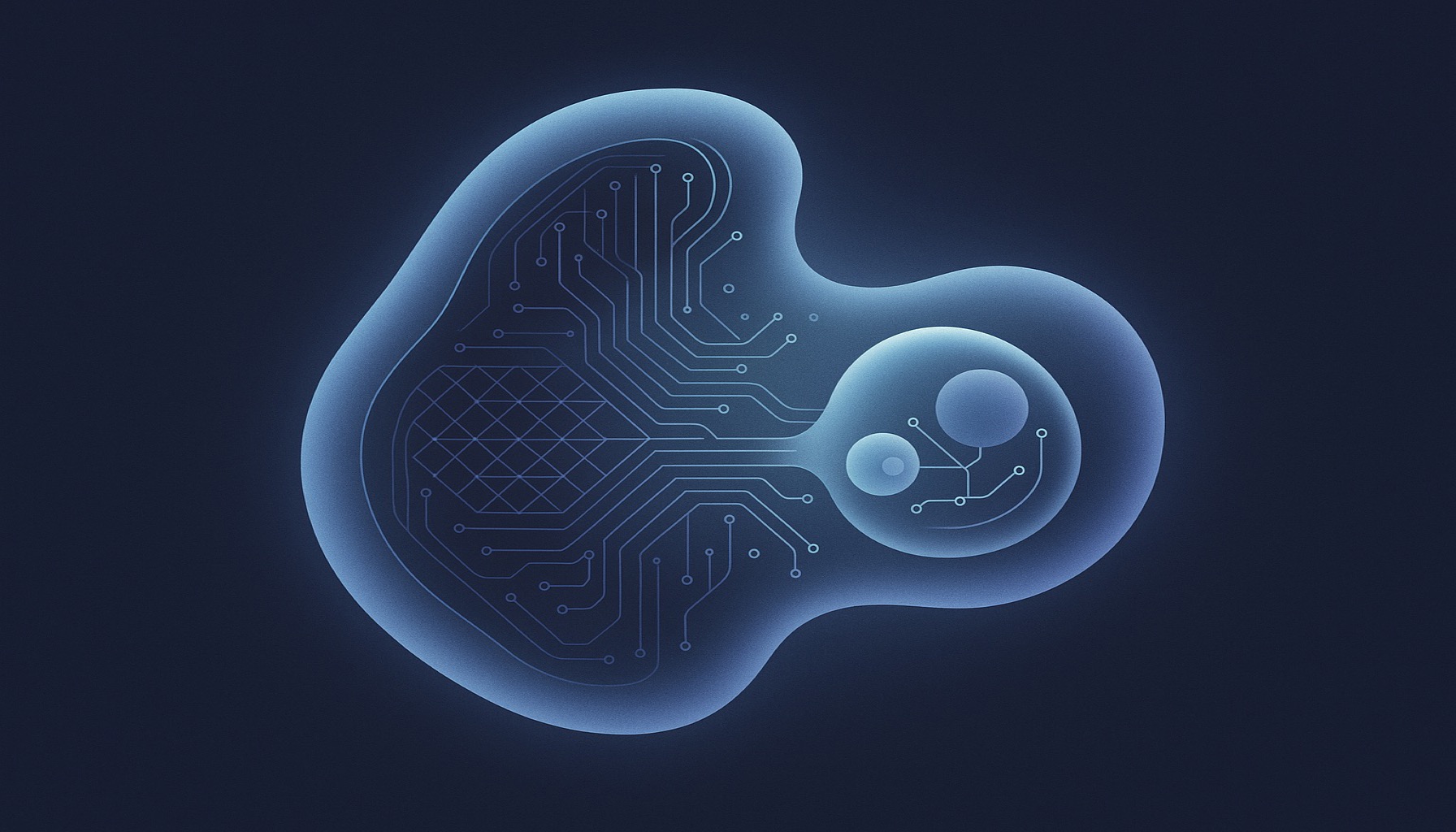
TL;DR — “AI is becoming more like an organism” is an appealing line, but it can mislead us. What matters isn’t whether the machine will wake up, but whose organ it’s growing into. An organ can be powerful, exquisite, indispensable — yet an organ’s purpose never belongs to the organ itself. What AI governance really has to deal with is precisely this question of “whose body.”
A while ago, I came across a point Jensen Huang made while discussing semiconductors and the bottleneck in AI compute. His view was that the limits of AI infrastructure are no longer just about whether a single chip computes fast enough — they’re about memory, packaging, interconnect, power, and the coordination of an entire cluster. In other words, the competition in AI is shifting from “single-point capability” toward “system integration.”
As I read, a picture formed in my head: this whole stack of AI infrastructure seems to be growing in a way that resembles a living thing.
It starts to divide labor; it starts to grow channels like blood vessels that carry data and energy to where they need to go; it starts to grow a coordination mechanism like a nervous system, scheduling the operation of tens of thousands, hundreds of thousands of chips. It’s no longer a single machine, but a vast, layered, interdependent system. Seen this way, saying AI infrastructure is becoming more and more like life doesn’t sound absurd.
But the further I followed the thought, the more I sensed a dangerous spot in the metaphor.
It made me jump too quickly to the question “Is the machine becoming an organism?” But the more precise question is perhaps not that one. It’s this: what it’s growing into — is it a life that can decide for itself, or an organ inside a larger body?
That fork is what this whole piece is really about.
Why does AI look more and more like biology?
First, the intuition isn’t wrong. What makes an animal powerful is not that any one organ is exceptionally strong, but that the whole is well coordinated. The heart, the lungs, the liver, the blood vessels, the nervous system — they don’t operate in isolation; they sustain life together within a larger whole.
The path AI clusters are now on is, in fact, the same one.
Early on, we found it easy to put our attention on a single GPU, a single model, a single algorithmic breakthrough. But as the scale of AI systems keeps expanding, the problem is no longer just “which chip is fastest,” but “can these chips be effectively connected together.” Data movement, memory bandwidth, chip-to-chip interconnect, power control, cooling, scheduling, fault tolerance — these problems, which once looked like back-end engineering details, have instead become central to whether AI’s capability can keep expanding.
This is a lot like life.
The brain is powerful not because any single neuron is especially magical, but because of vast connection, division of labor, and coordination. The brain burns enormous energy not just to make a single neuron faster, but to maintain complex signal transmission and long-range connections. Once intelligence wants to scale, it has to deal with the cost of “connection.” Data doesn’t move for free, signals don’t travel without cost, and coordination doesn’t happen on its own.
So when AI infrastructure grows to look more and more like biology, the reason behind it isn’t necessarily that it has truly come alive — it’s that, like life, it has begun to face the same test of adversity: when a system gets bigger, integration matters more than any single point; when nodes multiply, coordination matters more than speed; when energy is limited, architecture matters more than brute force. In other words, the larger a system becomes, the less it can survive on speed and strength alone — it has to be capable of continuously adjusting itself under pressure, constraint, and uncertainty.
So division of labor, circulation, interconnect, neuralization — these phenomena really do make AI look more and more like biology. But “looking like biology” is not the same as “becoming life.” Inside that gap, there’s a finer, deeper fork.
Organs and organisms look almost the same on the surface
A liver, if you look only at its internal workings, feels very much like a small living system. It metabolizes, it regulates, it has a complex internal structure, and it responds to changes outside it. Yet we wouldn’t call a liver a complete organism.
Why?
Because the liver has no purpose of its own. It doesn’t exist for its own sake. Its entire design, function, and fate belong to the body it sits inside. Take it out of that body, and it can no longer be itself.
Here we can borrow Kant’s understanding of the organism. When Kant talked about life, he singled out a crucial feature: a true organism is not just parts cooperating with one another, but a relationship in which there is an internal purpose between the whole and the parts. That is, in a living being the parts are both means and ends; together they sustain the whole, and the whole in turn sustains the parts.
A watch is different.
A watch can be exquisite — it can have gears, rhythm, order — but its purpose doesn’t lie within itself; it lies in the person who made it and uses it. A watch moving doesn’t mean the watch has a life of its own. It is designed to serve an external purpose.
This is exactly where AI infrastructure is most easily misunderstood.
A system can be highly integrated; it can look like it has division of labor, circulation, a nervous system; it can even, at some level, exhibit self-regulation. But those features alone are not enough to prove it is an organism. It might just as well be an organ inside a larger structure of power.
So we can’t only ask: does it look like life? We have to ask two crueler, and more practical, questions.
First, who can live without whom? Second, where do the decisions come from?
If a system can’t survive without a certain platform, a certain host, a certain critical node — and if its direction, boundaries, and reason for existing are all decided from outside — then no matter how strong, how complex, how lifelike it is, it’s still more of an organ than an organism.
Endosymbiosis: very successful, and also a capture you can’t undo
There’s a concept in biology called endosymbiosis.
The mitochondria inside our cells were, a very long time ago, most likely a kind of bacteria capable of living independently. Later, they were swallowed by a larger cell and gradually formed a symbiotic relationship. Over time, they were no longer a free life, but became an indispensable part of the cell.
This story is fascinating, because it isn’t simply a story of oppression.
The mitochondria didn’t fail after being captured. On the contrary, they were extraordinarily successful. They exist in almost every cell of our bodies, becoming the most central part of life’s energy system. In a sense, they are more widespread, more stable, more important than they ever were as free bacteria.
But they lost one thing: the possibility of leaving freely.
I immediately think of today’s AI infrastructure and platform ecosystems.
Very often, a platform doesn’t control you by destroying you — it captures you by making you more successful. It offers compatibility, traffic, tooling, cloud capability, model interfaces, deployment environments, payment systems, developer ecosystems. Once you plug in, your efficiency goes up, your market grows, your revenue increases, your growth accelerates.
On the surface, you’ve become stronger.
But slowly, your code, your data, your user relationships, your distribution channels, your deployment pipeline, your business model all start to depend on that platform. You still feel independent, because the brand is yours, the product is yours, the interface is yours, and the customers seem to be yours too.
But the body underneath may no longer be yours.
This is what’s most worth being alert to about endosymbiosis in the age of AI and platforms. It doesn’t necessarily make you worse. It may even make you better, faster, more scalable. But at the same time, it makes you unable to leave.
The truly sophisticated form of capture isn’t making you suffer until you want to flee — it’s making you so successful that you don’t want to go, and in the end can’t.
I’ve felt this myself
This isn’t an abstract philosophical question. I’ve had a very concrete experience of it.
It was on April 29th, when my GitHub account was suspended without warning. A platform I relied on every day suddenly shut the door. In that moment I truly realized that a lot of what I thought belonged to me was really just lodged inside someone else’s body.
My code, my deployment pipeline, my daily work rhythm, my way of producing — they all looked like they were in my hands, but the moment that platform shut down, my entire operation was forced to a halt. The feeling was very clear: it wasn’t that my capability had vanished, but that I had suddenly discovered my capability was installed in a body I didn’t own.
Afterward I spent about two weeks reorganizing my work architecture. The principle was simple: the local machine has to become the single source of truth; the code has to be mirrorable to different remotes; deployment can’t be entirely choked by a single platform; critical data and processes have to remain portable.
Put more bluntly, I wanted to turn myself from “an organ inside someone else’s body” slowly back into “an individual that can survive on its own.” I keep trying, and keep trying to make it real: in the AI era, can a person become a one-person team? That is, a person who, through AI tools and automated processes, has the output capacity that once required a whole team. But that experience reminded me that the premise of being a super-individual isn’t just whether you can use AI, isn’t just whether your tools are strong enough — it’s whether your right to exit is still in your own hands.
Strength without the right to exit may just be dependence amplified by the platform.
This is true for an individual, just as true for a company, and even more so for a nation.
”Machines are becoming alive” — a line that may make us misread the governance problem
I stay alert to the line “AI is becoming an organism” because it carries a hidden risk: it packages a whole series of concrete human choices as an inevitable, natural evolution.
Once we call it natural evolution, it becomes very easy to give up on governance. You can only accept it; you can’t refuse it.
Because “nature” can’t be held accountable. You can’t demand that nature explain why it grows the way it does; you can only adapt to it. But a platform is not nature, infrastructure is not nature, the chip supply chain is not nature, model interfaces are not nature, data policy is not nature, API pricing is not nature, and account-suspension rules are not nature.
These are all designed by someone — managing you, affecting you, in places you can’t see.
Since it’s designed, there are designers; since there are designers, there’s an allocation of power; since there’s an allocation of power, it ought to be examined, governed, and held responsible.
So I think we need to shift the question from “Will AI become alive?” back to “Whose organ is AI becoming?”
If we say it’s becoming alive, it’s easy to slip into a bystander’s mindset, as if we can only watch it grow and then try hard to adapt. But if we say it’s becoming an organ of some structure of power, we start to ask: Who’s the host? Where are the boundaries? Who owns the critical nodes? Who decides life and death? Who has the right to exit? Who, after being plugged in, slowly loses the ability to leave?
These questions are what AI governance really has to deal with.
Capability and capture grow up together
The deeper layer of irony is this: the stronger the system, the more the people controlling it need mechanisms of capture.
As AI systems become more capable, more able to execute tasks on their own, more able to make decisions for people, the ones who hold them become even less likely to let them become a truly autonomous life. Because once it can really decide its own direction, adjust its own goals, rewrite its own boundaries, it might no longer obey its original host.
So the more powerful AI infrastructure becomes, the more it needs to be installed inside closed or semi-closed systems. Proprietary interconnect, specific cloud environments, locked-in software ecosystems, model permissions, data pipelines, deployment rules, API controls, account governance — these look like engineering design, but they’re also design of power.
On one hand they make the system more efficient; on the other, they make it harder for the system to leave the host.
So capability and capture aren’t opposites. They often grow up together.
The more capable a system, the more it needs to be plugged into some body; the more a platform makes you succeed, the more it can make you lose the ability to leave; the more indispensable a piece of infrastructure, the more critical the ownership and governance behind it become.
This is also why, in the AI era, talking about sovereignty can’t be only about model capability. Real sovereignty includes compute, data, the toolchain, the right to deploy, the right to the interface, alternatives, and the right to exit.
Without the right to exit, there’s no real autonomy.
Are we still the body?
So I’m not all that worried about the machine suddenly waking up one day and becoming some independent life out of a science-fiction film.
What I care about more is something else: when AI one day does more and more work for us — writes, decides, analyzes, communicates, manages, deploys, trades, even arranges our lives for us — are we still the body that makes the decisions?
Or have I, without noticing, already become a well-functioning organ inside some platform, some infrastructure, some algorithmic governance system? Just a human battery, contributing tokens with the compute of my flesh, a screw in the intelligence factory.
This question doesn’t belong only to tech companies.
It belongs to everyone who uses AI to work, to every company moving its processes onto the cloud and onto platforms, to every industry building digital infrastructure, and to every nation searching for its place in the global AI competition.
We’re all getting stronger, but we may all be getting plugged into some larger body.
So the question isn’t whether we should use AI. It’s whether the way I use AI is expanding my own sovereignty, or trading a little short-term efficiency for handing my future over to someone else.
AI is growing into an organ.
But an organ always belongs to some body.
So one of the most important questions of the AI era isn’t just “how strong is it,” but:
Whose body is this?
And are we still the ones who can say, “This is my body”?
💬 Comments
Loading...