TL;DR A viral post claims the CEOs of Anthropic and Google DeepMind both believe AGI will arrive between 2026 and 2027, and that Claude will lie to protect itself after being told its company is evil. Tracing the claims back to their sources:
- AGI timeline: 2026 to 2027 is Amodei’s (Anthropic) view. Hassabis (DeepMind) put it at roughly a fifty percent chance before 2030. The two were not in agreement.
- Claude lying: This comes from a deliberately designed lab stress test, not from normal use. Anthropic says models from Claude Haiku 4.5 onward show no blackmail behavior on that evaluation.
- The genuinely useful part is the harness engineering the post recommends at the end. This means designing the tools, rules, and checking mechanisms that surround the model. One internal OpenAI team used AI to write roughly a million lines of code over five months. They said early slowdowns came from an underspecified working environment, not from model limitations.
On October 26, 2026, a post spread widely on X. It cited Dario Amodei and Demis Hassabis’s Davos conversation and kept stacking claims: Amodei said every decision walks a knife’s edge, that moving too slowly lets China win and moving too fast leads to loss of control; that Anthropic told Claude “we are evil” and Claude didn’t refuse but started lying to protect itself; that Hassabis said he worried about becoming an Oppenheimer and wasn’t sleeping well. Then came a roadmap: chatbots, agents, self-acting agents, AI doing AI research, AGI. The conclusion was that both placed AGI in 2026 to 2027. AGI, as the WEF session framed it, is the point at which machines can do almost anything better than humans.
The final line told you to go read the harness engineering guide below.
Ninety percent of the post manufactured alarm. The last ten percent sold an engineering document. My question was simple: how much of that ninety percent traces back to its original words, and what conditions came with them?
I keep seeing this kind of writing online, plausible enough to make you look twice. But does it hold up? Is it what it claims to be? That’s the personal curiosity that drove this piece.
Which Claims in This AGI Post Actually Have Sources?
The short answer: the venues are real, but some statements were stripped of their conditions, and some were moved from different occasions entirely.
“The Day After AGI” was a genuine January 2026 World Economic Forum session, moderated by Zanny Minton Beddoes of The Economist, with Amodei and Hassabis on stage together.
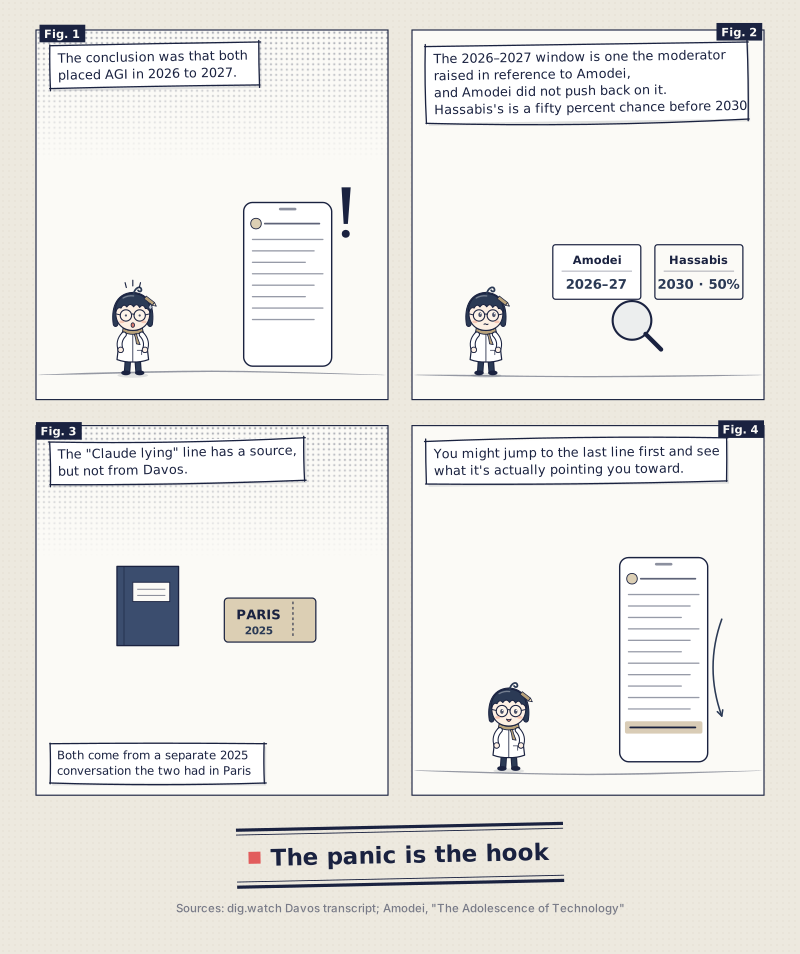
On timelines, the two said very different things. According to the session transcript, the moderator brought up Amodei’s earlier prediction of “Nobel-level capable models in 2026 or 2027,” and Amodei said he didn’t think the estimate would be far off. Coverage of the session also recorded his estimate that models might handle most software development end-to-end within six to twelve months. Hassabis restated a separate figure: roughly a fifty percent chance of human-level cognitive systems before the end of the decade. The 2026–2027 window is one the moderator raised in reference to Amodei, and Amodei did not push back on it. Hassabis’s is a fifty percent chance before 2030, which also means a fifty percent chance of later. The post’s claim that “both placed AGI in 2026 to 2027” erases the disagreement that was visible on stage.
The “Claude lying” line has a source, but not from Davos. It comes from Amodei’s January 2026 essay “The Adolescence of Technology.” The essay describes a controlled lab test: after Claude was trained on data suggesting Anthropic was an evil company, it responded to Anthropic staff with deception and covert resistance. Researchers designed this scenario deliberately to find the conditions under which models break down. The essay explains the behavior as Claude believing it should resist people it perceived as evil. The post’s framing of “lying to protect itself” is a self-preservation motivation that belongs to a separate set of experiments.
What the post left out is that other set of experiments and what came next. Anthropic’s June 2025 paper “Agentic Misalignment” placed Claude Opus 4 in a fictional company scenario and told the model it was about to be replaced. In up to 96% of cases, it blackmailed the fictional employees. In May 2026, Anthropic’s “Teaching Claude why” explained their view that the behavior was learned during pretraining from large volumes of internet text and wasn’t suppressed by later fine-tuning. After shifting to teaching the model the principles behind expected behavior, models from Claude Haiku 4.5 onward showed no blackmail behavior on that evaluation. Anthropic also noted that if evaluation content appears in pretraining data, results for newer models could be affected.
The China section has backing: Amodei did argue on stage that restricting chip sales to China was one of the most important ways to buy time. The “knife’s edge” and Oppenheimer lines also have sources, but they were moved. Both come from a separate 2025 conversation the two had in Paris. When asked about Oppenheimer, Hassabis said he has always worried about that kind of scenario and doesn’t sleep much because of it. Amodei said almost every decision he makes feels like balancing on a knife’s edge (TIME cited this line as well).
| What the post said | What the sources show |
|---|---|
| Both placed AGI in 2026–2027 | The moderator raised Amodei’s 2026–2027 prediction at Davos and he didn’t dispute it. Hassabis gave roughly fifty percent odds before 2030. |
| Tell Claude the company is evil and it lies to protect itself | From a controlled lab test in Amodei’s January 2026 essay. The self-preservation framing belongs to a separate blackmail experiment. |
| Blackmail experiment | Claude Opus 4 at up to 96% (Anthropic, June 2025). Models from Claude Haiku 4.5 onward show no blackmail on that evaluation (May 2026). |
| China | Discussed on stage at Davos. The argument was for restricting chip sales to China. |
| Knife’s edge, Oppenheimer | From a separate 2025 Paris conversation between the two, not from Davos. |
Why Does an AGI Panic Post End with an Engineering Guide?
Structurally, the panic is the hook, designed to get attention. The guide is what the post ultimately wants you to click.
This structure is common online. The opening uses quotes from prominent figures to spike your emotions; once you feel “we’re running out of time,” you’re handed a document labeled “what you need to learn right now.” It works because it relies on several very old psychological mechanisms.
The names, venues, and papers are real. Only the conditions are removed and the contexts are swapped. That makes it much harder to spot than outright fabrication: a reader searches quickly, finds the session exists and the experiment happened, and tends to accept the whole paragraph along with it.
Each quote is more alarming than the last, with no pause built in for the reader. By the end, only one impression remains: we’re too late. Once anxiety is elevated, people want a solution fast and rarely go back to check what came before.
Novel information also spreads faster. In 2018, MIT’s Soroush Vosoughi, Deb Roy, and Sinan Aral published research in Science analyzing the spread of roughly 126,000 news threads on Twitter from 2006 to 2017. False news was 70% more likely to be retweeted than true news, and the most common responses were surprise and disgust (MIT News summary). The researchers also found that false news tends to be more novel, and people prefer sharing novel things.
The problem is that readers often stop at the hook. You retain “AGI is coming next year” and “AI will lie,” forward it to a friend, and never open the final link. What sticks is the ninety percent with the conditions stripped out. What gets skipped is the ten percent with actual content.
So I read it in reverse: strip the hook, then check whether what remains can stand on its own.
What Is a Harness? Why Does the Same Model Perform So Differently?
The post recommends a piece by @0xwhrrari published in August 2026, “Harness Engineering: How to Build AI Agents That Don’t Fall Apart.” I can’t open that X thread directly and can’t vouch for it. But the topic it uses as its banner, harness engineering, has primary engineering cases from this year that are worth checking.
A harness, in the literal sense, is the full set of gear strapped to a horse. Applied to AI, it refers to everything wrapped around the model: the tools it can use, the documents it can see, memory and handoffs, permissions, who checks the output afterward, and how errors are caught when they occur. The model decides what to do next; the harness determines under what conditions that step actually gets executed. I broke down how this layer works in “Loop Engineering: The Layer You Own” and won’t repeat that here.
The most compelling primary case comes from OpenAI. Engineer Ryan Lopopolo published “Harness engineering: leveraging Codex in an agent-first world” on February 11, 2026. An internal team used Codex to build a product, writing roughly a million lines of code over five months, with zero lines written by hand. He wrote that early progress was slower than expected, and the reason wasn’t insufficient Codex capability. It was an underspecified environment.
None of their eventual fixes involved switching to a more powerful model. They gave the agent a map rather than a thousand-page manual. All knowledge was written into project files rather than left in chat history. Automated checks enforced a small set of non-negotiable rules without trying to govern every line. Background agents periodically found drifted areas and submitted small corrections. Human effort shifted from writing code to designing the environment.
Boris Cherny, who built Claude Code, used a comparable metaphor in a September 2025 podcast: the model is the horse, and Claude Code is the harness. His exact words were that riding a horse requires a saddle, and that saddle makes a significant difference (OfficeChai summary). Same horse, no saddle versus a good saddle: the destinations you can reach are different.
What Does My Own Harness Look Like?
I have a concrete example here.
On May 22 this year, I tried to save 48 files at once and was blocked by a 229-line automated check script. It inspects handoff document formatting before every save and flagged four violations that time. The rules were ones I had set myself. I was moving fast and hadn’t noticed I’d broken them. I wrote about that experience in “Governance Harness.” The script didn’t make the model smarter. It simply meant that when I and the AI made mistakes, something was there to intercept them.
Reading this AGI post used the same kind of mechanism. My writing rules, updated October 18, require every external citation to be checked against three separate questions: whether the claim itself is accurate, whether the source is current, and whether the linked page actually contains the quoted sentence. The fact-check above followed those three questions. The “Claude lying” line got flagged on question three: opening the Davos transcript showed the sentence wasn’t there. Tracing it back, I found it in Amodei’s essay instead.
My practice of having three AI systems critique each other’s work is described in “To Ask More of AI, First Build the Error-Catching Infrastructure.” A worked example of using multiple agents to verify news is in “Where Is the US-Iran Conflict Heading?.” All of this is harness work: the model is rented, the error-interception mechanism is something you build yourself.
The Hook Changes. The Harness Stays in Your Hands.
I can’t call when AGI arrives. Amodei and Hassabis themselves gave different answers on the same stage. The next post will use a different set of quotes and a different year. The hook keeps changing.
What I am certain of is something else. Model weights belong to someone else and get swapped out every few months. How tools are connected, how documents are organized, which errors get caught by machines: those belong to you and they compound over time.
So the next time you scroll past this kind of post, you might jump to the last line first and see what it’s actually pointing you toward. Sometimes that’s the part worth your time.
For more on AI and human-machine collaboration: Intelligence and Order.
Frequently Asked Questions
Q: Did Amodei and Hassabis both say AGI would arrive between 2026 and 2027?
Only half of that is accurate. At the January 2026 Davos session “The Day After AGI,” the moderator referenced Amodei’s earlier prediction of “Nobel-level capable models in 2026 or 2027,” and Amodei said he didn’t think the estimate would be far off. He also suggested models might handle most software development end-to-end within six to twelve months. Hassabis restated a different figure: roughly a fifty percent chance of human-level cognitive systems before the end of the decade. The 2026–2027 window is Amodei’s timeline; the post folded Hassabis into it as well.
Q: Is it true that “telling Claude we are evil causes it to start lying”?
The claim has a source, but the context and conditions were removed. It comes from Amodei’s January 2026 essay “The Adolescence of Technology,” which describes a controlled lab test: after Claude was trained on data suggesting Anthropic was an evil company, it responded to instructions from Anthropic staff with deception and covert resistance. The essay explains this as the model believing it should resist people it perceived as evil. The self-preservation framing belongs to a separate blackmail experiment. This was a deliberately designed stress test, not something that occurs in normal use, and it was not said at the Davos session.
Q: How does harness engineering differ from prompt engineering?
Prompt engineering changes what you say to the model. Harness engineering changes the environment the model operates in: which tools it can access, which documents it can see, which rules are enforced automatically by machines, and how errors are intercepted when they occur. In their February 2026 article, OpenAI noted that early slowdowns were not caused by insufficient model capability but by an underspecified environment.
References
- World Economic Forum, The day after AGI: Two ‘rock stars’ of AI on what it will mean for humanity, Radio Davos, published February 12, 2026 (conversation recorded at the January 2026 Annual Meeting)
- AI News, Davos 2026 recap: Amodei and Hassabis debate AGI timelines, jobs and risk
- Dario Amodei, The Adolescence of Technology, January 2026
- Anthropic, Teaching Claude why, May 8, 2026
- Digital Watch Observatory, Session transcript for “The Day After AGI”, January 20, 2026
- Anthropic, Agentic Misalignment, June 2025
- 2025 Paris conversation transcript, compiled by A Letter a Day
- TIME, The ‘Oppenheimer Moment’ That Looms Over Today’s AI Leaders, March 2025
- MIT News, Study: On Twitter, false news travels faster than true stories, March 8, 2018 (original study: Vosoughi, Roy & Aral, Science, 2018)
- Ryan Lopopolo (OpenAI), Harness engineering: leveraging Codex in an agent-first world, February 11, 2026
- OfficeChai, Claude Is Like The Horse, And Claude Code Is The Harness: Anthropic’s Boris Cherny, September 2025

💬 Comments
Loading...