Last month, a friend in manufacturing asked me: “Our company wants to adopt AI Agents—which vendor do you think we should use?”
I asked him back: “Do you want a tool that automatically runs reports, or a system that can judge production-line anomalies on its own and then decide how to handle them?”
He paused: “Aren’t those the same thing?”
They’re fundamentally different, and confusing them is costly.
One Word, Two Completely Different Things
The word “Agent” was used to death in 2024. Every AI company is selling Agents, but what they’re selling differs absurdly.
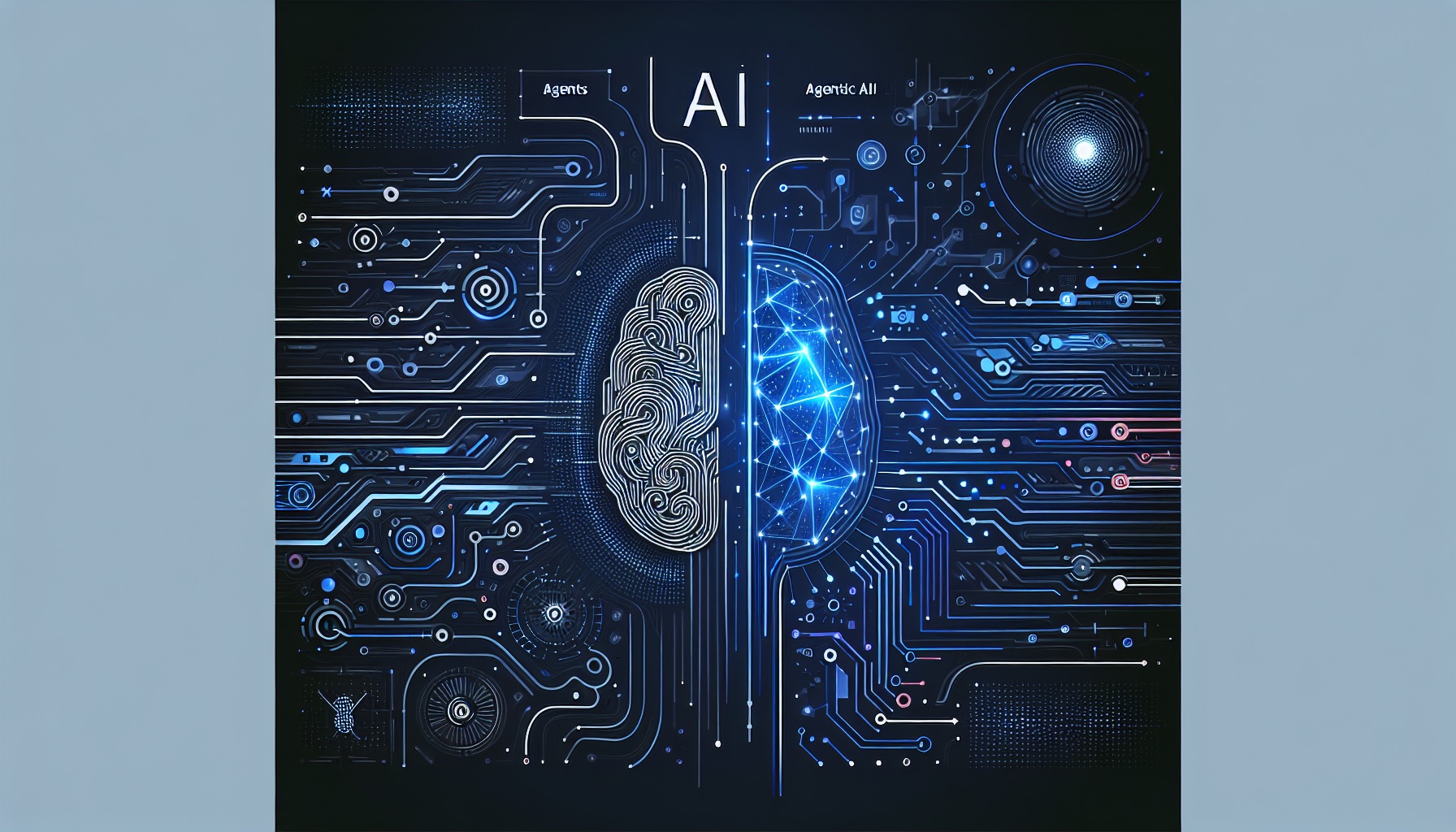
AI Agents are task-oriented automation tools. You give them a clear goal, well-defined tools, and explicit rules, and they execute for you. A medical decision-support system that matches symptoms against a database to offer recommendations, an industrial control system that adjusts parameters based on sensor data, an automated test script that runs tests according to a preset workflow—these are all AI Agents. Their core value is reliability: within defined boundaries, executing repeatedly without surprises.
Agentic AI is another matter entirely. It doesn’t just execute—it plans, breaks down problems, and adjusts its strategy mid-execution based on new information. You throw it an open-ended task—“help me research the entry strategy for this market”—and it decides for itself what data to gather, how to analyze it, and when to stop and ask for your input. Its core value is agency: when facing uncertainty, it can autonomously make a reasonable next move.
The difference between the two, by analogy: an AI Agent is an excellent executor—you tell it “go buy coffee,” and it completes the task precisely. Agentic AI is more like a junior partner—you say “I need a pick-me-up for the afternoon meeting,” and it judges for itself whether to buy coffee, brew tea, or suggest you take a fifteen-minute nap first.
Why This Distinction Matters
Choosing the wrong architecture is far more than an academic problem—the whole system breaks down from the ground up.
I fell into this pit when building my auto-posting pipeline. I initially designed it in an Agentic style—letting the system judge for itself when to post, what content to post, and which images to use. It sounded cool, but the result was a system that made bizarre decisions every other day: posting long-form pieces at three in the morning, pairing a serious article on the circular economy with a colorful abstract painting, even taking it upon itself to change a post’s hashtags.
Later I figured it out: auto-posting doesn’t need agency, it needs reliability. I rebuilt the architecture as a pure Agent mode—reading the schedule from a Google Sheet, generating images by rule, posting on time. Everything became stable. As I shared in The AI Agent Planning Guide, the key to deploying Agents isn’t technical capability—it’s boundary design. The root of this lesson lies right here: you have to first work out whether a task fundamentally needs an agent or an agentic partner.
The reverse holds true too. My debate engine was initially designed as a pure Agent: each model spoke a fixed three rounds, in a fixed order, in a fixed format. The result was poor debate quality, because real debate requires models to adjust their strategy based on the opponent’s arguments. Later I added agentic design—letting models choose to rebut, follow up, or shift their argumentative angle—and only then did the debate quality jump to a new level.
The rule is simple: clear task boundaries and predictable outputs → Agent. Open-ended tasks requiring dynamic judgment → Agentic. Mixing them up will inevitably cause trouble.
The Cost of Agency
Agentic AI is powerful, but the price of freedom is uncertainty. And this uncertainty is unlike a traditional software bug—it isn’t “broken,” it’s “made a reasonable decision you didn’t anticipate.”
Hallucination is especially dangerous in agentic systems. When an ordinary chatbot hallucinates, at worst it gives you a wrong answer. But Agentic AI will take its next step based on that hallucination—sending a request to a nonexistent API endpoint, citing a nonexistent paper to support its analysis, making strategic recommendations based on faulty data. The error snowballs.
Task Collapse is another characteristic problem. When an agentic system executes multi-step tasks, it may suddenly forget the conclusion from step three at step seven, or lose context in the transition between subtasks. I encountered this running the debate engine in long-conversation mode: by the fourth round, the model started repeating arguments from the second round, completely forgetting that someone had rebutted them in between. The fragility of long-chain reasoning still has no perfect solution to date.
Accountability is the thorniest. When a system makes autonomous decisions, who’s responsible when something goes wrong? If an Agentic AI makes a “reasonable but loss-making” decision in a financial transaction, is it the developer’s fault, the user’s fault, or the model’s fault? There’s currently no consensus on this question at the legal or ethical level.
My practical approach is to add a mechanism I call “rein design”: give the system agency, but set hard checkpoints at critical decision points. For example, the debate engine can freely choose its argumentative angle, but the number of rounds has a hard cap; agentic analysis can autonomously gather data, but the final recommendation must be confirmed by a human before it can be executed. Free, but not out of control.
The Market Is Entering a Turning Point
The evolution from pure tool to agentic partner isn’t just a technical upgrade. It changes the collaborative relationship between humans and AI.
In the past, the way you used an AI tool was much like using Excel—input, process, output. Now, agentic AI talks back, asks questions, and says “I think there might be a problem with this direction of yours.” This requires users to develop a new capability: the ability to negotiate with AI. Not just issuing commands, but judging whether its recommendations are reasonable, when to trust it, and when to override its decisions.
In my own experience, the biggest mental shift in collaborating with agentic AI is accepting that “it will make mistakes but is better overall.” It’s like mentoring a smart but inexperienced newcomer—you don’t stop them from doing work because they occasionally misjudge; instead, you design a fault-tolerant workflow that lets them grow through mistakes while ensuring those mistakes don’t cause irreversible damage.
This aligns with the view I discussed in Code is Cheap: From Vibe Coding to CLAWS: in the post-code era, the truly core capability isn’t writing code—it’s architecture design and taste judgment. Likewise, in the age of agentic intelligence, the core capability isn’t operating AI—it’s designing the architecture of human-machine collaboration: what to automate, what to leave to human judgment, and how to connect the two.
The Art of Choice
Back to my friend’s question. In the end, he didn’t “adopt AI Agents.” He did something more fundamental: first taking stock of which processes in the company suit agents (clear, repetitive, predictable) and which problems need an agentic partner (open-ended, dynamic, requiring judgment), then choosing different architectures for different needs.
This sounds less flashy, not as buzzworthy as “comprehensive AI transformation.” But it’s the right approach.
Agentic intelligence is on the rise, and this direction won’t reverse. But rising doesn’t mean every scenario needs agency. The best system design often uses the reliability of Agents where it’s right, and unleashes the agency of Agentic AI where it’s right—and then, between the two, designs precise reins.
The difference between tool and partner isn’t one of superiority, but of fit for different contexts. Work out which kind of problem you’re facing, and the answer emerges.

💬 Comments
Loading...