New Year’s Eve. Halfway through the reunion dinner, my mother started up again.
“You know, the sisters at the temple say lighting a blessing lamp is especially effective this year…”
“Doing good deeds brings blessings, you know—look at Mrs. Wang next door, she donated two hundred thousand to the temple, and afterward her son got into NTU…”
“A pilgrimage walk does wonders for your health. The last time I went, my knees stopped hurting…”
Before I could even respond, my son—who was homeschooling—had already wheeled out the cannons of logic.
“Grandma, if merit can be accumulated, then if I carry a stone to the side of the road that’s accumulating merit, so if I carry it back and then carry it over again, can’t I just farm merit infinitely?”
“If lighting lamps works, why doesn’t everyone who lights a lamp become rich? And what about people who never lit a lamp but are very rich?”
“Where’s the causal link between getting into NTU and donating money? Is there a control group?”
My mother’s expression went from cheerful to awkward, finally settling into a wounded silence. “Aiya—I’m not going to talk to you all about this anymore.”
My son glanced at me triumphantly, waiting for me to take the side of reason.
But in that moment, I couldn’t laugh.
The Red Envelopes Still Go Out, the Logic Still Gets Demolished
The red envelopes were handed out all the same. Tucked inside the envelope Grandma slipped to her grandson were probably more than a few thoughts of “dedicating merit.” The grandson took the envelope and went right on with his logical deductions.
Between grandmother and grandson, there was destined to be no point of logical convergence.
But the red envelope was still given, still received. Because the kinship is there, the love is there. Blood is a bond that transcends reason—you don’t need to agree with someone’s worldview to love them.
Watching this scene, I suddenly realized something: every one of my son’s rebuttals was correct. Logically, merit cannot be accumulated, lighting lamps cannot change one’s fate, and causation cannot be attributed so simply. But what use is being “correct”?
So what if you’re right? You win an argument and lose an old person’s heart.
The Structure of Good-Deed Economics
Let me analyze the structure of my mother’s faith without emotion.
What she believes in is a system I call “good-deed economics.” In this system, good deeds are currency that can be deposited into an invisible account (the ledger of merit). Save up enough, and you can redeem it for good fortune, health, and your children’s success. Temples and religious organizations are the banks, offering various ways to make deposits: lighting lamps, donations, pilgrimages, chanting sutras.
This system is logically riddled with holes. But psychologically, it provides three extraordinarily scarce things: a sense of control, a sense of meaning, and a sense of belonging.
A sense of control: I did something, and so something good will happen. In a world full of uncertainty, this kind of causal certainty is a luxury.
A sense of meaning: my daily actions (donating, worshipping, going on pilgrimage) are imbued with a higher significance—accumulating blessings for myself and my family. Every small act carries cosmic meaning.
A sense of belonging: the sisters go on pilgrimages together, hold ceremonies together, share testimonies together. At an age when one’s children are each busy with their own lives, this community offers companionship more stable than family.
Once you understand these three things, you understand why rational rebuttals don’t work. Because what you’re rebutting is actually a person’s support for staying alive, not a proposition.
After My Father Passed
My father’s passing wasn’t exactly sudden, but for my mother, every loss was sudden.
When my father was alive, my mother’s world had a very clear center. He was the one who made decisions, the reason to go out, the one who defined the rhythm of daily life. It wasn’t that my mother had no self—she was clever, capable, kept the household in perfect order. But her self revolved around my father, like a satellite orbiting a planet.
The planet vanished, and the satellite lost its orbit.
In the days after my father left, my mother’s state was hard to describe as “grief.” Grief has direction—you know what you’re crying about. But my mother’s state was more like weightlessness. She didn’t know what to do tomorrow, didn’t know why the day should even begin, didn’t know what role she still had in this world.
It was during that time that the religious community caught her.
The sisters took her to the Buddhist hall every week, took her to do volunteer work, took her on pilgrimages. I don’t agree with the theological content of these activities, but they accomplished something I couldn’t: they gave my mother a reason to get out of bed every day.
Do you know what an elderly person who has lost their center of gravity needs most? Not reasoning, not analysis, not the chicken soup of “you need to think positively.” It is a fixed daily schedule, a group of people who will call to check on her, and a belief system that makes her feel what she does has meaning.
Never mind whether it’s “real.”
The Rotting Crutch
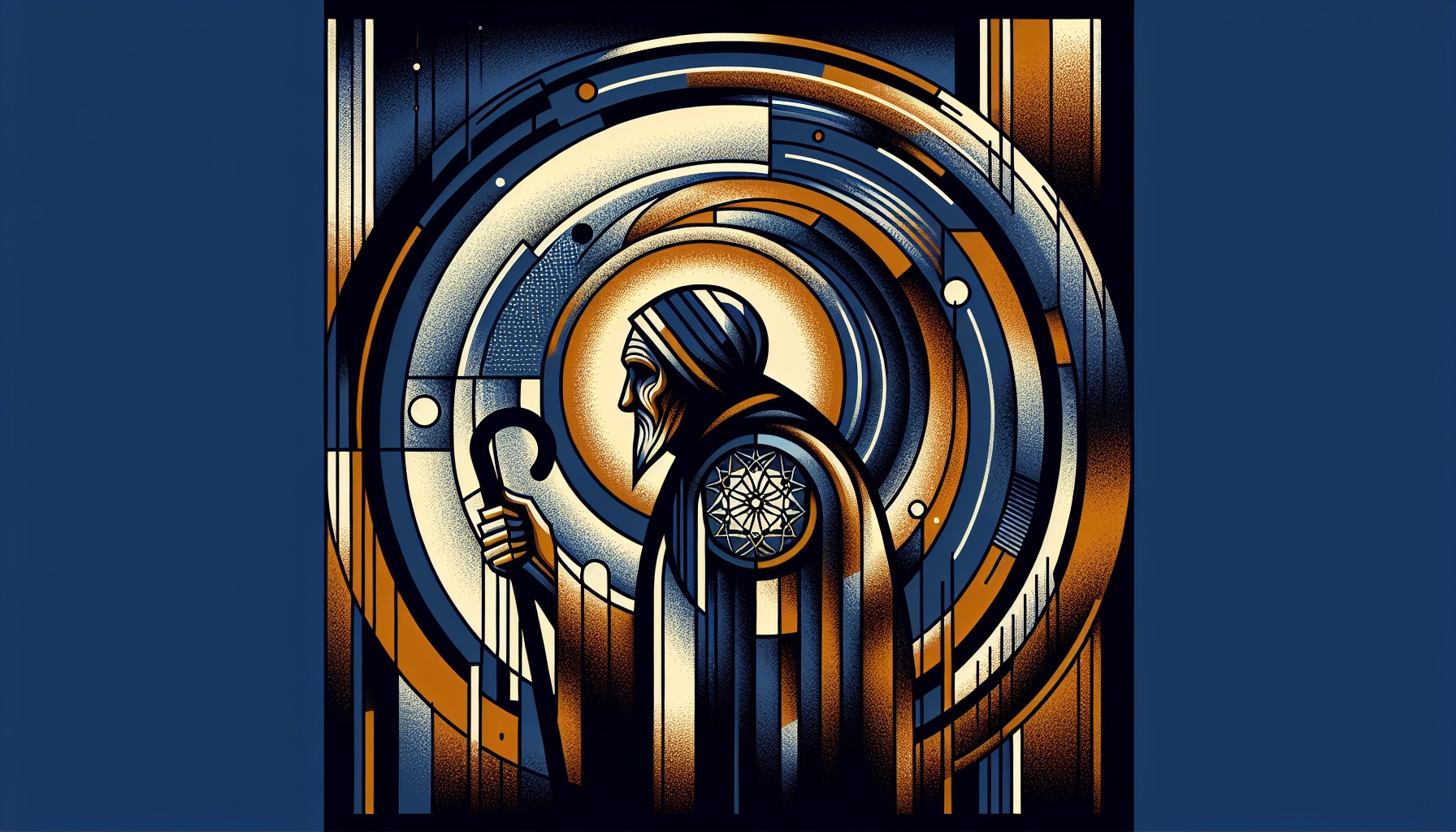
This is the core of what I want to say: if a rotting crutch can still be used, don’t be in a hurry to break it.
I have theological training. I am more capable than most of deconstructing my mother’s faith—good-deed economics doesn’t hold up theologically, the accumulation of merit is problematic in both orthodox Christian and Buddhist theology, and the simplistic version of karmic retribution cannot withstand any serious ethical scrutiny.
But theological training also taught me something else: truth is not only the correctness of propositions; it also includes its function within a concrete life.
For my mother, these beliefs are not propositions that need to be verified. They are a crutch. A crutch that may be crooked, may be cracked, may—from a purely theological standpoint—already be rotten. But every day it supports my mother in getting out of bed, walking out the door, chatting and laughing with a group of people, and then coming home with a little feeling of “I did something meaningful again today.”
Do you want me to use reason to break this crutch?
And then what? What do I have that’s better to give her?
In “The Collapse and Rebuilding of Faith”, I talked about how faith that lacks self-reflection is fragile. But that piece was aimed at faith communities with influence in the public sphere. For a mother facing old age alone, to demand that her faith withstand academic scrutiny is not rigor—it is cruelty.
The Limits of Reason Are Not the Failure of Reason
I must make this clear here: I am not opposing reason.
Every one of my son’s logical rebuttals was correct, and I have no intention of teaching him to abandon critical thinking. Quite the opposite—critical thinking is one of the most important educational investments I can think of.
But reason has its range of application. Just as a screwdriver is a good tool, but you can’t use it to comb your hair.
Reason is suited to handling propositions: “Can merit be accumulated?” That can be analyzed. “Can lighting a lamp change your luck?” That can be checked. “Is there a causal relationship between donating money and exam results?” An experiment can be designed.
But reason is not suited to handling existence: “How does a seventy-year-old who has lost their partner find a reason to go on living?” This is not a problem that can be “solved”—it only needs to be accompanied.
Humility, in this context, means acknowledging: even if you get everything right, you may still not be able to help the person who needs help.
Those Who Charge Ahead, Remember to Look Back
Sometimes I wonder, what is it that holds up those of us out there “pushing the world forward”?
Is it reason? Professional ability? A vision for the future?
Maybe all of these. But at a deeper level, there is a fact we are reluctant to admit: someone is holding things up behind us. It is those forces we may not agree with, may even find a little absurd—a mother’s prayers, parents’ worries, the nagging reminders of the elderly—that, in places we cannot see and in ways we cannot understand, sustain the stability of the whole system.
If these “rotting crutches” were not there, accompanying our elders as they walk on alone and giving them something to hold onto, the momentum of us young people who think we’re charging ahead would likely be cut in half.
Because while you’re fighting on the front lines, you don’t have to worry that the people behind you will collapse. That peace of mind is the value of the crutch.
Humility has never been an easy lesson. It contains elements of compromise and surrender. The fact that we can hold forth and argue our views is often only because our own circumstances are still comfortable. The day will come when you, too, lose the planet on your orbit—and then you will understand how precious a rotting crutch can be.
Life is not merely a rational discussion. Life is being truly, genuinely alive. And being alive sometimes requires not the correct answer, but a reason to be willing to get out of bed tomorrow.
💬 Comments
Loading...