
TL;DR: A middle school entrepreneurship course that didn’t stop at encouraging kids to talk about dreams. It brought students into three very different real companies, had them run their own school fair as a first entrepreneurship experience, and used a mentor program to connect the classroom to the real world. Entrepreneurship has never been a slogan. It’s a form of training: define the problem clearly, pull the resources together, create the value, and that can only be learned at the edge of the real world.
“What do you want to be when you grow up?” Kids have ready answers for that one. The harder question comes next: What problem are you solving? For whom? And why you?
The easiest mistake in entrepreneurship education is stopping at the first question. The teacher encourages students to dream boldly, someone pitches a cool idea on stage, everyone applauds, and class is over. The ideas all sound great. Not one survives the follow-up: “And then what?”
The BTS entrepreneurship course is something I designed, and I wanted it to work on the second question. It doesn’t teach kids to talk about dreams; it trains them to break dreams down into something executable and testable. That’s hard to do inside a regular classroom. You have to take students into the real world.
Entrepreneurship Doesn’t Have One Face
The first order of business was letting students see what entrepreneurship actually looks like, and that it looks like more than one thing.
Because I work within the startup ecosystem and know many founders, bringing the students to visit real companies was a natural fit. We went to AppWorks, one of Taiwan’s most concentrated startup accelerators, where students saw the high-growth, fundraising, scale-fast version of entrepreneurship. We went to 甘樂文創, a social enterprise doing local revitalization work in Sanxia, where students saw entrepreneurship as a response to a community problem. We visited an educational game company, where students saw how a genuine interest becomes a product that people actually use.
Three companies, three versions of entrepreneurship. The accelerator shows you speed and the startup community. The social enterprise shows you that a business can carry values and meaning. The game company shows you how passion turns into a livelihood. Tell students this in a lecture, or show them a single TED Talk, and they’ll walk away thinking entrepreneurship has one shape: a great idea plus courage. Walk through those three places, meet and talk with the founders in person, and students find it easier to understand: entrepreneurship was never a single shape, but a whole spectrum made up of different choices, scales, and ways of living.
Field visits aren’t field trips, and they’re not about collecting stamps. Before each visit, students went in with questions; they came back with observations. Back in the classroom, we unpacked them together: What problem does this company solve? What’s its value? What keeps it alive?
A School Fair, and the First Real Customer
Watching someone else build a business is different from doing it yourself. So the course included another piece: students had to organize their own school fair as a first entrepreneurship experience.
A school fair sounds modest, but it runs through the most fundamental loop of entrepreneurship at a scale a middle schooler can actually carry. What are you selling? What does it cost? What do you charge? How do you set up your stall so people actually stop? What do you do when things don’t sell? After you collect the money, how do you figure out whether you made anything?
On paper, these questions stay abstract. But when you’re actually standing behind the booth watching foot traffic walk past without stopping, the weight of the word “value” becomes concrete. Getting someone to reach into their pocket turns out to be much harder than imagined. A good idea and a thing people will actually buy are separated by a significant distance.
This is what I wrote about in “System vs. Intuition in Planning”: most people get stuck very early, before they’ve worked out who they are, what they’re selling, and why anyone would buy it. The fair puts that distance in front of students in the most direct way possible.
Real Frameworks, Real Thinking
After seeing real companies and running a real stall, students still needed a tool to turn those experiences into structured thinking. The course used the Business Model Canvas.
The Canvas isn’t a nine-box worksheet to fill in and hand over. It’s a set of questions that won’t let you off the hook: Who is your customer? What value are you offering? How does it reach them? Where are your costs, and where does revenue come from? When students filled in the boxes for their fair stalls and for the companies they’d visited, they discovered that many boxes stayed empty. Those empty boxes were exactly where their thinking hadn’t gone yet. I had them sell things themselves, handle their own customer questions, collect the money, and call customers to work through problems.
The value of a framework isn’t making answers look polished. It’s making “I haven’t thought this through” visible. That’s the opposite of a test: a test pre-cuts the questions for you; the Canvas forces you to find the questions yourself and lets the market do the teaching.
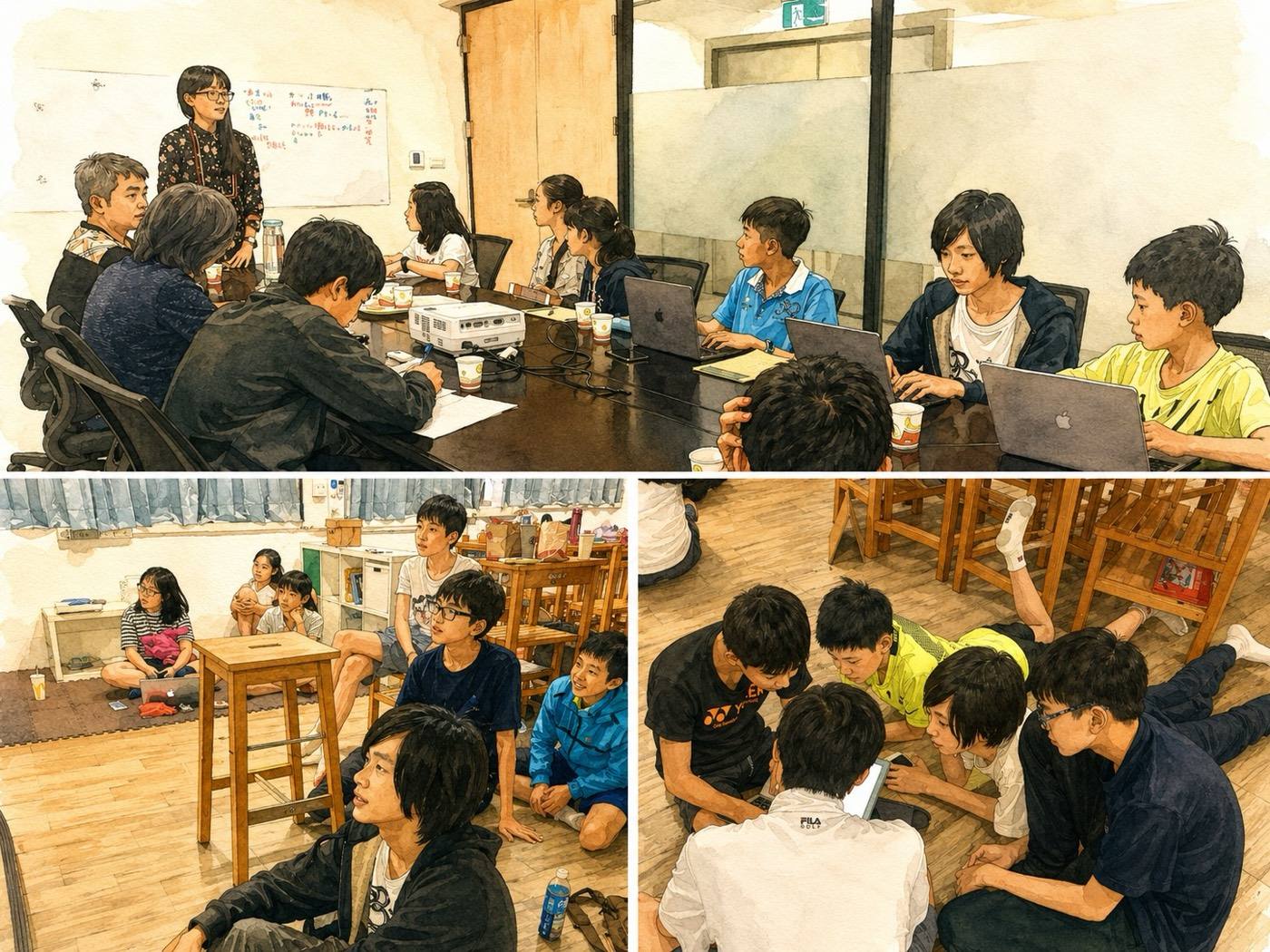
The entrepreneurship class in session. A whiteboard, a projector, a few laptops, and a group of kids breaking their ideas down into questions.
Mentors: The Line That Connects Classroom to World
What ties all of this together is the mentor program.
Entrepreneurship is practical knowledge. A classroom teacher isn’t necessarily the best teacher for it. People who have actually built something, failed, and are still in the fight have tacit knowledge that no textbook delivers. The mentor program brings those people in and connects students’ learning to the real world.
But as I wrote in “The Hidden Ledger of Educational Innovation,” a mentor program is not just finding an impressive person to give a few talks. It requires governance: selection criteria, résumé review, contracts, formal appointment letters, teaching evaluation forms at the start of the term, and check-in meetings at mid-term and year-end. Finding the right person is the easy part. Making that person a trackable, accountable, evaluable participant within the system, that’s where the real work is. The line connecting school to the real world has to be held in place by structure.
Entrepreneurship as a Way of Meeting the World
When the course ends, I’m not expecting these middle schoolers to go start companies. Most won’t. Most don’t need to.
What I hope they carry with them is a capacity, or more precisely, a way of meeting the world. When something is unsatisfactory, the instinct isn’t to complain but to ask: What’s the actual problem here? Can it be solved? What do I have to work with? When an opportunity appears, they can judge whether it has real value and whether it’s worth the effort. When they want to make something happen, they know how to move it from a vague idea to something someone will actually pay for.
That capacity matters for entrepreneurs, but it doesn’t belong to entrepreneurs alone. It’s the capacity to turn a blurry world into one that can be worked on. Getting your hands dirty, solving problems firsthand, that’s the character I hope they develop.
An entrepreneurship class doesn’t teach you how to start a business. It teaches you not to treat “I don’t know how” as a period, but as a problem you can start to break apart. That’s another way of saying what the overview piece “From Flipping to Climbing” puts it: the heart of education is bringing children into contact with the real world, then helping them grow the capacity to change it.
💬 Comments
Loading...