
Bottom Line First
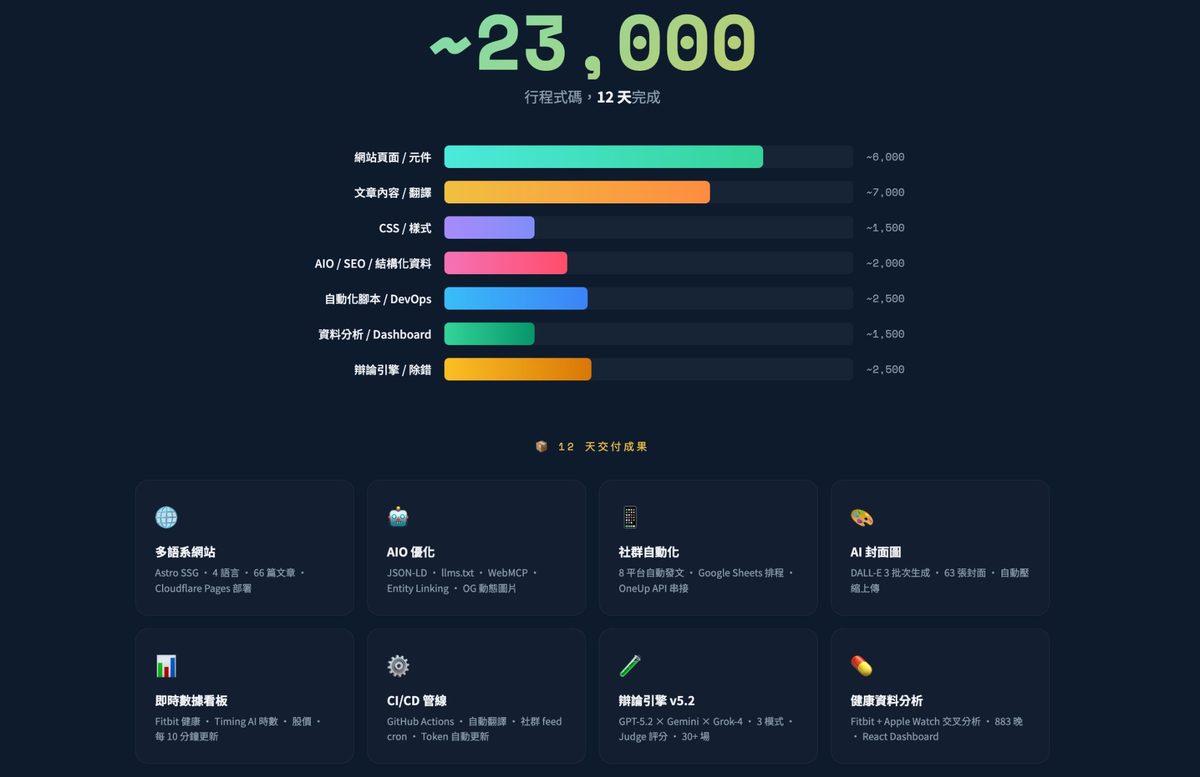
12 days. 23,000 lines of code. One person who can’t program, plus one AI.
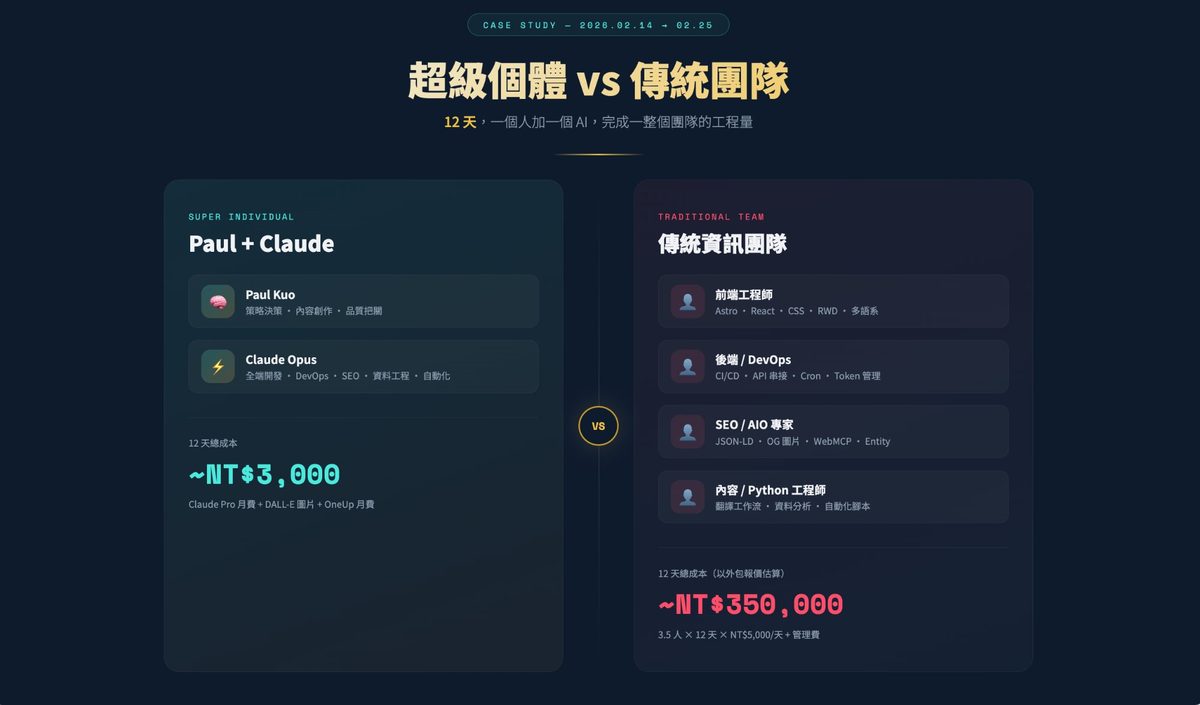
What we accomplished: four-language personal website, eight-platform social auto-posting system, multi-model debate engine, real-time health data dashboard, automatic AI cover image generation, complete CI/CD pipeline.
If outsourced to a traditional team, the quote would start at NT$350,000, requiring 3.5 engineers for 12 days. Not counting my invested time, I spent less than NT$3,000. This is my Lunar New Year Agent Coding record—exploring the feel and output of human-AI collaboration.
My Starting Point
I can’t use Terminal. Black screens with white text make me anxious. Python, JavaScript, Astro—these are alien languages to me.
My background is in life sciences and theological training. Through my entrepreneurial journey, I’ve worked in Fintech, agricultural e-commerce, as vice president of construction companies, CDO, CMO, and consultant. Digital transformation, circular economy, and Taiwan-Japan exchange cooperation are all in my wheelhouse—all ESG-related. I use Excel but can’t write macros. In the past, when I needed programming, I’d build teams or outsource to third parties.
Mid-month, I transformed my domain (bought years ago) from a single-page HTML into a complete content platform. Previously, this scale of engineering would take at least six months, or three months at the fastest.
What Actually Happened
Day 1: Claude helped me set up the Astro framework, push to GitHub, deploy to Cloudflare Pages. I watched the entire process, participating in discussions and making decisions when necessary.
Day 3: I began understanding what git push does, what frontmatter fields mean. Not because I suddenly learned programming, but because every operation had concrete context—I knew “this line of code makes article titles display on cards.”
Day 5: I could directly tell Claude: “The year filter on the Tags page is broken on mobile, there’s a problem with the pillar and year combination logic.” I didn’t know how to fix it, but I knew where the problem was. This distinction is important.
Day 7: I started proactively making requests: “I want automatic cover image generation for each article, using DALL-E, compressed to under 300KB, auto-uploaded to GitHub.” I wasn’t learning to code. I was directing a partner who could code.
Day 12: The system was running. Every 10 minutes automatically fetching Fitbit steps and heart rate, Timing App AI usage hours, stock data, pushing to GitHub triggering auto-deployment. Social posts written in Apple Notes, automatically queued in Google Sheets, posted to eight platforms via API. Articles pushed automatically translate to English, Japanese, and Simplified Chinese through GitHub Actions.
Three Things I Learned
First, the definition of “knowing how” has changed.
Previously, “knowing how to code” meant starting from a blank file and building logic line by line. Now, “knowing how” means: you know what problem to solve, you can judge output quality, you can describe problems when things go wrong.
I still can’t write a Python script from scratch. But I can spot problems in Claude’s code, which architectural decisions will create future pitfalls, which CSS will break on mobile. This isn’t programming ability—it’s engineering judgment “intuition.” And this ability came from intensive practice during the New Year period.
Second, AI won’t replace your judgment, but it will amplify your judgment.
I cut half of Claude’s first article draft. I overturned its suggested database architecture twice. I rejected and redid its cover images.
AI’s value isn’t in being always right, but in compressing the time from “idea to implementation” from three months to three days. What’s compressed isn’t quality, but the repetitive, mechanical, automatable steps in between. Judgment is still your job.
Third, a super individual isn’t someone who knows everything, but someone who knows how to orchestrate.
I used Claude for coding, DALL-E for images, OneUp for post scheduling, GitHub Actions for automation. I’m not proficient in any single technology. But I know how they can be connected.
This feels like leading teams in the past. The difference is, previously I had to manage people’s communication, emotions, schedules, leave requests. Now I collaborate with a partner that doesn’t get tired, doesn’t take leave, and still helps debug at 1 AM. The cost difference is 117x.
A Supplement
This doesn’t mean AI can replace all engineers.
What I built were personal websites, automation tools, content platforms. The complexity of these doesn’t match banking core systems or semiconductor manufacturing software.
But that’s exactly the point: medium and small projects that previously required a team can now be completed by one person with good judgment plus AI. This will change the game rules for freelancers, small entrepreneurs, and personal brand operators.
No need to wait for AGI. Change is already happening.
42 Person-Days, Completed by One Person
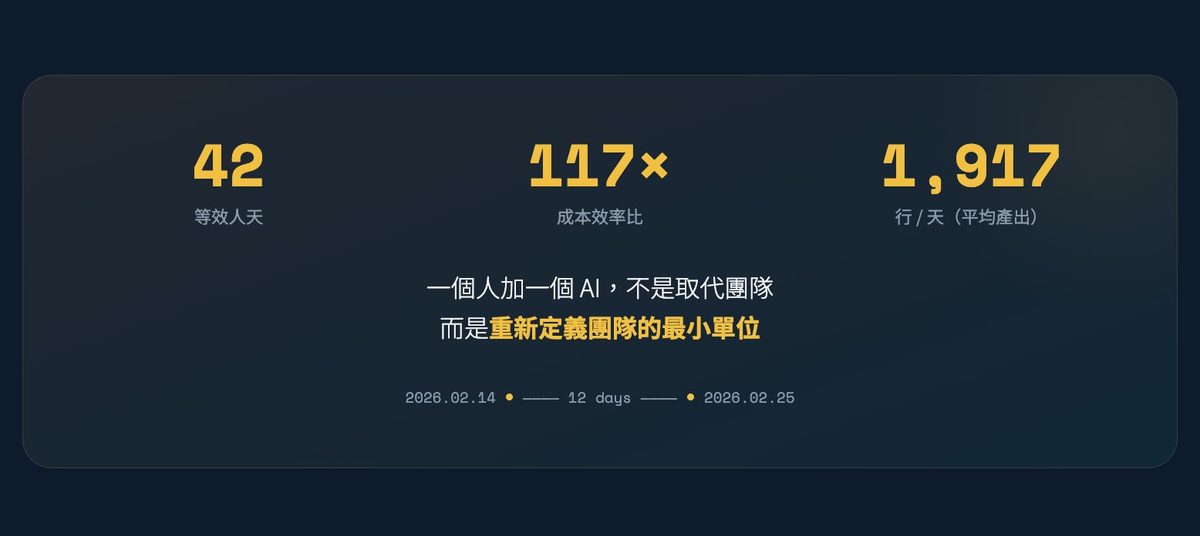
Back to the numbers: 42 equivalent person-days of work, completed in 12 days for less than NT$3,000.
It’s not that I’m particularly capable—it’s that the tools have changed, and I was willing to jump in and use them.
You don’t need to learn programming first before using AI to get things done. You just need: a concrete enough problem, some patience to not fear mistakes, and the decision to change “I don’t know how” to “Let me try.”
That decision, AI can’t make for you.

💬 Comments
Loading...