
I came across a discussion on X about Meta rebuilding its AI team. The research core of nearly one hundred people, and Zuckerberg’s personal involvement in recruiting, got me thinking about talent density. The discussion on X, interview transcript
But understanding this strategy requires looking at how leaders at other labs think about it too.
Dario Amodei argued as early as a 2024 interview that talent density matters more than raw headcount. Sam Altman has also written about concentrating resources and measuring how talent affects the broader organization. Amodei interview, Altman’s management reflections
That raises a question worth sitting with: when everyone says they need great people, where does the difference actually lie, and how does each company get those people to work together?
Talent Density and Scale Answer Different Questions
Scale answers how many. Talent density asks what standards a team applies to capability, and how well each member’s abilities fit the work at hand.
It also matters to separate a research core, total company headcount, and support functions. Meta’s research core of nearly one hundred still sits inside a large company with considerable resources; other companies’ headcounts may include product, commercial, and operational staff. Placing numbers from different scopes side by side makes it easy to mistake organizational division of labor for a verdict on strategy.
So I’ll start with how each leader approaches hiring, then look at how resources, decision rights, and collaboration are arranged. High hiring standards are a claim about talent strategy; the working conditions around them determine whether capability can actually be put to use.
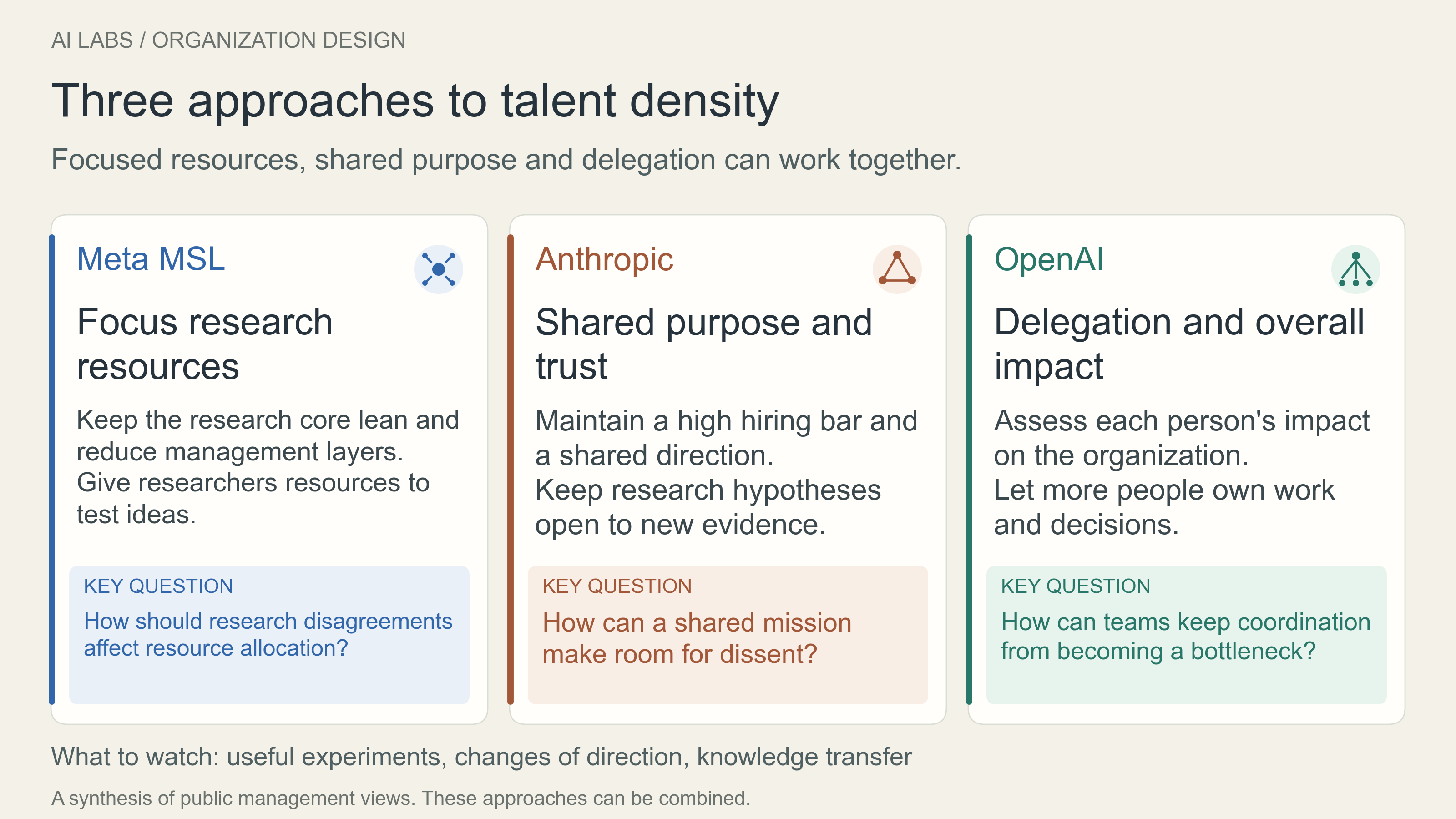
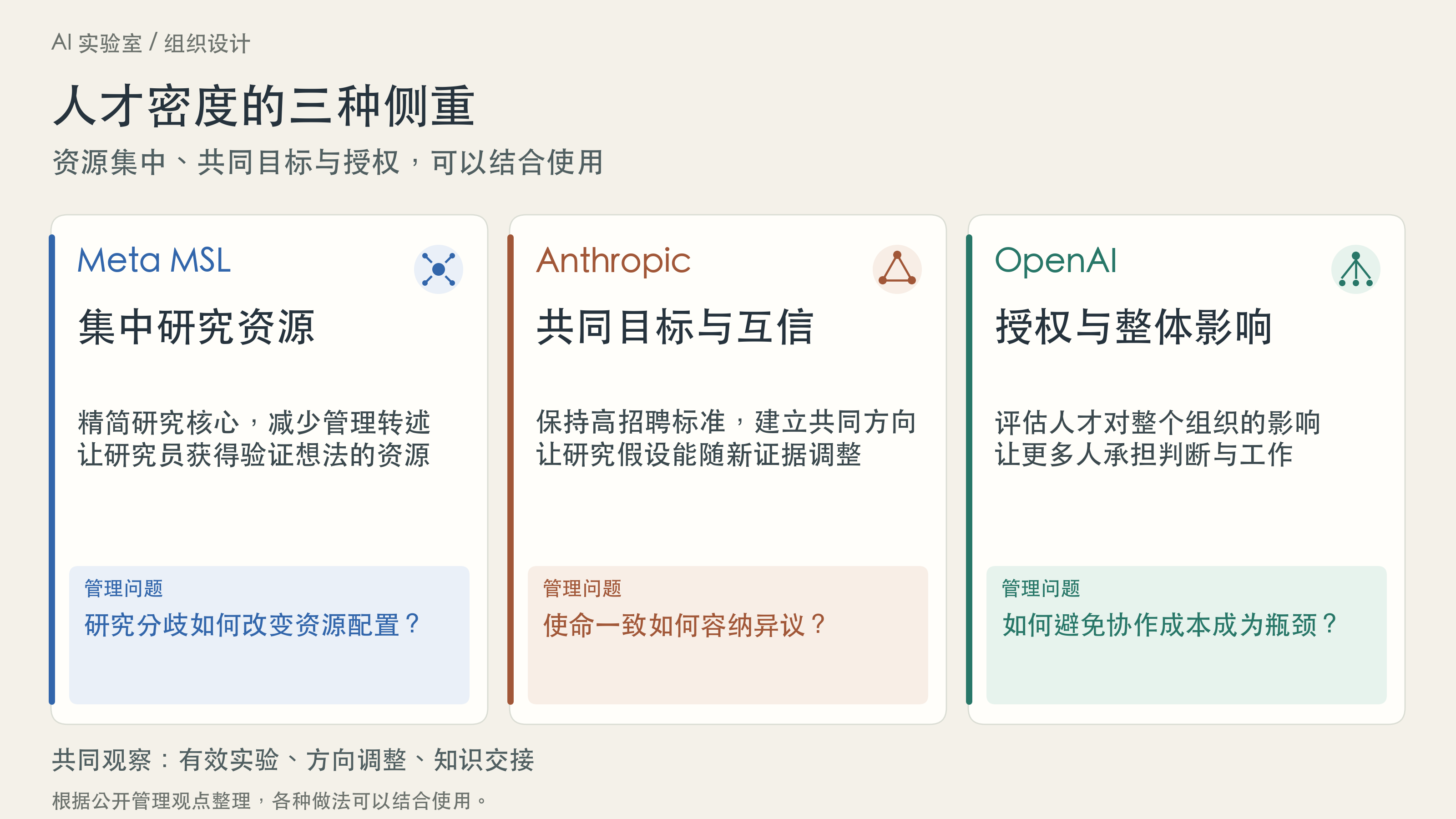
Figure 1: Organized from public statements by leaders at each company. These approaches can complement one another.
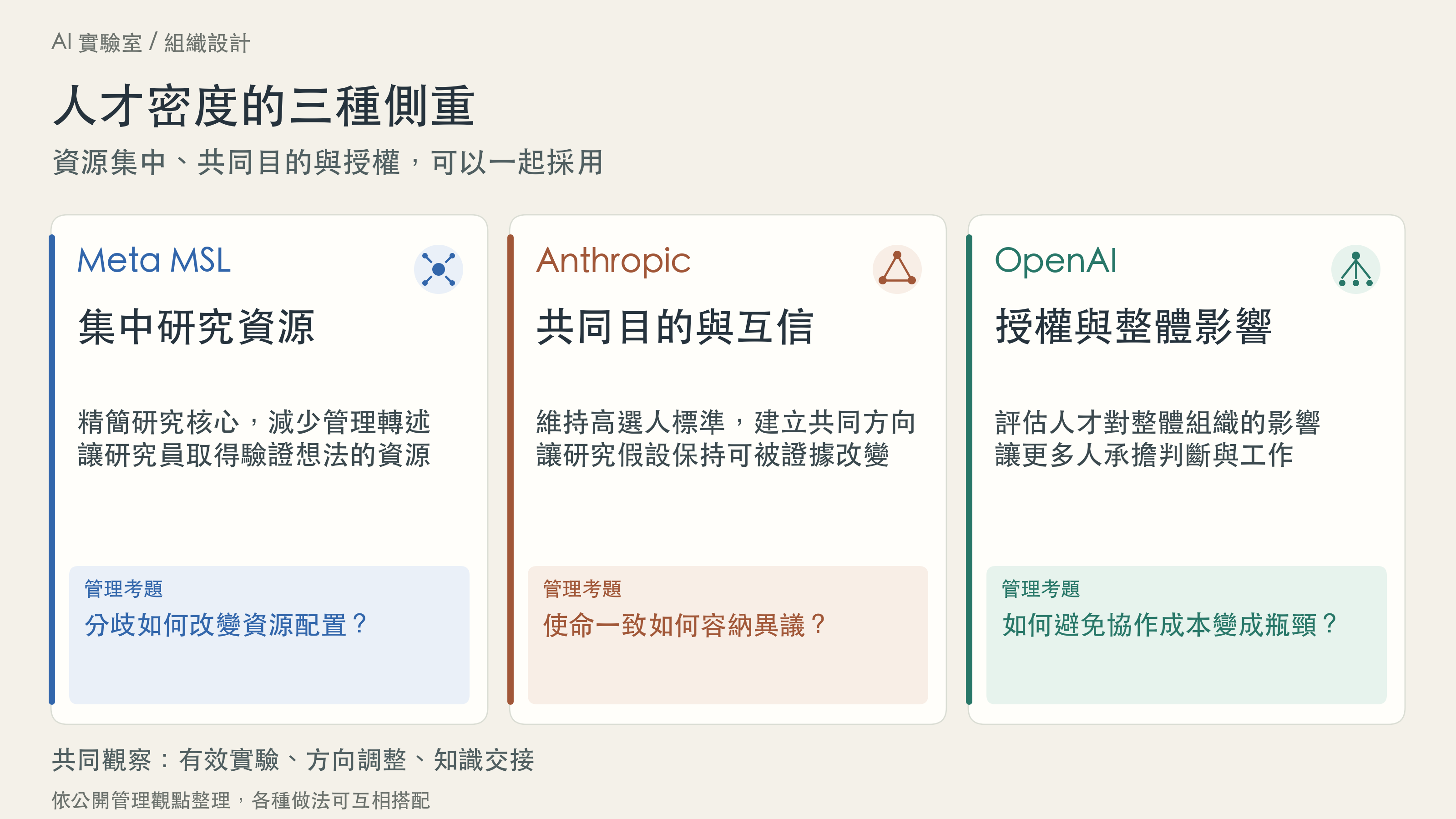
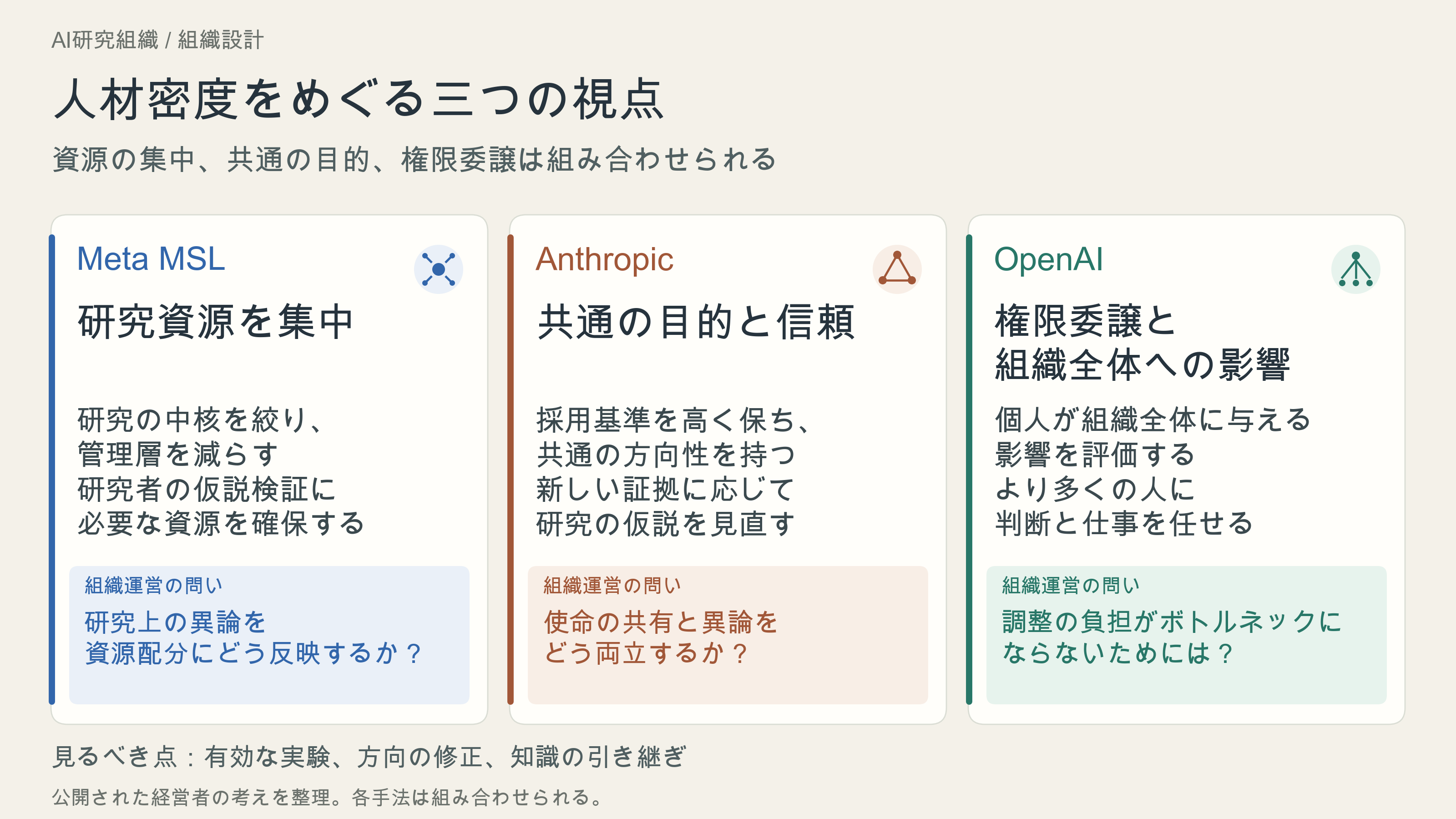
View full-size diagram in other languages
Traditional Chinese · English · Japanese · Simplified Chinese
Meta: Concentrate Resources in a Lean Research Core
In the October 2026 Cheeky Pint interview, Wang stressed rigorous talent screening, while Zuckerberg talked about avoiding the spread of compute across too many research projects. Both want a lean core to command more resources, with fewer management layers that stay removed from technical details. Interview transcript
The recruiting process also shaped how the rebuild took form. Zuckerberg said that through conversations with external talent, they gradually confirmed the need to reconstitute the team; strong members from the original Llama and FAIR teams would be brought in as well. He personally cleared about one to two months to meet with researchers at scale. Interview transcript
What I take from this is that the company was responding to what research talent actually requires from a working environment. The compute access and research autonomy that they need in order to join may, in turn, reshape the original organizational structure.
One question remains for this approach: once resources are concentrated, who decides which directions are worth continuing? When a small group of researchers commands more compute, a misjudged direction may concentrate the cost in a small number of decisions.
In the same interview, Zuckerberg said he wants people to argue for what they believe in. What I’ll keep watching is whether those disagreements can feed into experiments, giving new evidence a real chance to shift resource allocation. Interview transcript
Anthropic: High Standards and Shared Purpose as the Foundation for Trust
Amodei’s account of talent density puts its weight on how members perceive one another.
In his 2024 interview with Lex Fridman, he argued that capable, committed people who genuinely understand a shared mission allow colleagues to trust each other. When hiring standards slip, an organization may need more process to manage low trust and internal politics. He also noted that Anthropic was then approaching one thousand people and was deliberately slowing its hiring to grow more carefully. That was his self-description of the organization at the time, and the headcount figure was his approximate recollection. Amodei interview, starting around 1:38:25
This passage directly corrects the impression that Anthropic simply chases scale. A company can grow, and it can also slow that growth to preserve hiring quality.
The way I read his emphasis: when members trust that their colleagues are capable and willing to take ownership of shared problems, collaboration can spend less time second-guessing motives and confirming decisions already made.
But shared purpose can also produce pressure toward conformity. When a researcher disagrees with a given direction, how does the team tell apart a technical objection from a question about goals?
In the same interview, Amodei lists openness as an important quality in research and engineering talent: a willingness to look at data with fresh eyes and put ideas into experiments. That suggests to me that shared purpose needs to sit alongside judgments that evidence can actually change. Same interview, starting around 1:42:09
Mission can help a team decide which problems are worth solving. How to solve them still requires someone to raise a different view.
OpenAI: Measure Talent by Its Effect on the Whole Organization, Then Delegate
Altman’s public management thinking offers a third angle.
In his 2023 essay “What I Wish Someone Had Told Me,” he argued for concentrating resources on a small number of directions you deeply believe in, and warned that evaluating star talent means looking at its effect on overall organizational performance, not just individual output. He also encouraged hiring high-potential people who are growing fast, and looking for evidence that they actually get things done. Altman’s management reflections
These are his stated principles, not proof that every personnel decision at OpenAI follows them. Still, they put forward a practical standard: someone being strong, and that person making the whole team stronger, are two things that still need to be evaluated separately.
In a Conversations with Tyler interview published in 2025, Altman described how OpenAI handles an expanding workload by hiring and promoting excellent people, then handing responsibility to them. He treated this as the sustainable approach he knows. Altman interview
My reading is that as an organization takes on more work, it also needs more people who can carry independent judgment. This coexists with Meta’s lean research core approach, just applied to different functions.
After delegation, coordination costs still appear. Altman acknowledged in the same interview that the volume of Slack messages consumes his time and can generate work with no real value. Same interview
That gives OpenAI’s story one more question worth pressing: after responsibility is handed off, can the company keep important information flowing without letting coordination itself become the new bottleneck?
Looking at Retention Data
In its 2025 report, SignalFire compiled two-year retention rate estimates for several AI labs. SignalFire State of Talent Report
| Lab | Two-Year Retention Rate (Historical Estimate) |
|---|---|
| Anthropic | 80% |
| DeepMind | 78% |
| OpenAI | 67% |
The two-year retention rate represents the share of employees who joined at least two years prior and were still at the company by the end of their second year.
The analysis covers 2023 to 2024 and draws on publicly self-reported LinkedIn employment histories, which may contain date errors or gaps. Meta’s figure of 64% covers the whole company; Meta AI was not broken out separately, and the data predates the founding of MSL.
Anthropic’s retention figure warrants attention, but the report does not prove that mission drives high retention, nor that higher retention necessarily produces better models.
Working together requires accumulated experience. Which experiments failed, and under what constraints, often shapes how the next judgment gets made.
In my essay on knowledge management through pipelines rather than discipline, I wrote about how knowledge moves from capture to use. For research teams, there is an additional question: when someone leaves, can the documentation help their successor understand why a decision was made that way at the time?
The Real Comparison Is How Work Gets Done
The emphases of the three leaders can be summarized as follows. These approaches can complement one another.
| Company / Leader | Organizational Emphasis | Management Question |
|---|---|---|
| Meta: Wang, Zuckerberg | Lean research core with concentrated resources | How do research disagreements feed into resource allocation? |
| Anthropic: Amodei | Maintain hiring standards; build trust through shared purpose | How do you let mission alignment and research dissent coexist? |
| OpenAI: Altman | Measure talent by its effect on the broader organization; give more people real ownership | After delegation, how do you keep coordination costs from consuming working time? |
On mobile, the table can be scrolled horizontally.
Having read through these perspectives, what I most want to see is how much waiting lies between an idea and a valid experiment; whether a team can change direction when new evidence appears; and whether work can continue after people leave.
For talent density to translate into real results, the people who genuinely understand the work and hold the authority to allocate resources and adjust responsibilities must be the ones designing how talent collaborates. Who raises issues, who makes decisions, how resources are distributed, how disagreements get tested: all of this needs to be clearly defined and revisable in light of actual outcomes.
The people who understand the work must have the power to change how collaboration happens. The people who hold that power must understand how the work gets done. Without that combination, even the strongest concentration of talent can find itself trapped inside the same old process. Talent density, shared purpose, and delegation will all become empty slogans.
💬 Comments
Loading...