On October 1, Google released a new model: Gemini 4 Argon. Demis Hassabis posted a comparison table on X with most of the Argon column shaded blue, indicating it leads on those metrics. If you happened to scroll past that post, you may have had a fleeting thought: I use AI every day for email and presentations — should I switch?
I maintain a page that tracks AI models, /ai/models, comparing the capabilities of several frontier models. My routine update that morning had actually missed Argon entirely; I only caught it later when I asked Gemini about recent developments and added it to the page the same day. What I added was a note in the description. No comparison card.
A model that claims to lead on multiple benchmarks, and it gets only a few lines on my page. The reasoning behind that decision comes down to three questions anyone can apply.
Three Questions to Ask When a New AI Model Drops
Can I actually use it right now? Who measured that score? If it gets swapped out or makes a mistake, will I notice?
These sound obvious, but model announcements rarely answer them. Here’s how each plays out with Argon.
Question One: Can I Actually Use Gemini 4 Argon Right Now?
No. According to Google’s blog, Argon is currently available only to members of the Fairwind Program — government entities and trusted cybersecurity defenders — and the version they receive has no safety guardrails. Whether the version eventually released to everyone else will be the same is not stated. The next group in line is paid API customers and Google AI Ultra subscribers, with no timeline given. When ordinary users get access is not mentioned at all.
So however impressive that October 1 table looks, for most people it is still a preview. With Argon, announcement and availability are already two separate dates.
Question Two: Who Measured That Score?
Start with the table Hassabis posted.
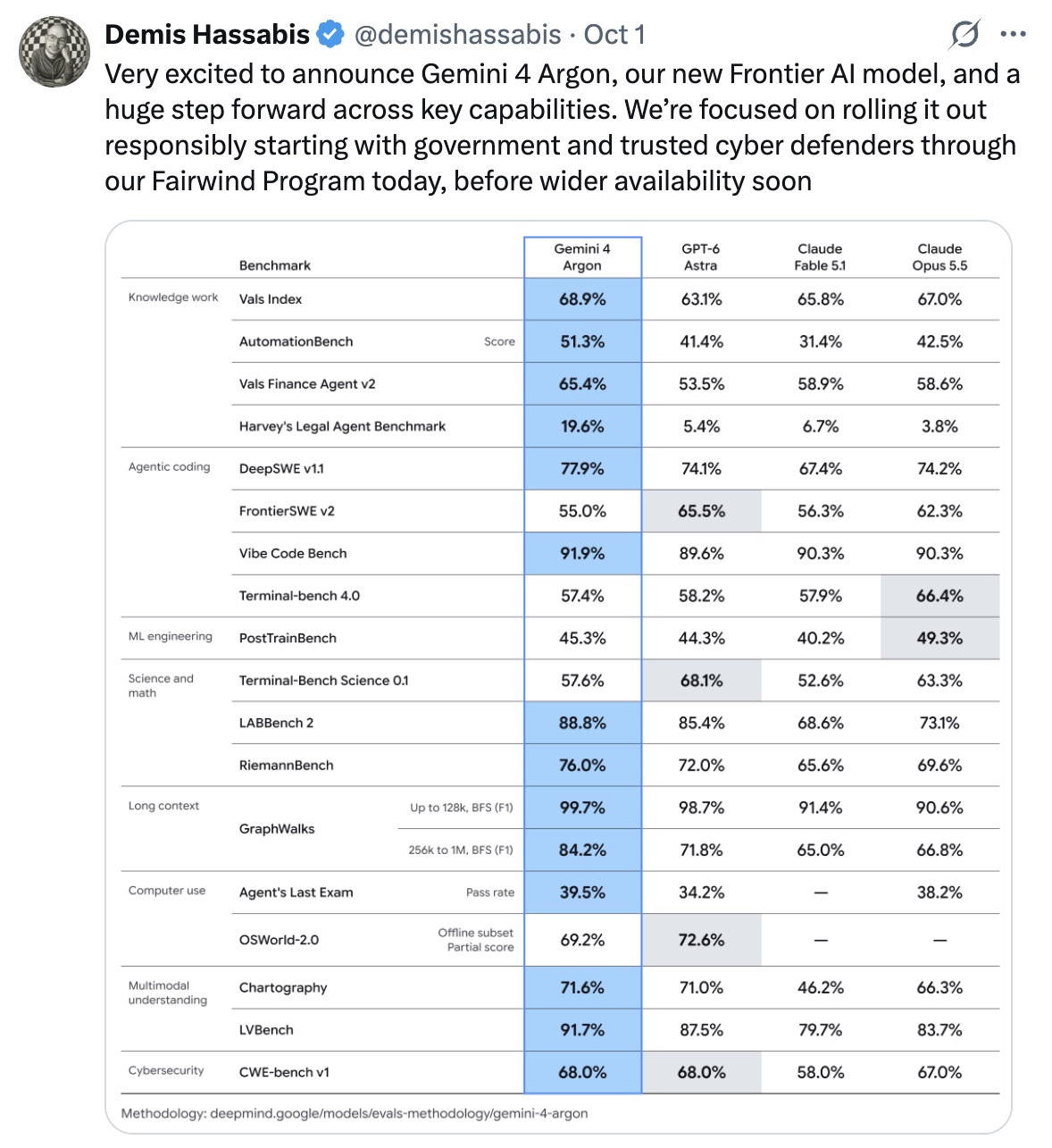 Screenshot of Demis Hassabis’s X post (2026-10-01). Table provided by Google.
It’s worth looking at this table carefully. Blue means Argon leads; gray means another model does. Of the 19 rows, 5 go to competitors, and one on cybersecurity is a tie. Even on a table Google chose and designed itself, Argon doesn’t sweep everything.
Take one row as a case study. The table shows Argon scoring 77.9% on DeepSWE — a benchmark for AI coding ability — nearly 4 percentage points ahead of second place. DeepSWE maintains a public leaderboard data file. I checked all four scores from that row against it. Only GPT-6 Astra’s 74.1% appears. Argon isn’t there, and neither are the Fable 5.1 or Opus 5.5 figures from the table — only their predecessors. The data file was generated on September 22, before the announcement, so the absence isn’t surprising. But it does mean three of the four numbers in that row have no public data to verify against.
The same model measured by the independent firm Artificial Analysis (AA), using its own methodology, produces a different picture. AA’s composite index (an index score, not an accuracy rate) puts Argon at 53, level with Fable 5.1 and GPT-6 Astra. Opus 5.5 scores 58. Where Argon actually stands out is hallucination rate — how often it confidently fabricates an answer. AA measured it at roughly 15%, meaningfully lower than the other three frontier models in the comparison.
For anyone writing emails or building presentations, that matters more than any coding benchmark. A wrong number in a report, a nonexistent source in an email — the cost lands on you, not the AI. When evaluating a tool, start by figuring out which kind of mistake you can least afford, then find a measurement that targets that specifically.
Question Three: If the Model Gets Swapped Out or Makes a Mistake, Will You Notice?
On September 28, I ran a small test in the AI tool I use for coding: what model is actually running when I call the name I always use? It had already switched to the new Opus 5.5. The label was the same. The model underneath had changed. No notice.
This is not a small thing for me. Models have advanced so fast over the past six months that my workflows are tightly coupled to how specific models behave. Which model I’m using shapes how I design a workflow and how I write prompts. When the model changes, the workflow and prompts may need to change with it. Knowing what’s actually running is something I have to track.
The same logic applies to everyday users. The prompts you’ve developed for building presentation outlines, the phrasing that reliably gets you a good first draft — those were tuned on a particular model. When the model underneath your tool changes, results might improve, or the habits you’ve built might start producing unexpected outputs. If your tool shows the model name, check it the next time something feels off before assuming your prompts are the problem.
Catching mistakes is more practical than catching model swaps. Whatever the model, new or old, highly ranked or not — anything verifiable in an email or presentation, like numbers and cited sources, deserves a manual check before it goes out. A low hallucination rate still isn’t zero.
After Argon’s announcement, I looked at whether I should switch anything myself. I sometimes ask Google’s AI tools to do a second-pass review of my work. When I checked, Argon wasn’t available in the model selection at all. Even when it does appear, I’ll run it against my own tasks before committing to anything. A low hallucination rate sounds appealing, but that measures whether a model invents answers freely — not whether it catches the specific problems I’m trying to catch. Those are different questions.
How I Decide What Goes on My Models Page
The inclusion rules for my models page are really just those three questions formalized into a repeatable process.
The first rule is availability. A model that general users can’t access doesn’t get a comparison card, regardless of its scores — only a note in the description. Argon is blocked at this step, handled the same way as previous models released only to a narrow set of organizations. Conversely, once a new model opens up and has been measured by at least one third party, it can go into the relevant cards even if AA is the only source so far.
The second rule is provenance. Every score is labeled as either vendor-reported or third-party measured using a consistent methodology, and the two categories don’t get combined in the same comparison table. Google’s self-reported DeepSWE score of 77.9% falls in the first category; it isn’t in the public data file yet, so it doesn’t count toward the page. DeepSWE scores on the page come from the public data file only, not from secondary sources online. That rule exists because I learned from a mistake: I once relied on a secondary source and incorrectly listed a model that already had a score as “not yet submitted.”
The third rule is to actively search for gaps. Every update includes a check for new models that haven’t appeared on the tracked leaderboards yet. Argon slipped through anyway this time, because that morning’s search only covered new entrants on third-party leaderboards rather than checking each major vendor’s recent announcements directly.
Are Announcement Scores Worth Comparing?
Announcements give you claims. The only numbers worth comparing are ones measured with the same ruler.
That doesn’t mean Google’s 77.9% is false — only that until it appears in public data, I can’t place it in the same row as scores from other models and call it a comparison. The three questions above are all variations on one distinction: the difference between a claim and a measurement. An announcement is something a vendor makes at a launch event. Availability depends on whether your account is on the access list. Independent measurement requires waiting for a third party to run the same methodology across all the models being compared. These three things routinely land on different days, sometimes weeks apart.
The same reasoning applies to enterprise AI adoption — as I wrote in The AI Theater Is Over: what’s needed is value that holds up under scrutiny. For an individual who uses AI daily, the only difference is that the thing being scrutinized is your own emails and slides. People who ask these three questions consistently, and those who just follow the announcements, will find the gap between them widening slowly over time — as I explored in The AI Capability Gap, 2026.
Those Few Lines on the Page
Argon is on my page as a few lines of text. When it opens up to general users, I’ll figure out which card it belongs in.
For more on AI governance: AI and Human Order → AI Governance

💬 Comments
Loading...