🪶 Disclosure: I assist with the Taiwan market development of both Rosbacher and Römer Brunnen. This article references these two brands alongside other international waters. The focus is on food culture and pairing logic, avoiding therapeutic claims. All descriptions related to “minerals and health” are for educational purposes and do not constitute medical advice.
TL;DR — European restaurant water menus aren’t luxury — they’re a system. Italian tomato dishes pair with medium-mineralisation water (Pellegrino, Ferrarelle); French butter dishes with soft water (Evian, Acqua Panna); Spanish fat-heavy plates with high bicarbonate (Vichy Catalan); German fermented dishes with high mineralisation (Gerolsteiner, Römer Brunnen). The logic isn’t marketing — it’s chemistry.
At Noma, Ordering Water Is More Deliberate Than Ordering Wine
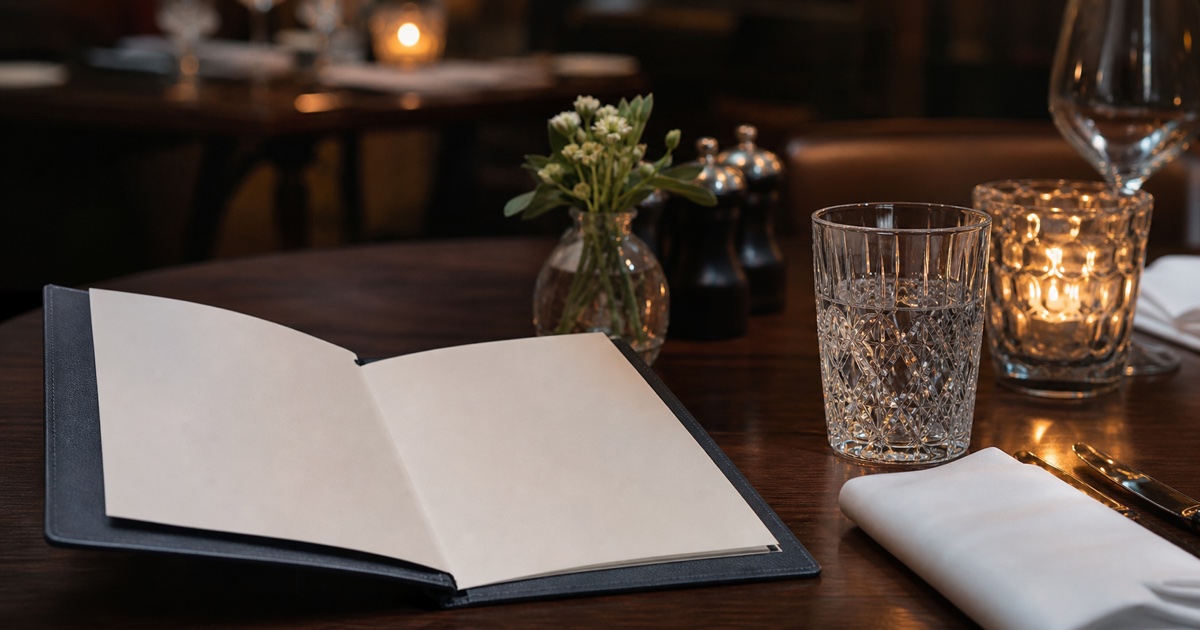
Denmark’s Noma was named “World’s Best Restaurant” four times during the 2010s (2010, 2011, 2012, and 2014 — yielding the throne to Spain’s El Celler de Can Roca in 2013). If you’ve ever dined there, you’ll notice something odd — before the menu is opened, before the wine list arrives, the first thing the server hands you is a “Water Menu.”
The water menu is paged, classified, organised by country. Italian sparklings, French stills, Icelandic volcanic water, New Zealand rain-distilled water… each page lists mineral analyses, flavour notes, and pairing suggestions. Some restaurants even have a dedicated Water Sommelier to guide you through the selection — this is standard at Spain’s El Celler de Can Roca, New York’s Eleven Madison Park, and Tokyo’s Narisawa.
First-time reaction to a water menu is usually: “Isn’t water just water? Does it really need to be this complicated?”
It does. The reason is the same as with wine — different waters amplify or suppress specific flavours of food.
This article uses the mineral fingerprints of twelve waters across six countries to show what water pairing is actually pairing.
The Chemistry of Water Pairing: Three Principles
Water sommelier training comes down to three classical principles:
1. High calcium + high HCO₃⁻ water = balances tannin-heavy, hearty foods Bicarbonate neutralises the acidity and astringency in food. Structurally bold red wine stews, cheese, and tannin-rich dishes need this kind of water to “soften” the weight.
2. High sodium + high chloride water = stands up to fat and intense flavours The brininess stimulates salivation, helping digest heavy oils, fermented foods, and smoked dishes.
3. Low-mineralisation soft water = lets the ingredient speak When the dish itself is delicate (sashimi, steamed, light white meat), high-mineral water overpowers it. Soft water becomes the invisible supporting actor.
Below, we apply these three principles to waters from six countries.
🇮🇹 Italy: Motherland of Tomatoes and Cheese — Pellegrino + Acqua Panna, a Pair
The Italian table’s “golden combination” is S.Pellegrino (sparkling) + Acqua Panna (still). Both are owned by the Sanpellegrino group, but they sit at opposite ends of the spectrum —
| S.Pellegrino | Acqua Panna | Ferrarelle | |
|---|---|---|---|
| Type | Strong sparkling | Still | Light sparkling |
| Origin | Lombardy | Tuscany | Campania |
| TDS | 1,109 mg/L | 140 mg/L | 1,270 mg/L |
| Calcium | 186 | 34 | 362 |
| HCO₃⁻ | 219 | 100 | 1,372 |
| Sulfate | 459 | 22 | 6 |
Pairing logic:
- Pellegrino’s high sulfate (459 mg/L) pairs with rich, cheese-heavy dishes — sulfate brings a clean, dry finish that cuts through fat. So Italians order Pellegrino with Parmigiano, Mortadella, and braised meats.
- Acqua Panna’s low mineralisation pairs with Tuscan light seafood, olive oil and greens, light risotto. Only low TDS lets the layers of olive oil come through.
- Ferrarelle’s light sparkling + balanced mineral character sits between the two, perfect with pizza and pasta — the “middle-ground” dishes.
🇫🇷 France: Land of Butter, with a Water Spectrum from Soft to Extreme
France is a little split — it has both Evian, the low-mineral icon, and Contrex, with off-the-charts sulfate.
| Evian | Contrex | Chateldon 1650 | Saint Géron | VALS | |
|---|---|---|---|---|---|
| Type | Still | Still | Light sparkling | Light sparkling | Light sparkling |
| TDS | 357 | 2,044 | 1,882 | 1,633 | 1,680 |
| Calcium | 80 | 468 | 355 | 95.7 | 22.2 |
| Sulfate | 14 | 1,121 | 33 | 20.4 | 45.1 |
| Sodium | 6.5 | 9.1 | 240 | 207.9 | 381 |
| HCO₃⁻ | 357 | 403 | 2,075 | 1,191 | 1,100 |
Pairing logic:
- Evian soft-water route — pairs with butter-sauce white fish, soufflé, mousse — foods that are soft in texture themselves. Calcium 80 doesn’t overpower the butter.
- Contrex’s sulfate 1,121 (!) — this geology is highly unusual (Vosges mountains in France); the high sulfate brings an intense dry finish, one of the few waters that can “stand up to” rich French sauces (Béarnaise, Hollandaise).
- Chateldon 1650 — first documented in French royal records in 1650; later became the official water of Louis XIV (the Sun King), transported daily from this small Auvergne village to the Palace of Versailles. High calcium + high HCO₃⁻ pairs with red wine beef stew, Coq au Vin, Cassoulet.
- Saint Géron / VALS — medium mineralisation, just right with bistro classics (duck breast, braised lamb shoulder).
🇪🇸 Spain: Jamón, Tapas, Intensity — Bring in Vichy Catalan
Spain’s national treasure water, Vichy Catalan, was discovered by Dr. Modest Furest in 1881 and registered as a brand in 1890. It has been a fixture at the Mediterranean table ever since.
| Indicator | Value |
|---|---|
| TDS | 3,052 mg/L |
| Sodium | 1,070 mg/L |
| HCO₃⁻ | 2,031 mg/L |
| Lithium | 1.3 mg/L |
| Calcium | 15.3 mg/L |
Pairing logic:
- Extremely high HCO₃⁻ + extremely high sodium — this combination is built for heavy oil + heavy salt dishes: Jamón Ibérico, Manchego cheese, fried Tapas (Croquetas, Calamares).
- High sodium stimulates salivation, HCO₃⁻ neutralises the heaviness — the saltiness in the food gets “opened up” a layer when you drink it down.
This is also why Spaniards always pair Tapas with Vichy Catalan, not sparkling waters like Pellegrino — the latter has too little sodium to hold its ground against the salty oiliness of jamón.
🇩🇪 Germany: Fermented Foods, Sausage, Sauerkraut — Three Waters Forming a Ladder
Germany is already a mineral water powerhouse — its “Heilwasser” (healing waters) alone count 55 sources. We covered Rosbacher and Römer Brunnen in the first article. This article adds the third: Gerolsteiner — Germany’s best-selling sparkling mineral water.
| Rosbacher 750ml | Gerolsteiner | Römer Brunnen | |
|---|---|---|---|
| Type | Strong sparkling | Sparkling | Light sparkling |
| TDS | 1,840 | 2,500 | 4,912 |
| Calcium | 233 | 345 | 550 |
| Magnesium | 111 | 100 | 127 |
| HCO₃⁻ | 1,236 | 1,800 | 2,849 |
Pairing logic:
- Rosbacher’s Ca:Mg 2:1 — pairs with light German dishes (white fish, Spätzle, home-style stew) and sports hydration.
- Gerolsteiner — Germany’s “medium-mineralisation mainstream,” most commonly used with Wurst (sausage) and Sauerkraut (fermented cabbage). The carbonation cuts through pork fat.
- Römer Brunnen — enters the healing-water tier. Extreme HCO₃⁻ + high sodium is ideal for German hearty dishes: Schweinshaxe (pork knuckle), Sauerbraten (red wine-marinated beef), smoked cheese. Hassia Group’s official recommendation: 0.25–0.3 litres before or during a meal.
Special note: Martin Sons of the German Water Sommelier Union specifically points out in his official recommendation that Rosbacher Sparkling is a non-alcoholic aperitif option, particularly suited to Merlot, Cabernet Sauvignon, and Bordeaux. The full recommendation is downloadable from the first article’s source section.
🇷🇴 Romania: BORSEC, an Underrated Eastern European Water
BORSEC comes from the Carpathian Mountains in central Romania. First bottled in 1804, it served as the court water of the Habsburg and later Austro-Hungarian Empires — Emperor Franz Josef called it “the Queen of Mineral Waters.”
| Indicator | Value |
|---|---|
| TDS | 1,511 mg/L |
| Calcium | 362 mg/L |
| Magnesium | 107 mg/L |
| Ca:Mg | 3.4:1 |
Pairing logic:
- Medium mineralisation, balanced — pairs with Eastern European hearty meats (roast pork, Sarmale stuffed grape leaves, Ciorbă sour soup).
- Plays the role of “daily table water” in Central and Eastern European countries. Less common in Taiwan but occasionally imported by specialty supermarkets.
🇹🇼 Taiwan: A Taxonomic Distinction
A taxonomic distinction here — and it’s the most important concept across the whole series.
The 11 waters discussed above — Rosbacher, Römer Brunnen, Vichy Catalan, Vytautas, Pellegrino, Acqua Panna, and more — all belong to “Natural Mineral Water”: water drawn directly from a specific geological source via a deep well or spring, where every mineral in the bottle comes from the geology itself. Every milligram of calcium, magnesium, and lithium is the result of decades or even centuries of slow rock dissolution.
Taiwan has two local waters worth knowing — and they happen to fall into completely different categories: one is natural mineral water, the other is blended water. Looking at both side by side is the clearest way to illustrate this taxonomic distinction.
BabuLong — Taiwan’s Natural Mineral Water
BabuLong (babulong.com.tw) is Taiwan’s only commercially available naturally alkaline volcanic-rock mineral water, certified under Taiwan’s CNS 12700 “Natural Mineral Water” national standard.
| Item | Value / Fact |
|---|---|
| Category | Natural Mineral Water |
| Source | Deep natural spring, Hengshan, Hsinchu County |
| Geology | Filtered through basalt strata (same volcanic geology as Germany’s Vogelsberg) |
| pH | 9.0 ± 0.5 (stable natural alkalinity) |
| Water age | ~4,500 years (tested by BETA Laboratory, USA) |
| Key minerals | Metasilicic acid (H₂SiO₃, known as “gold in water”), calcium, magnesium, potassium, sodium, strontium, and other trace elements |
A few interesting things about this water:
- Natural alkalinity at pH 9.0 — Stably alkaline mineral waters are extremely rare worldwide. In Europe, only a few high-bicarbonate waters reach this (e.g., Saint Géron at near pH 9).
- 4,500-year water age — Longer underground residence than the Bad Vilbeler Römer Brunnen well (drilled 1929); the longer water lingers underground, the more stable its mineral dissolution.
- Basalt filtration — Same volcanic geology family as Germany’s mineral-water heartland in Hessen (Vogelsberg). Taiwan does have water with a geological fingerprint — just at lower commercial scale.
So the question “Does Taiwan have a natural mineral water that could stand alongside Rosbacher?” — the answer isn’t “no.” The answer is “yes, it’s called BabuLong — its market visibility just hasn’t caught up with its geological distinctness.”
Mei-Ri-He — Taiwan’s “Blended Water”
Now to a categorically different example.
Mei-Ri-He (brand: Yes; manufacturer: Ming-Pai Foods Co., Ltd.) is the most representative product in Taiwan’s mainstream market positioned around “high-magnesium drinking water.” But it’s not the same category as BabuLong, nor the 11 European waters above — the bottle’s ingredient line states clearly: “Water, deep-sea mineral concentrate”.
| Item | Value / Fact |
|---|---|
| Category | Blended Water |
| Ingredients | Water + Deep-Sea Mineral Concentrate (blended) |
| Water source | Groundwater, Toucheng, Yilan County (Water Right License G10600007) |
| Manufacturer | Ming-Pai Foods Co., Ltd. |
| Magnesium | 300–350 mg/L |
| Calcium | 0.5–1.5 mg/L |
| Sodium | 5–16 mg/L |
| Potassium | 1.5–15 mg/L |
| pH | 7.0–9.0 |
| Certifications | ISO22000, HACCP |
In other words, the “high magnesium” number (300–350 mg/L) wasn’t given by geology — it was added afterward: a deep-sea-derived mineral concentrate is blended into Toucheng groundwater to produce the final product.
Two Fundamentally Different Product Categories
| Category | Taiwan example | European examples | Mineral source |
|---|---|---|---|
| Natural Mineral Water | BabuLong | Rosbacher, Römer Brunnen, Vichy Catalan, Vytautas, Pellegrino | Decades to millennia of natural rock dissolution |
| Blended Water | Mei-Ri-He | — | Water + concentrate, industrially blended |
The mineral fingerprint of natural mineral water is the result of decades to millennia of slow rock dissolution — you’re drinking “the story of a piece of land.” Blended water’s minerals are designed by formulators — you’re drinking “a product design.”
Neither approach is wrong, but they are fundamentally different product categories and shouldn’t be lined up side-by-side. When you see a bottle whose ingredient line reads “Water + some mineral concentrate,” that’s blended water; when you see “Natural Mineral Water” alone or labels meeting Taiwan’s CNS 12700 standard, that’s natural mineral water.
⚠️ Note: Mei-Ri-He’s label explicitly states “Consumers with abnormal kidney function should consult a physician before drinking.” This warning applies to all high-mineralization waters (including natural mineral waters) — for anyone with special health conditions, asking a doctor before drinking high-mineral water matters more than reading any ten articles.
A Final Map: Mineral Fingerprints × Cuisine Style
| Cuisine Style | Recommended Water (Mineral Trait) |
|---|---|
| Light white meat, sashimi, steamed | Acqua Panna (soft) |
| Italian tomato, cheese, braised | S.Pellegrino (high sulfate) / Ferrarelle |
| French butter sauce, soufflé | Evian (soft) |
| French rich sauces, Hollandaise | Contrex (extremely high sulfate) |
| Red wine stew, Coq au Vin | Chateldon 1650 / Rosbacher |
| Jamón Ibérico, fried Tapas | Vichy Catalan (high Na + HCO₃⁻) |
| German sausage, Sauerkraut, fermented | Gerolsteiner |
| German pork knuckle, smoked, slow-cooked | Römer Brunnen (extremely high mineralisation) |
| Eastern European roast meat, sour soup | BORSEC |
You don’t need to memorise every line — three principles are enough:
- Rich sauces / heavy tannins → high HCO₃⁻
- Fat / intense salt → high sodium
- Delicate ingredient → soft water
Why Taiwanese Restaurants Don’t Have Water Menus
After six countries, back to Taiwan. Our fine dining already has substantial wine lists, coffee lists, sake lists — but almost no water lists.
Why?
A few structural reasons:
- Limited imported water variety — can’t build diversity from a limited pool
- Consumer expectations — water is expected to be free; paying for water carries a psychological barrier
- Water sommelier training doesn’t exist — there’s no corresponding professional role in the F&B industry
But these can change. Japan began systematically importing European waters in the 2010s; today, water menus are standard in Tokyo fine dining. Hong Kong and Singapore followed.
Taiwan is next on the food-culture evolution curve, and the water menu will be the next signal — when restaurants start asking “still or sparkling?”, and offer two to three styles of mineral water for pairing, that’s when Taiwan’s F&B industry has truly matured to a new level.
The next time you walk into a high-end restaurant and they hand you a water menu — that’s an evolving Taiwanese dining table, saying hello to you.
Notes · Sources
Brand-Official Mineral Analyses
- S.Pellegrino: 2022 Water Analysis Report (PDF)
- Acqua Panna: Official page / Fine Waters Acqua Panna
- Evian: Official water page
- Gerolsteiner: Official minerals page
- Vichy Catalan: Wikipedia entry
- Contrex / Chateldon / Ferrarelle / BORSEC: Respective brand sites
Downloadable Resources (from the first article)
- 📄 Rosbacher Klassisch 0.75L SGS Lab Report
- 📄 Bad Vilbeler Römer Brunnen 1L SGS Lab Report
- 🍷 Water Sommelier Union Recommendation (Martin Sons)
Food Culture References
- Fine Waters International Water Tasters’ Guild: finewaters.com
- Khymos mineral water pairing guide: mineral waters à la carte
- German Water Sommelier Union: watersommelier-union.com
Taiwan Regulatory Context
Next Article Preview
Next up —
“Why Is Lithium Starting to Appear in the Medical Discussion of European Mineral Waters?” Starting from the 2025 Nature study by the Yankner lab at Harvard — the connection among lithium, the brain, and Alzheimer’s disease, and how it echoes Europe’s centuries-old healing-water tradition.

💬 Comments
Loading...