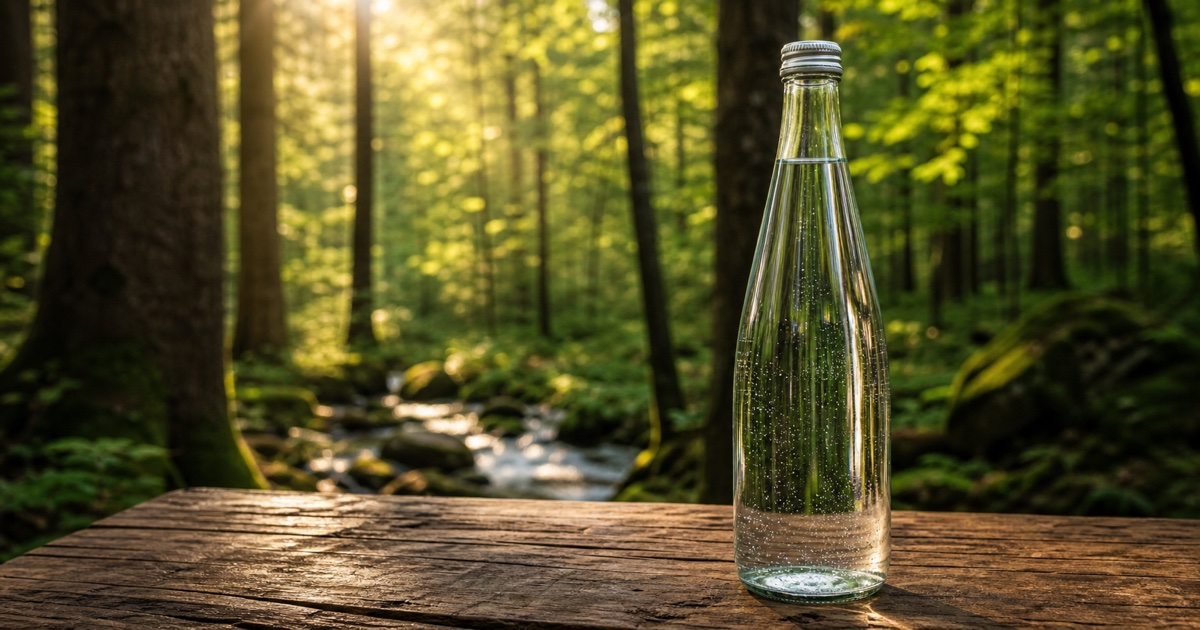
🪶 Disclosure: I assist Hassia Group’s Rosbacher in entering the Taiwan market under the Spring Origin brand. This piece covers the parent group’s sustainability practices and the commitments and limitations on the Taiwan end of cross-ocean import. All “sustainability” claims are geographically scoped (Germany / cross-ocean / Taiwan), without exaggeration or greenwashing.
TL;DR — 2,000 years ago, Celts were already drinking from the Rosbach spring; 1565 marks its first appearance in scholarly literature. Tonight’s 750mL glass bottle on your Taiwan dining table is backed by 160 years of Hassia Group’s sustainability system: 100% hydropower, Bad Vilbel plant climate-neutral since 2020, Mehrweg glass bottles cycling 50 times. But that story ends at Hamburg port. After the 20,000 km sea journey, Taiwan’s commitment begins the moment you choose a glass bottle at the table.
Celts Drank from It. Romans Drank from It. Tonight You Will Too.
2,000 years ago, Celts were already drinking from this well in Rosbach. The Romans took over and kept drinking. The first scholarly mention appears in 1565 — Commentarius de balneis (On Bathing), by Johann Günther von Adernach. That year, Shakespeare had just turned one.
This well sits in Rosbach vor der Höhe, a small town in Hesse, Germany — 25 km north of Frankfurt, on the eastern slope of the Taunus mountain range. The geology: Taunus quartzite filtration, deep artesian well. A calcium-to-magnesium ratio of 2:1 is this water’s mineral fingerprint — uncommon in nature (most mineral waters fall between 3:1 and 8:1).
But the 2,000-year history isn’t the real point of this piece.
What’s actually interesting is this — when you open your refrigerator tonight, pull out a Rosbacher 750mL glass bottle, and pour it into your glass, the bottle has just completed a 20,000 km journey. From the artesian well in Rosbach, to the bottling line in Bad Vilbel, to a shipping container at Hamburg port, to Kaohsiung port, to your table.
Follow this one bottle through the whole journey — and you’ll find that “sustainability” stops at eight stations along the way, getting translated each time.
Station 1: This Bottle’s Water Source — The Rosbach Artesian Well
The water in your Rosbacher 750mL glass bottle comes from a deep artesian well in Rosbach vor der Höhe. The steward of this well is Hassia Mineralquellen — founded by the Hinkel family in Bad Vilbel in 1864, 160 years in the water business, and adding Rosbacher to the group in 2001 as the flagship for its “moderate mineralization, balanced” line.
Bad Vilbel is a German mineral water hub — a small town of just 30,000 people, densely populated with 20+ mineral water producers, dubbed “Germany’s Mineral Water Capital” by the German Mineral Water Association in the 2010s.
The group that stewards Rosbacher today:
- 30 springs, 10 production facilities
- Annual third-party sustainability audits by certified bodies since 2016
- ZNU “Nachhaltiger Wirtschaften” Sustainable Operations Certification from January 2026, independently verified by TÜV Rheinland Cert GmbH
📊 Key Data
- History: Parent group founded 1864, 160 years in the water business
- Rosbacher joins group: 2001
- Group scale: 30 springs, 10 production facilities
- Sustainability audit: Annual third-party audit since 2016
- Latest certification: ZNU Sustainable Operations (effective 2026/1, TÜV Rheinland verified)
These numbers aren’t here to flex credentials. 160 years doesn’t automatically equal sustainability — but 160 years has given the group that stewards this water a “record they can’t hide.” Any sustainability claim on the European end can be independently verified, questioned by consumer groups, or revoked by TÜV.
In sustainability discourse, this is called “accountable commitment” — and it’s the first layer of responsibility behind the bottle in your hand.
Station 2: Why Is This Bottle Glass, Not PET?
Why is your Rosbacher 750mL a glass bottle? — The answer starts at the Bad Vilbel bottling line.
Walk into Hassia’s Bad Vilbel plant, and the first thing being recycled isn’t empty bottles — it’s “bottles that will come back to be refilled 50 more times.”
Germany’s Mehrweg (multi-return) system works simply: when you buy a bottle of water, you pay a deposit (Pfand) averaging €0.15–0.25. After drinking, you return the empty to the store, deposit refunded. Empties go back to the beverage plant — cleaned, inspected, refilled. A Mehrweg glass bottle is refilled an average of 50 times, PET Mehrweg bottles roughly 15–25 times.
Hassia’s products are >90% Mehrweg — for every 10 bottles produced, more than 9 enter this circular system, not single-use. Rosbacher 750mL glass is one of the main formats in this >90% Mehrweg line.
Let me be clear about one thing — this piece is about table water logic, not a “glass vs. PET” value judgment.
PET bottles have their place: sports hydration, outdoor activity, drinking on the move, hiking, long bike rides — situations that need lightweight, unbreakable, single-handed grip and opening. Glass bottles don’t fit these contexts (heavy, fragile, limited volume). Hassia Group itself has PET product lines too — including the small-format Rosbacher Power Sparkling 500mL PET — exactly responding to this “mobile hydration” need.
But sitting down to a meal, household water storage, food pairing — these contexts need something else: substance, carbonation retention, ritual, washable reuse — and that’s Rosbacher 750mL glass bottle’s territory.
Comparison of the two packaging types:
| Dimension | Mehrweg Glass Bottle (Table) | Single-Use PET (Mobile) |
|---|---|---|
| Suitable scenarios | Dining, home, ritual settings | Sports, outdoors, mobile, lightweight needs |
| Weight | Heavy (600g+ with bottle) | Light (30g) |
| Carbonation retention | Months without loss | Best short-term |
| In Germany’s Mehrweg system | 50 cycles | 15–25 cycles |
| After recycling in Taiwan | Melted and remade into new glass containers | Chemical breakdown, regenerated (strength degrades each cycle) |
| “Infinite circulation” possible | Yes | No (material structure limit) |
The last two rows of this table matter — we’ll come back to them.
Station 3: The Bottling Line Filling This Bottle — Climate-Neutral Since 2020
What fills Rosbacher mineral water into your 750mL glass bottle is the Mehrweg glass bottling line at the Bad Vilbel plant. This line has done a few things that are “more expensive, more labor-intensive” on the sustainability front:
- Running on 100% German hydroelectric green power since January 2015 — among the earliest German beverage producers to go fully green
- CO₂ emissions reduced 55% vs. 2015
- The entire Bad Vilbel plant has operated climate-neutral since June 2020 — meaning residual unavoidable emissions are voluntarily offset using international standards recommended by the German Federal Environment Agency (UBA)
- New Mehrweg bottling equipment: compared to older systems, saves 20% water and 25% electricity per bottle
- Waste recycling rate: 97%
Note that I qualified “climate-neutral” — “Bad Vilbel plant.” This is not a carbon-neutral claim for Rosbacher’s entire product line, nor for the entire group. It’s that plant, that physical site.
In sustainability discourse, vague boundaries are worse than no claim at all. After the EU’s Green Claims Directive took effect in 2024, this kind of qualifier isn’t copywriting — it’s a legal obligation.
Station 4: Your Bottle Takes a Different Path Than Its “German Cousins”
After bottling, the Rosbacher glass bottle’s next stop is the Mehrwegkasten (returnable beverage crate). One crate holds 12 bottles, palletized, loaded onto trucks, sent out.
But here’s where your bottle parts ways with its “German cousins” —
The vast majority of Rosbacher glass bottles leaving Bad Vilbel circulate inside Germany — 87% of Hassia’s distributors are within 125 km of the Bad Vilbel plant, and Germany’s mineral water industry has an overall return rate of 98%, leading Europe. The “total journey” of those bottles rarely exceeds 250 km, with drink → return → wash → refill cycles repeating 50 times.
Your bottle is not among that 87%.
Your bottle is one of the rare ones that crosses Germany’s borders, exports to Asia, travels 20,000 km by sea to Taiwan — the “export cousin.” It shares the same climate-neutral bottling line, the same water source, the same ZNU certification system as its sibling bottles staying in Germany — but after leaving Hamburg port, it takes a different storyline.
Station 5: This Bottle’s Cross-Ocean Starting Point — Hamburg Port
Your Rosbacher 750mL glass bottle leaves the Bad Vilbel plant, travels north by land freight to Hamburg port.
The cross-ocean path is sensitive territory in sustainability discourse — because however you calculate, it emits more carbon than locally produced. Honestly: cross-ocean imported mineral water will never be the “lowest carbon footprint” option.
But the question isn’t “zero emissions or not” — it’s “were emissions honestly disclosed, and was the lowest-emission shipping method used?”
The three cross-ocean shipping options:
- Air freight: roughly 500–1,000 g CO₂/ton·km (highest)
- Sea freight: roughly 10–20 g CO₂/ton·km (lowest)
- Land freight (rail/road): between the two
Air emits 20–50 times more than sea — for the same 1-ton shipment over 10,000 km, air emits ~6 tons CO₂, sea ~0.16 tons (DEFRA 2025 data).
Choosing sea freight isn’t because it’s “green” — it’s because it’s the lowest-carbon option among the three import shipping methods.
Station 6: The 20,000 km Sea Route This Bottle Travels
From Hamburg port, through the North Sea, English Channel, Mediterranean, Suez Canal, Red Sea, Indian Ocean, Strait of Malacca, South China Sea, to Kaohsiung port — approximately 11,000 nautical miles ≈ 20,000 kilometers.
By sea. Why was covered at the last station — among the three import shipping options, sea has the lowest per-unit carbon emissions.
This isn’t an apology for cross-ocean imports. It’s about getting the accounting right — so when you hold this bottle, you know what route it took, how far, by what means.
When I wrote the previous piece ⟨Why Are European Restaurant Water Menus Longer Than Their Coffee Menus?⟩, I covered Rosbacher 750mL glass bottle’s food pairing logic. That piece was about “why drink this water.” This piece is about “where this bottle goes after drinking” — the next stop for the bottle in your hand.
Station 7: After Kaohsiung Port — Your Bottle’s “Taiwan Story”
This is the core of this piece.
Germany’s Mehrweg system ends at Hamburg port.
Germany’s deposit mechanism, return network, wash-and-refill industry chain — the “physical radius” of this entire system stops at Germany’s border. The moment your Rosbacher 750mL glass bottle leaves Hamburg port, it can never return to the Bad Vilbel plant for refilling. This isn’t failure — it’s geographic reality. It’s also the biggest difference between your bottle and those 87% staying in Germany.
So where does this 750mL bottle that arrived in Taiwan go next?
Your bottle’s Taiwan story begins at Kaohsiung port.
Walking into Taiwan’s recycling system, look at two numbers first —
📊 Key Data (Taiwan)
- Taiwan PET bottle recovery rate: ~95–97% (top tier globally, Ministry of Environment Resource Circulation Administration)
- Taiwan glass container recovery rate: ~45% (over 50,000 metric tons annually in the past three years, Ministry of Environment Resource Circulation Administration)
- Bottling industry furnace reuse ratio: ~50% (90%+ of which is clear glass)
First reaction usually: “Wait, PET is higher than glass?”
Yes. In Taiwan, PET bottle “recovery rate” is world-class — this is an achievement of Taiwan’s resource recycling system, not something to be diminished. But this number has a critical nuance to clarify:
“Recovery” doesn’t equal “circular reuse.”
PET bottles, once recovered, go through chemical breakdown and regeneration into fibers or new bottles. But PET is a long-chain polymer — with each regeneration, the molecular chain slightly fragments and degrades. Regenerated PET’s purity and performance degrade with each cycle, ultimately becoming waste or breaking down into microplastics.
Greenpeace has detailed coverage of PET’s structural circulation limits — even at Taiwan’s 95% recovery rate, the remaining 5% and microplastics generated during regeneration still enter oceans and the food chain.
The EU has recognized this structural limit. The PPWR regulation starting in 2025 mandates that PET bottles must contain at least 25% rPET (recycled PET), rising to 30% by 2030 and 65% by 2040. The entire global PET industry is moving toward “extending PET’s lifespan” — the best that can be done in the PET context.
Glass’s material properties are different.
Glass containers are among the few packaging materials that can truly circulate infinitely, without degradation. Crushed, melted, remade — the molecular structure doesn’t change. Recycled glass containers have purity and strength nearly identical to virgin glass.
Taiwan’s 45% glass recycling rate may look modest — but the bottles that do enter that 45% are entering a true “infinite circulation” track.
So for table water in Taiwan, the glass bottle logic looks like this —
PET bottles do well in their context (sports, mobile, outdoor), and Taiwan’s recycling system handles PET well. But when you sit down to eat and want a bottle that can stay on the table — that context isn’t where PET fits.
A glass bottle’s advantages in the table context are in its material essence: carbonation lasts for months, doesn’t release microplastics, recyclable infinitely.
Germany’s Mehrweg is “deposit-fee-locked 50-cycle refill.” Taiwan has no Mehrweg, no deposit fee — so choosing a glass bottle for table water is the simplest, most direct entry point for Taiwanese consumers to participate in circular economy.
Station 8: This Bottle’s Final Stop — Your Choice
When you pour the first glass of water, this Rosbacher 750mL glass bottle completes its main mission.
The water in your glass: a mineral fingerprint shaped by decades of Taunus quartzite filtration, with a water age older than you; passed through 160 years of a group’s responsibility system, the Bad Vilbel plant’s climate-neutral bottling, and 20,000 km of sea route to reach your table.
But the bottle’s journey isn’t over. It has one last station — you decide its next stop.
Two choices:
- A. Put it in general recycling: Ministry of Environment recycling truck → private glass plant → melted, remade into new glass containers
- B. Keep it for reuse: vase, oil bottle, decoration. No right or wrong, but remember it eventually goes back to recycling.
This is the core logic behind Spring Origin making Rosbacher 750mL glass bottle the main Taiwan table-water offering: in the “sitting down to eat” context, glass is the most fit-for-purpose choice at a material level — durable carbonation, no microplastics released, infinitely circulable. The 750mL two-person European table volume is also designed around this scenario.
PET bottles still have their role in sports, outdoor, and mobile contexts — that’s a different tool for a different situation, not the “table water” territory this piece addresses. Hassia Group itself produces in both lines (including the small-format Rosbacher Power Sparkling 500mL PET). But for sitting down to a meal — Rosbacher 750mL glass bottle is the no-compromise option.
Closing: Responsibility Stopped at Several Stations Along the Way
I wrote this because — import and sustainability are two words that usually argue with each other.
Import means crossing oceans, means carbon, means you can’t claim “greener than locally produced.” So the easiest stance is: “We don’t talk sustainability, we just sell good water.”
But that stance is lazy. It makes “sustainability” a word only domestic producers can use, leaves importers off the hook for any environmental responsibility.
My choice is another stance — import and sustainability can be discussed together, as long as the accounting is honest and the boundaries are clear.
What Hassia Group does in Germany is German-end work — it can be verified, it can be cited. But once it crosses Hamburg port, it’s not what Spring Origin can continue to claim on the Taiwan end. The responsibility Taiwan must carry runs on a different track: choose glass over PET, ship full cases without single-use gift packaging, clearly disclose origin and ingredients in CNS Chinese labels.
This piece isn’t marketing copy. It’s about taking this Rosbacher 750mL glass bottle’s journey apart — so when you hold it, you know what stations it passed through, what happened at each, and that the last station is your choice.
Germany’s circulation system ends at Hamburg port; Taiwan’s commitment begins the moment you choose a glass bottle, not PET.
The Celts drank from this well 2,000 years ago. They didn’t know what sustainability meant. You do — so the responsibility of choice rests in your hands.
Footnotes & Sources
Hassia Group & Sustainability Practices
- Hassia Mineralquellen Official Sustainability Page — sources for green electricity, Mehrweg, climate-neutral, and other specific data
- ZNU Standard “Nachhaltiger Wirtschaften” — the sustainability operations certification the parent group earned starting January 2026
- Hassia: Bad Vilbel Now Produces Climate-Neutral — June 2020 climate-neutral announcement
Rosbacher History & Mineral Fingerprint
- Rosbacher — A Brand with History — prehistoric drinking record, 1565 first scholarly literature, 1584 Renaissance record
- Rosbach vor der Höhe — Wikipedia EN — town history and geography
- Rosbacher Official Water Quality Page — calcium-to-magnesium 2:1 mineral fingerprint
Germany’s Mehrweg System
- Simple Germany — Pfand & Mehrweg System — glass Mehrweg bottles average 50 cycles
- German Beverage Industry — Mehrweg Facts — Germany’s mineral water industry 98% return rate
Taiwan Recycling System
- Ministry of Environment Resource Circulation Administration — glass container recovery, PET bottle recovery
- Greenpeace Taiwan: What is PET? Are PET Bottles One of the Largest Plastic Pollution Sources? — PET and microplastics
EU Sustainability Regulations
- EU Green Claims Directive — green claims boundary regulation
- EU PPWR Regulation 2025/40 — PET bottle rPET content requirements
Sea Freight Carbon Emissions
- DEFRA 2025 Greenhouse Gas Reporting — sea vs. air freight carbon benchmarks
- Sea freight: ~10–20 g CO₂/ton·km (container ships WTW 16.12 gCO2e/tkm)
- Air freight: ~500–1,000 g CO₂/ton·km (long-haul average ~600 gCO2e/tkm)
- IMO (International Maritime Organization) maritime carbon emission regulatory framework
Next Piece Preview
In the next piece, I’ll write —
“160 Years of a Family Water Business: How Does Hassia Write ‘Next Generation’ Into Every Decision?” From the Hinkel family’s first well in 1864 to the sixth-generation takeover in 2024 — what are the systemic differences between European family-business succession logic and East Asian family business? Why is sustainability a default in European family enterprises?

💬 Comments
Loading...