
Late last month, a 2026 global AI adoption chart blew up on social media. It made the rounds in my circles several times, and each time I looked at it, something new stood out.
The chart maps the AI usage of 8.1 billion people into a mosaic of color-coded blocks. The visual is intuitive, the impact immediate: 84% of people have never used AI. About 16% have tried a free chatbot. Those willing to pay $20 a month for an AI subscription account for roughly 0.2% to 0.3%. And the people actually using AI coding tools? Globally, somewhere between 2 and 5 million—less than 0.05%.
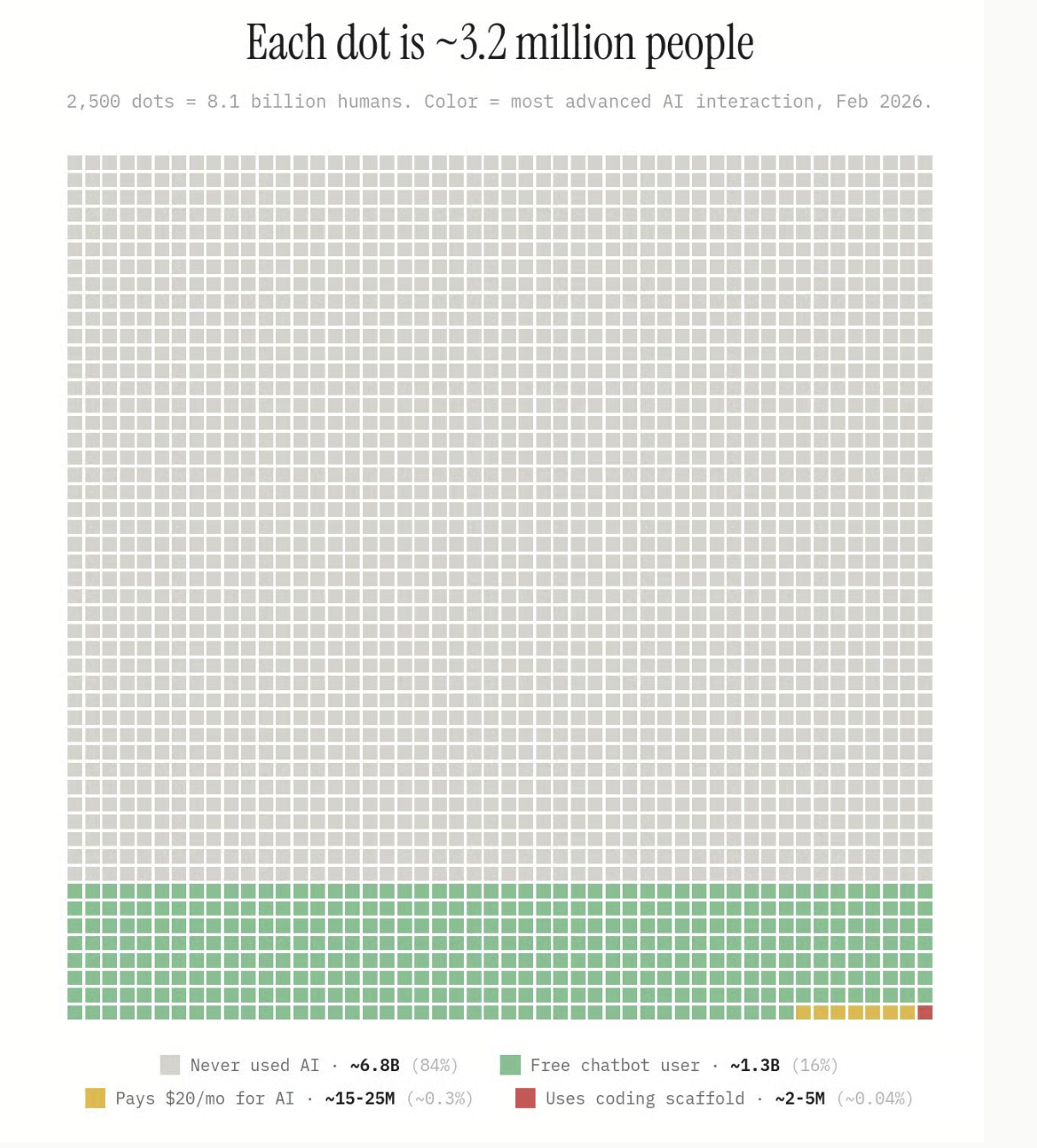
The most important thing about this chart isn’t just the staggering disparity. It forces you to face a few questions: Which color block are you in right now? How do you plan to move to the next one? Which block are your customers in? Are you ready for this extreme world?
This isn’t just an AI market infographic. It’s a capability map.
The Spectator’s World
Many people’s understanding of AI remains in what I’d call a “spectator state.” They know the names—Gemini, OpenAI, Sora, Manus, Perplexity—the way you might know the title of a hit movie without ever walking into the theater. Everyone can drop the tool names, but very few have spent sustained time using them, let alone integrated them into their workflows. Quite a few still treat AI as another Clubhouse—the app that exploded in popularity a few years ago and cooled off just as fast. A wave of hype, wait for it to pass.
That’s not what this is.
A colleague recently asked me: if you’re interviewing a CIO candidate, what questions should you ask? My advice was simple—ask three things directly. Are they a paying AI user? What AI tools are they primarily using? Ask them to show you an AI project they’ve actually built. Once you see what someone has actually done, you can tell pretty quickly whether they’re genuinely on this learning track and whether they have the ability to lead a team forward.
The Acceleration Is Itself Accelerating
In November 2022, my partners and I decided to go all-in on large language model applications for industry. Three years in, I originally assumed younger people would be more willing to pick up new tools. But after going deep into production lines and real industries, I found things aren’t that simple. The people who keep up tend to share a certain personality trait—it’s not correlated with age.
AI’s rate of change isn’t linear. It’s not “fall behind a little today, catch up next month.” It’s more like a system where the acceleration itself keeps accelerating. If you enter the game one step late, the world you see may already be a different version. Every time I fire up code and interact with the models, the gut feeling is that they’re smarter than last week. That feeling is so strong that since February, I’ve been spending at least five hours a day interacting with AI—opening terminals, setting permissions, wiring APIs, submitting requests, validating results, fixing bugs, and then entering another bug-fixing loop, accompanied by various API billing notifications. Stepping on landmines daily, but loving every minute of it.
One day, mid-run, a thought hit me: what’s the difference between the Paul who went through this intense AI baptism and the Paul who didn’t?
Honestly, they’re worlds apart. The two Pauls can barely understand each other. The Paul who didn’t go through this can’t grasp why you’d spend hundreds of dollars extra per month, what the point of building bespoke software is, or what difference it makes that you can produce McKinsey-grade research reports. “The world still looks like it’s spinning just fine, nothing different.” And yes, that statement sounds perfectly reasonable—but those of us in the thick of it know it’s not true. AI isn’t just an efficiency tool. It’s more like an amplifier of thinking. I wrote about a similar idea in “Breaking Through the AI Storm: A Personal Advantage Strategy Map”—the key isn’t the tool itself, but what you use it to amplify.
K-Shaped Divergence: Not Just an Economic Phenomenon
After COVID, the concept of a “K-shaped recovery” became widely discussed—economic shocks don’t hit everyone equally. Some ride the upper arm of the K upward, others slide down the lower arm, and the middle gets hollowed out. AI capability divergence is following the same pattern.
The ascending group uses AI to amplify their thinking, multiplying their output. The descending group uses AI to avoid thinking—or simply doesn’t engage at all. The result is a capability gap that keeps widening and becomes increasingly difficult to close. This K-shaped divergence isn’t just happening at the enterprise level; it’s happening at the individual level too. Is this a hidden societal risk? I believe it is.
Taiwan Is Not the Global Average
Back to that chart. If you simply overlay the “global 8.1 billion” AI adoption distribution onto Taiwan, you’d underestimate Taiwan’s actual situation. Taiwan has one of the world’s highest concentrations of technology and semiconductor industry density.
According to 2024 industry statistics, Taiwan’s semiconductor industry employs approximately 330,000 people, the computer, electronic products, and optical products manufacturing sector has about 250,000 employees (Directorate-General of Budget, Accounting and Statistics), and the information software and services industry employs approximately 287,000 people (MIC, Institute for Information Industry, “2025 Information Software and Services Industry Yearbook”). Adding telecommunications, systems integration, and internal IT departments across enterprises, the broad technology workforce is reasonably estimated at 900,000 to 1.1 million.
According to iThome’s “2024 CIO Survey,” Taiwan’s top 2,000 enterprises employ approximately 140,000 IT professionals, of which about 64% are developers, yielding an estimated core development workforce of approximately 84,000. This doesn’t yet include engineering teams at SMEs, startups, freelance developers, or data scientists and technical professionals who write code frequently in their daily work. Taiwan’s total developer population reasonably falls in the range of 200,000 to 400,000.
Those who truly enter the “AI coding tools” tier are highly concentrated within this technically dense group. If we estimate from a developer base of 200,000 to 400,000, assuming 5% to 15% have already integrated tools like GitHub Copilot, Cursor, or Claude Code into their daily workflows, the reasonable range of active users of these advanced development tools in Taiwan is approximately 10,000 to 60,000.
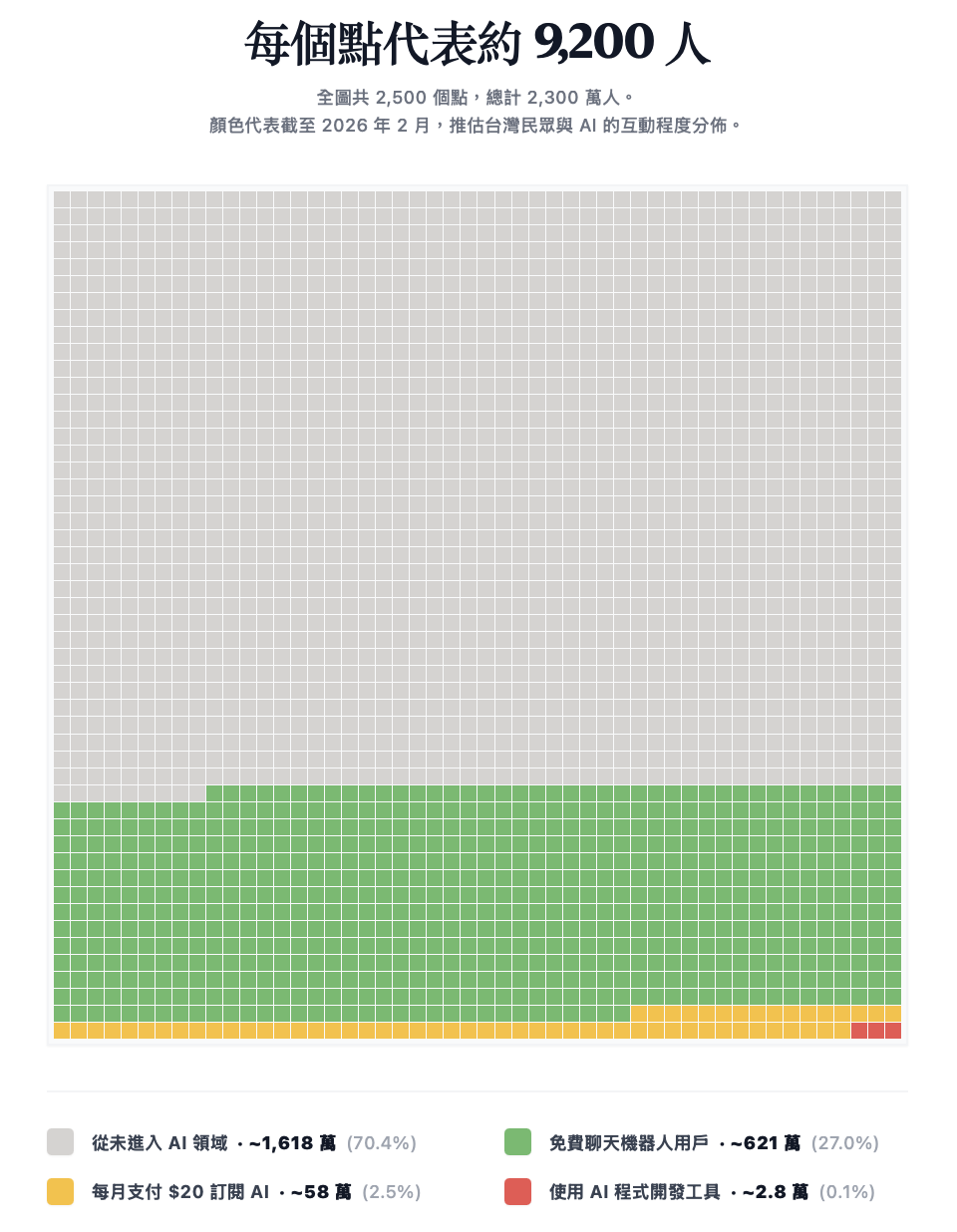
If you simply apply the global average of 0.04%, Taiwan’s 23 million population would yield only about 9,200 people using AI coding tools—clearly an underestimate. Combining the “global average model” with the “Taiwan industrial structure model,” I conservatively estimate that the number of people in Taiwan who have truly entered the AI coding tools tier is approximately 10,000 to 30,000, or about 0.04% to 0.13% of the total population.
Following the same logic to adjust Taiwan’s overall AI adoption landscape: “never used AI” revised down to approximately 70%, “free chatbot users” revised up to approximately 27%, “paid AI subscribers” revised up to approximately 2.5%, and the top tier “AI coding tool users” revised up to approximately 0.1%.
A Few at the Frontier, a Challenge for All
Taiwan has indeed entered the AI era earlier than the global average. But those truly standing at the frontier of the tool chain, possessing foundational creative capabilities—whether 30,000 or 60,000—remain a minority.
If you’re already on this path, don’t stop. If you haven’t started yet, it’s not too late—but wait much longer, and what you’re chasing isn’t distance, it’s version gap.
To all the business owners, entrepreneurs, Chief Digital Officers, and department heads out there—how do you see your enterprise’s transformation? If the knowledge gap required for transformation keeps growing wider, how do you plan to respond?
Original source: “There Are Levels to This: AI Adoption in 2026” by John Crowley, published on Thayer Method.

💬 Comments
Loading...