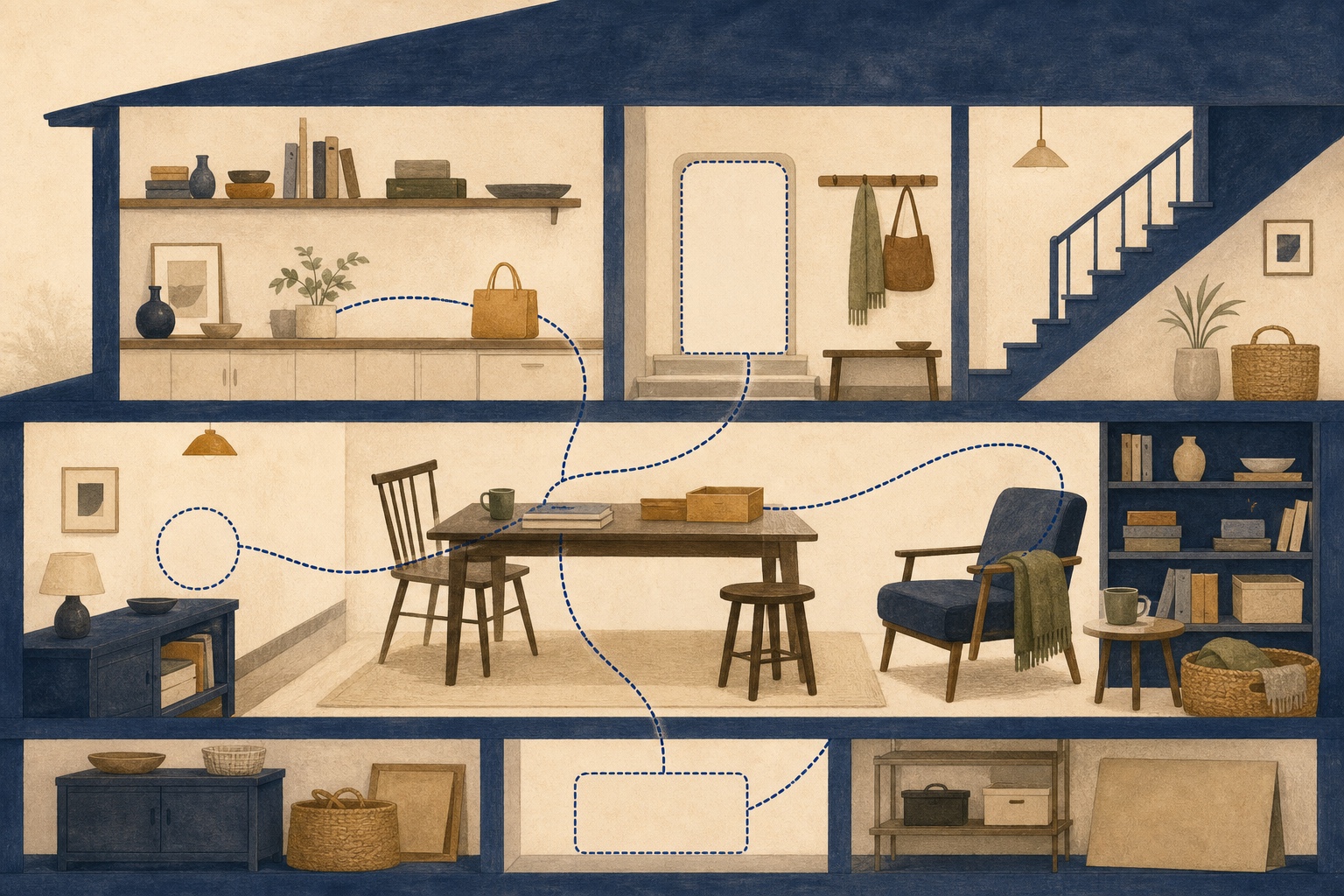

Blaming household chaos on one person’s laziness is quick, but it does not explain why the same objects and tasks keep landing in the same few places. Sometimes someone is carrying a responsibility that is not theirs. Sometimes someone keeps giving up their space until the whole household forgets that they, too, need to be provided for.
Chaos does not happen only on the floor and the shelves. It also happens in the allocation of roles. When roles do not line up, objects cannot find an owner, and work cannot find someone to take it on.
Look first at who has been fixed as the source of the problem
A household may long keep its attention on the member who most needs care, most often raises needs, or most easily triggers conflict. Those needs do have to be handled. But if everything else is paused because of them, the couple’s living rules, the children’s habits of use, and responsibility for shared space never get discussed.
This is not about pushing responsibility back onto the person being cared for, or denying anyone’s needs. It is about separating layers: care needs are met by suitable support, while the rules of living together are decided by the people who use the space. When every problem is hung on one person, work that should be shared easily becomes, by default, one caregiver’s duty.
Space shows who has been left out
Walk through the home and ask three questions: Whose things have a fixed place? Whose things can only be put down temporarily? Who has no corner that does not have to be given up to someone else? The answers are often closer to actual life than “we are all fair.”
Someone may give shared space over to a child’s things. Someone may give up their rest place to care supplies. Someone may scatter personal belongings across rooms. In the short term it looks like consideration. Over time that person’s work, rest, and say in decisions can all be squeezed. A household is not only about who does a little more. It also includes who can keep a stable place at home.
Separate ownership from care responsibility
Role misalignment also shows up in objects. That someone is responsible for cleaning, moving, and storing does not mean they can decide for everyone what stays and what goes. That someone owns the right to decide about an object does not mean other family members must store and maintain it indefinitely. Personal and shared objects need different kinds of negotiation. One set of rules cannot cover everything.
You can first list, for each object, the current user, the keeper, and the decision-maker. If those three are not the same person, say what happens next: who takes it back, who agrees to temporary storage, who is responsible for finding out where it went. The list is not meant to turn the household into an office. It is meant to make invisible work visible, so the most conscientious person is not always the one who fills the gap.
Someone standing at the edge of the relationship can ask a new question
People inside the family easily get used to an arrangement. Someone who has only just joined the shared life, or who does not carry the old history, can ask why only one person can sit here, or who decided these things would stay here. The questions need not become criticism at once. They can first be used to look again at circulation, use, and safety.
Change that actually works is not forcing one member to give way. It is the people living together confirming which places are shared, which can be personal, which work should be taken on by care support, and which objects still belong to their owners to decide. Where health, care, jointly owned things, or residential safety are involved, seek appropriate professional help. This article does not make legal, medical, or psychological judgments for any household.
Tidying a home is not labeling one member as the problem. It is checking whether roles, objects, and responsibility line up with one another. When everyone has a place that is recognized, objects are less likely to pile ownerless in a corner, and work is less likely to keep returning to the same person. Asking first who has been left out and who is filling in, then talking about how to tidy, usually gets closer to the root than first finding one person to blame.
Realignment need not start with the whole house. Choose one shared surface first. Confirm who uses it, who maintains it, and which objects can stay. Then take the same questions to the next place. A small trial can let the household see responsibilities that were never spoken, and leave room to pause and adjust when people disagree.

💬 Comments
Loading...