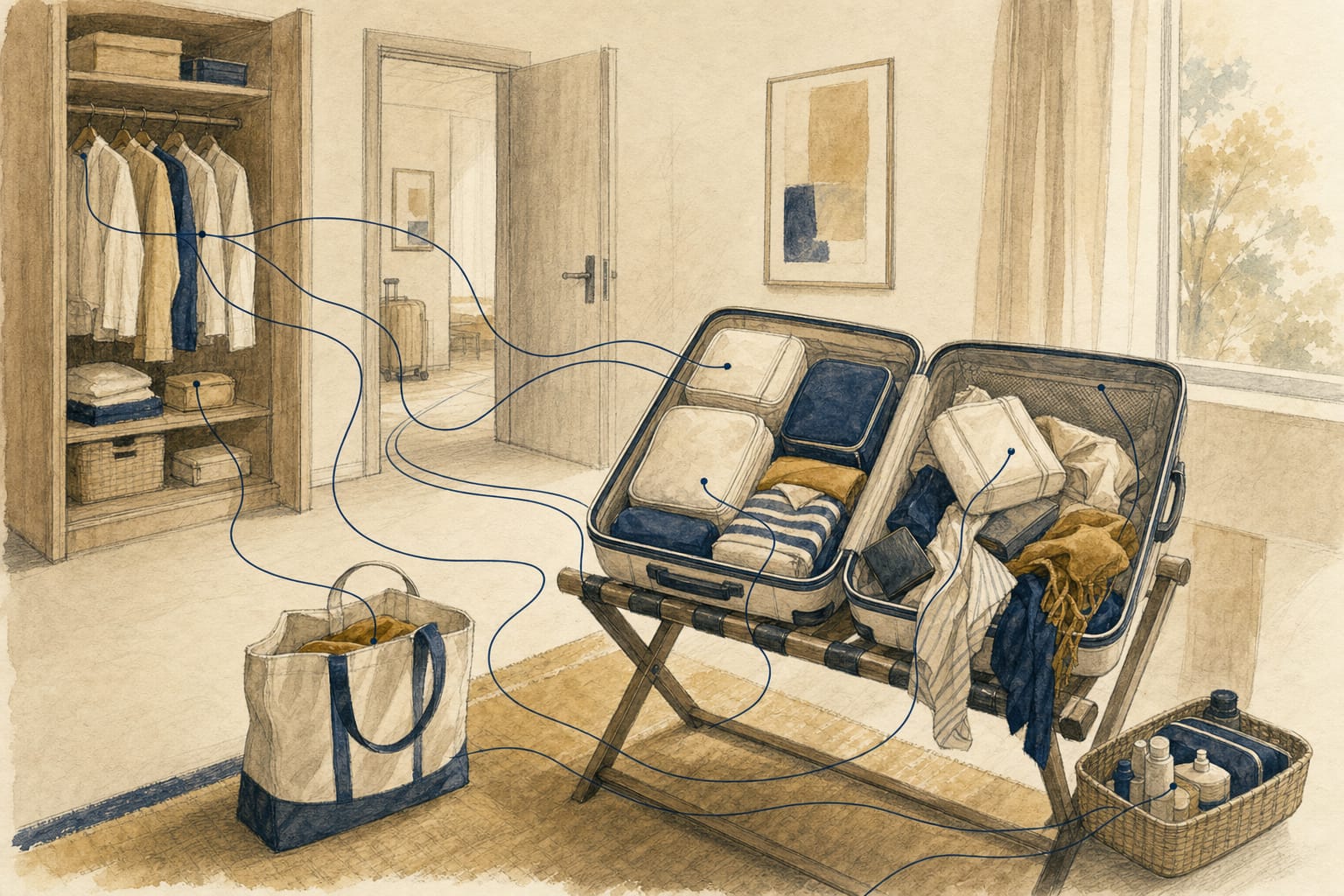
TL;DR: A professional organizer fell apart on the road because movement removed the fixed-position premise her system depends on. In the second half of the same trip, three people split responsibility for money, communication, safety, and daily logistics, and she lost nothing. When a system moves into a new context, redistributing responsibility works better than demanding greater personal discipline.
I recently read a post by a professional organizer about a work trip. Her job is helping other people bring order to their homes; this post was about how she fell apart the moment she left hers. On an overseas group trip, she was carrying three bags. Everything had been sorted before departure. The moment they started moving, she was scrambling, and she left a neck gaiter in the mesh pocket of the tour bus seat.
Reading it, I kept returning to the question I ask most often when looking at any system: what context was this approach originally designed for?
Why Does a Professional Organizer Fall Apart on the Road?
The short answer: her storage system was validated in a space that doesn’t move. Travel took away the fixed-position premise.
Her three bags each had a role: the small bag held her passport and money, the tote held things she’d need on the plane, the backpack held everything else. Every time she went through security she was scrambling, and whenever she panicked she stuffed things into whichever bag was closest. Finding something later meant searching all three. On the first day, the tour leader reminded everyone this would be their last time on this particular bus, everything had to come off. She rushed off, left the neck gaiter in the seat pocket, and didn’t realize until the third day, long after the bus had moved on. Her tour leader eventually retrieved it by passing it through a chain of different drivers.
Her own diagnosis was movement. Today’s hotel: unpack everything. Tomorrow’s checkout: pack it all back up. New city, new room, unpack again. The charger goes on the nightstand tonight, the desk tomorrow, maybe next to the TV the day after. At home, and in her clients’ homes, nothing moves. Once a position is set, habit does the rest. Things are easy to find and easy to put back.
Why Does Fixed-Position Logic Break Down on the Road?
The way I read it, any storage method actually has two layers. The visible layer is where each thing goes. The invisible layer is the assumption that the space itself doesn’t change. Nobody writes the second layer down, because at home it’s always true. When travel removes it, the first layer can’t hold no matter how carefully it was constructed.
This kind of failure is almost always attributed to the person. Not careful enough, not disciplined enough. She wrote about herself with self-deprecating humor, calling herself “organizationally helpless abroad.” But the same person performing so differently in two contexts: the more plausible explanation is that the context changed and her method didn’t.
I came across the same point in Travel Organization Follows Context, Not Location: when the scene keeps moving, your categories need to follow the moment of use. Following the name of the object keeps letting you down.
What Held the Second Half of the Trip Together?
Division of responsibility. In the second half of the trip, in a different country, three fellow organizers each took charge of different things. One managed money: her cash was actually split across all three people, so when she needed to spend she went to that person. One spoke excellent English and handled any situation that required communication. One was a former police officer who shared her room every night and took charge of safety and daily logistics. That leg of the journey: nothing lost.
She wrote it plainly. She hadn’t suddenly become more capable. She just had three people looking after different pieces of her world.
What I see here is the distribution of attention. A person in motion is continuously processing a new environment: new hotel, new route, a language she can’t follow. There is very little attention left over for tracking where things are. Once money, communication, and safety were each assigned to someone else, every person only had to remember their own domain. Nobody had to hold everything at once.
When Context Changes, What Should You Reassign First?
A view I’ve held for a long time, and wrote about in An Order Stress Test for “Truth Pending”: whether an arrangement is sound shows most clearly when the context becomes uncertain: can it still hold? The organizer’s first half and second half of the trip involved the same number of objects and the same person. The difference was whether responsibility had been redistributed.
Scaled up to the circular and sustainable systems I care about, the structure is similar. A process that works in stable conditions often leans on a single person or department to hold it together through force of will. When conditions shift, that node fails first. The right questions, in order: What context was this process originally designed for? Now that the context has changed, does responsibility need to be redrawn? Whether the people executing it are being careful enough: that question belongs after those two.
Your Suitcase Doesn’t Remember Where Things Go
Next time things fall apart on the road, my first move won’t be to blame myself. I’ll look for something that could be handed to someone traveling alongside me. Packing is a small thing. What it reminds me is this: order needs a division of responsibility that can keep up with the context it’s operating in.

💬 Comments
Loading...