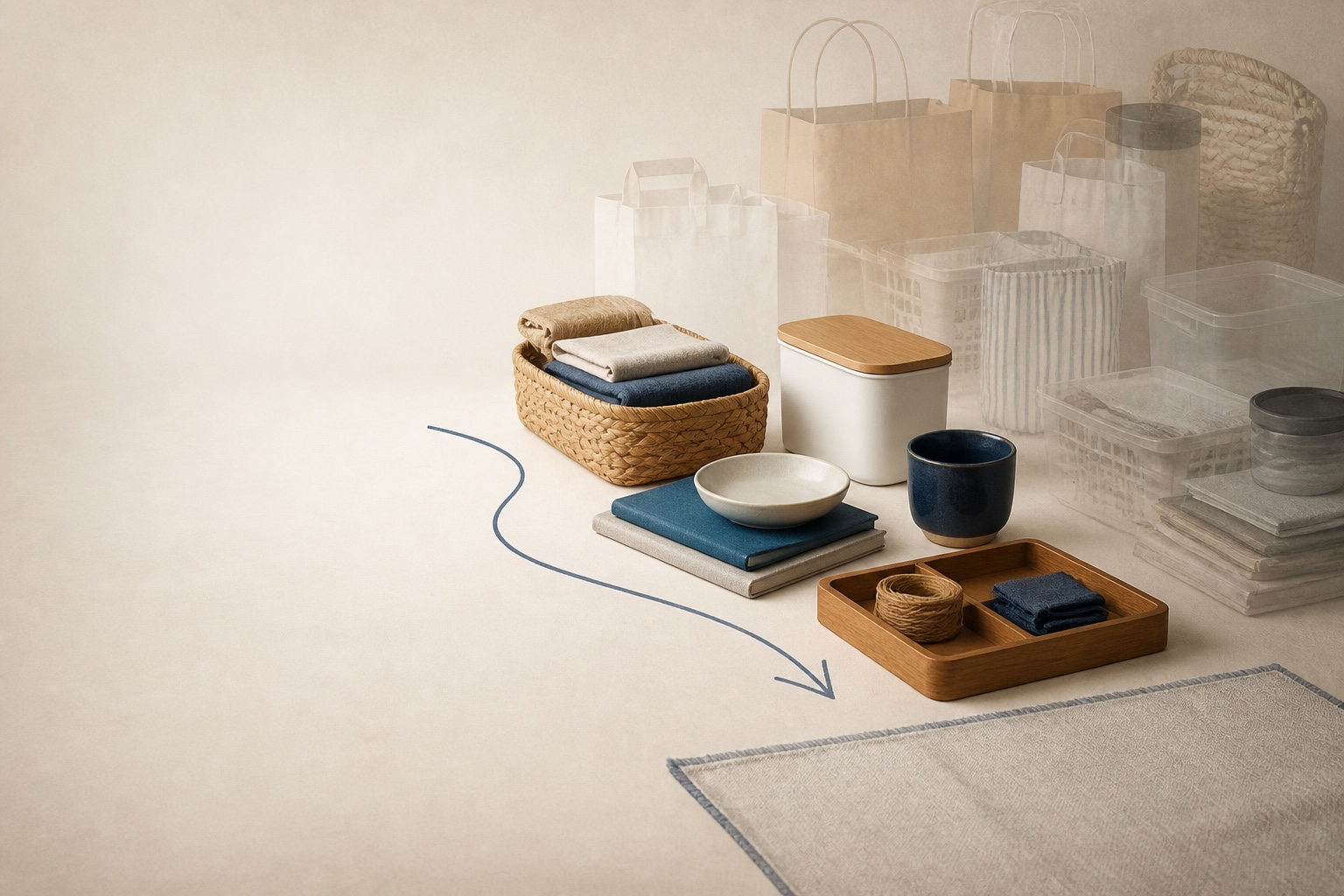

When reducing, people usually ask first: “Should I throw this away?” The question is natural, and it also makes it easy to get stuck. Every object you pick up has to be explained again as to why it should stay: it still works, the condition is not bad, it might be needed later. When each piece has to be judged on its own, organizing is no longer only handling objects; it also adds the burden of defending them one by one.
The order can be reversed. Do not start by asking what to throw away. Ask yourself to pick a few things you most want to keep, that best fit life now, or that most represent your preference. The act is not a sentence on what remains. It first gives the standard for keeping a visible shape.
Pick what you like first, then look at the rest
Some people keep large numbers of bags, clothes, or collections that are still in good condition, because they can all “still be used.” If you ask item by item whether to throw them away, every piece can find a reason to stay. If you first ask the person to pick what they truly like, what is most distinctive, or what best fits current use, preference slowly comes into view.
Once the standard is clear, remaining objects no longer each have to offer their own defense. They can be regrouped by use, quality, frequency of use, or whether someone will take them on. You are not forced to prove why a given object is not worth keeping. You first answer which objects you are actually willing to keep space for.
There is no need here to invent a psychological or personality label for the situation of objects in good condition that are therefore hard to let go. What still matters is how the person defines “good,” and whether that definition serves life now.
What the keeping side lowers is decision friction
Starting from the keeping side does not mean organizing will automatically get faster. It may lower the friction of explaining, item by item, why something should stay. There is currently no comparison of the same set of objects under the two ways of asking, so this method cannot be claimed to work for everyone. Memory objects, collections, and family pieces may still need a pause: who has the right to decide, who is willing to take them on, and whether photos or a list should hold the memory.
If you cannot even say what you most want to keep, step back and ask first for which occasion these things are being kept: daily use, gifts, work, commemoration, or only because there is nowhere to send them. Once use is spoken, preference is usually easier to form.
You can also put the picking result in a place you can see, and come back after a few days. This is not postponing the decision. It lets the keeping standard leave abstract imagination and return to actual life: is it really being used? Are other objects still being taken out all the time? If the few pieces finally kept also do not return to life, the problem may not be that the selection was not good enough, but that the use has already changed.
For shared objects, picking cannot be finished by one person alone. First confirm who will use them, who is responsible for keeping them, and whether others need them at particular times. When the keeping standard lines up with actual users, organizing will not turn one person’s preference into a rule everyone must follow. If views differ, write down each person’s situations of use and timing first, then decide which objects need to be kept in common. This step can also keep organizing from becoming a one-sided command.
Exits have to be designed together with choosing
Reduction cannot only be moving objects from one room to another. Kept objects need a place. Objects that cannot yet be decided need an observation area. Objects no longer in use but still in good condition need handover, donation, or another suitable exit confirmed first. Only those that can no longer be used go into the corresponding material processing.
That way, an object’s leaving is not simply disappearing. It enters a next node where it might still be received. Start by picking the best, and what remains at the end is not only a smaller quantity, but a clearer standard of use and choice. Change the question from “what should I throw away” to “what do I actually want to keep,” and choosing has a chance to move from self-trial to organizing the preferences of a life, with more direction.

💬 Comments
Loading...