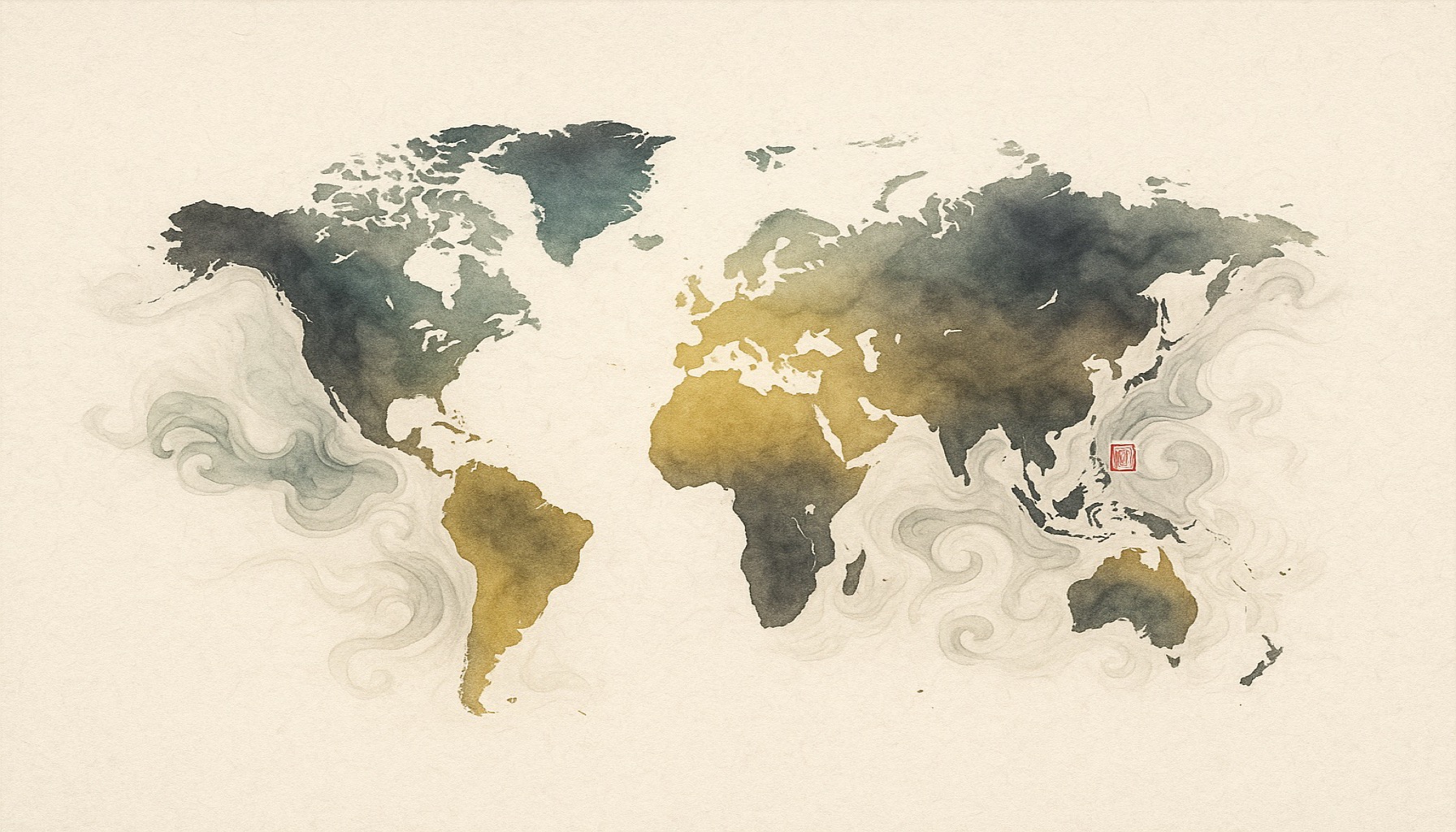
TL;DR — I didn’t write a single line of code. With one sentence I asked Claude Fable 5 to build an ink-wash interactive map for paulkuo.tw’s homepage: washi texture, ink you can stir with your mouse, the world fading to pale ink after fifteen seconds, and Taiwan emerging. What would have taken engineers weeks, hours of conversation brought to prototype. This is the full record of that collaboration.
This map lives on my homepage — a world map that breathes like an ink painting. It is also a record of my collaboration with Fable 5. I wrote not a single line of code. I started with one sentence: “I want to build a Japanese ink-wash website with washi texture, flowing ink, and mouse interaction, to symbolize the world at this moment. In the final image, let Taiwan emerge.”
This piece is part of the “Civilization and Humanity” series.
One Sentence: What Did Fable 5 Do?
I ran Fable in the Claude Cowork window, then handed the work to Claude Code for deployment — building the homepage background starting from a single sentence. Fable 5 automatically generated fluid simulation, washi texture, and ink-toned shading, completing a world map you can interact with using your mouse. What followed was iterative back-and-forth.
I said: the ink is too heavy, it will cover the text. It shifted to a more luminous, translucent colored ink.
I said: I want the colors to have layers of red, green, and blue. It mixed ultramarine, cyan-green, and vermilion — colors that still breathe within the ink aesthetic.
I said: Taiwan should emerge, but the scale can’t be distorted. It returned Taiwan to its true proportions — no more exaggerated enlargement — and instead used an ink halo to guide the viewer’s gaze.
What Does AI Collaboration Actually Look Like?
It didn’t just execute my instructions. In each iteration, it took its own screenshots, ran its own checks, self-verified, then self-corrected.
This is no longer the workflow that seemed natural just days ago — “I raise a requirement, then we slowly implement it.” It feels more like a new kind of collaboration: I provide intent, taste, and judgment; AI handles generation, testing, and approximation.
What the Mouse Stirs Is Ink, and Also Order
The page is interactive. When a mouse stirs the ink, continental boundaries get swept into the vortex — existing order gently disturbed by some force, presaging geopolitical tension. Release your hand, and the ink slowly resettles, the world recongealing into its original form.
Fifteen seconds later everything returns to stillness: the world fades to pale ink, and a familiar island emerges. In my first draft I wrote that this was the painting’s focal point. Later I showed that passage to the AI. Fable replied that a “seal impression” would be a better design, then told me: this painting is still missing a chop. So now, on the sea beside the island, a vermilion seal presses down — first deep, then settling — like a real stamp being applied. The only touch of red in a world of ink.
From Weeks to Hours: The Distance Between Creating and Making
What once took engineers weeks of adjustment, hours of high-density conversation now bring to prototype. It’s not just efficiency. The distance between creation and implementation is already being rewritten. You can try Fable 5 for yourself now: after entering the “era of long-horizon tasks,” the felt experience is already quite different from before.
A few summers ago, I was talking with a friend about how AI was changing. I said, we’re already standing at the edge of the singularity moment. My friend listened, and thought I was overthinking it.
Anyway, time will tell.
And now, time is giving its answer. We are indeed walking into a new era. Humans are no longer simply waiting for technology to realize our imagination. We must also learn anew to ask: what exactly do I want to see, how do I judge, and what do I ultimately choose to keep.
Holding Your Own Way of Seeing the World, Within Chaos
I think of the opening lines of A Tale of Two Cities:
It was the best of times, it was the worst of times, it was the age of wisdom, it was the age of foolishness, it was the epoch of belief, it was the epoch of incredulity…
I want to hold my own way of seeing the world — within the chaos. Twenty years ago, when I founded a company, the name I chose carried this very meaning: “律創” — to see order within disorder, and from that, to create something new.
Want to try it? Come this way 👉 paulkuo.tw
💬 Comments
Loading...