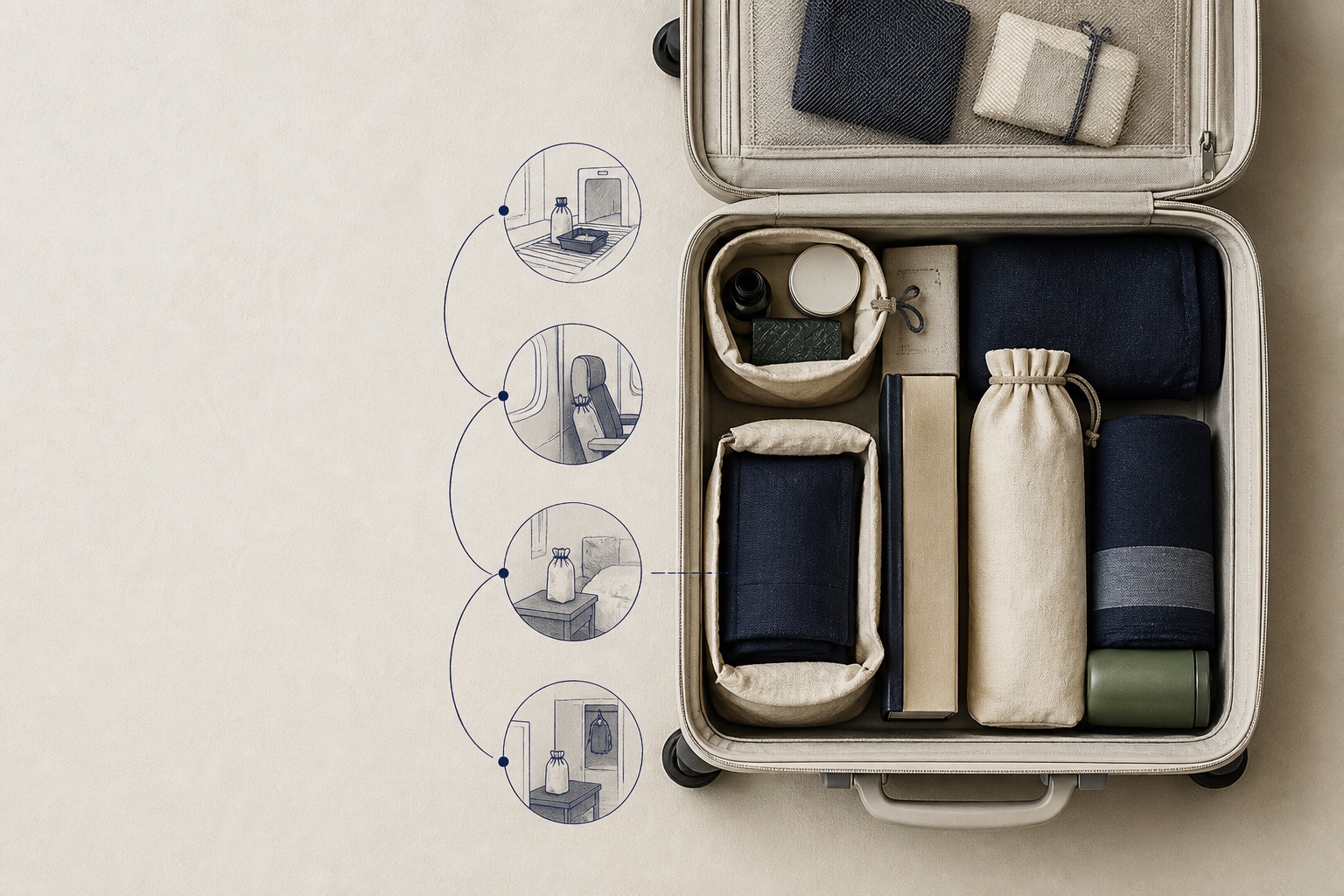

Being good at organizing at home does not mean things will go as smoothly once you leave. Home storage rests on a premise that is easy to miss: the house looks roughly the same every day. Clothes stay in the wardrobe, cables in a drawer, toiletries in the bathroom. Location itself becomes part of memory.
On a trip, that premise disappears. Today you are on a plane, tomorrow in a car, at night in a different room, and the next day you leave with luggage again. The objects have not changed, but the scenes keep changing. Sorting by “what this is” can turn into “I remember it is in some bag, but I do not know which one.”
Fixed locations need a stable scene
Fixed locations work because you do not have to decide again every day. Life on the move has no cabinet that never changes. You first ask: where is the next stretch of the trip? What will you be doing then? Which things must be at hand?
At immigration, the point is not to put every electronic device in one category, but to gather what you need to take out in a place you can reach easily. On a long transfer, glasses, charging gear, drinking water, and personal items can form a short-use set. After you reach lodging, laundry, toiletries, and things you will use while resting go into a new temporary zone.
The same charging cable belongs with electronics at home; on the road it may belong to “the bag for use in transit.” The object has not changed; its grouping follows the situation. That is not a failure of sorting. The axis of sorting needs to move.
Containers should match the retrieval path
Situational grouping is not a universal formula. If a bag is too deep, the dividers do not match your habits, or you have to dump everything out each time you take something, even a neat grouping can fail. The tighter the itinerary, the more you need to think before leaving: what do you take on which stretch? From which opening? After use, can it go back in the same place?
When you cannot reach something, the first impulse is often to buy another bag. The problem may not be the number of bags, but that the container and the sequence of action do not line up. Put the most frequently retrieved items in one visible, reachable place first, then notice what keeps getting stuffed on the outside. That observation says more about the real friction than buying new organizers at once.
Bring the method home
People whose lives change often can treat situational grouping as something to test, not a general answer. Shift work, business travel, shared space, or changing family routines can all mean “permanent locations” need another look. You can split clothes into work, home, and exercise situations, or let things you always use after returning home rest where they can be put back naturally after you walk in, then see whether taking and putting them away really gets easier.
The value of situational grouping is that it forces a concrete question: will the next stretch of life actually use this? Packing by object type makes it easy to keep adding because “one more of the same kind can still go in.” Listing needs by situation makes duplication and excess easier to see.
When the trip ends, send objects back to suitable places in daily life. A travel bag can be emptied, checked, and dried, then returned to a spot that is easy to reach before the next departure. Small kits assembled only for the trip can be taken apart into the home’s existing groups. Return is not stuffing everything unchanged into a cabinet. It is checking which items are still everyday goods and which were only a temporary set for one itinerary.
If a situation kit always leaves a large amount unused, adjust the list before the next departure. The point is not to squeeze luggage to a minimum, but to give carrying and use a clearer basis, and to avoid buying again because something could not be found.
A sorting method need not stay loyal to one set of rules. Home can run on fixed locations because the scene is relatively stable. When scenes start to move, let storage follow the person’s next action. For some people, one less search may also mean fewer repeat purchases from not finding things, but that still has to be observed in one’s own life.

💬 Comments
Loading...