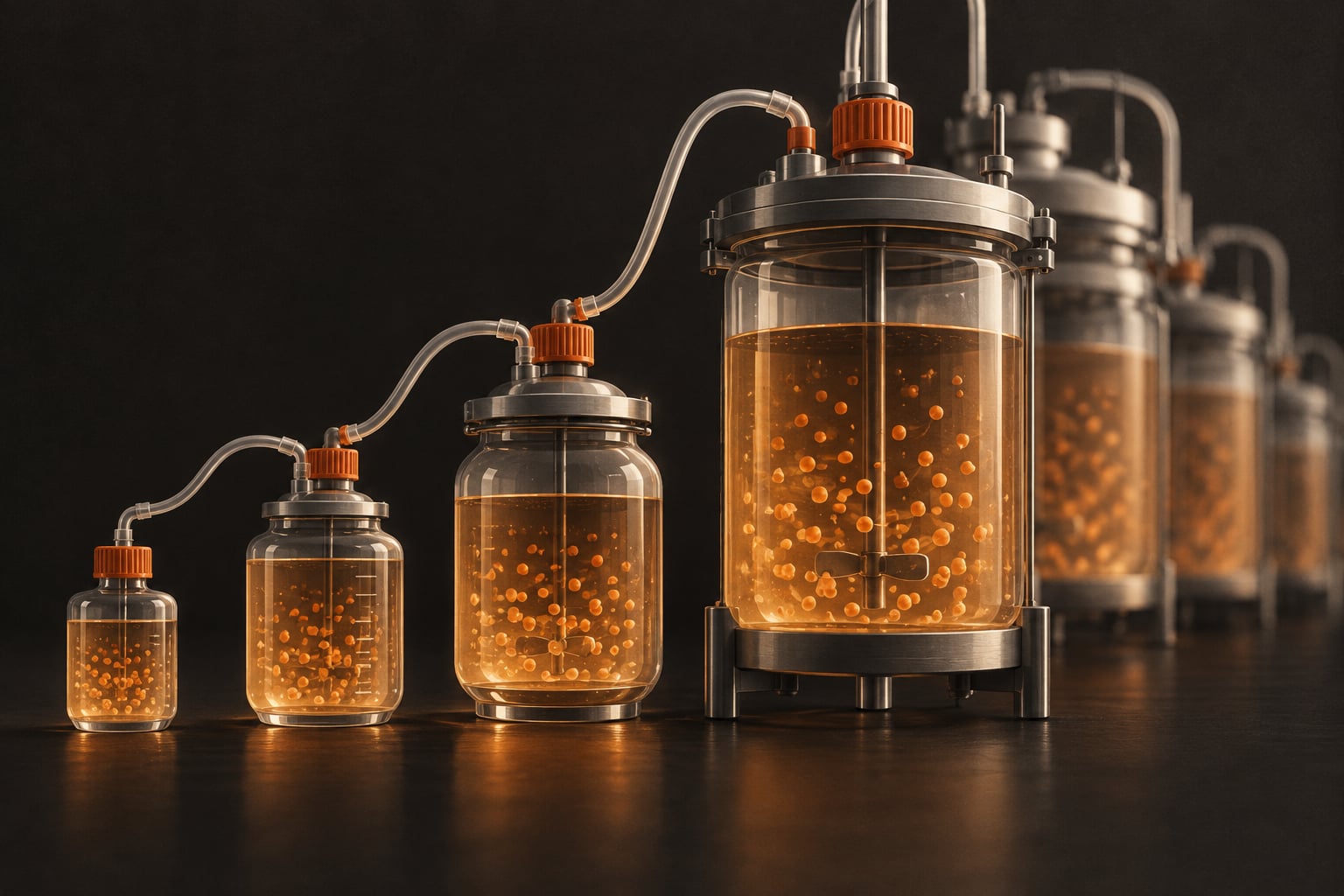
In May 2026, Japan’s CellFiber announced progress in its collaboration with Taiwan’s Locus Cell (樂迦再生科技). The announcement said that Locus was using CellFiber’s technology to establish a commercial-scale process for umbilical cord-derived mesenchymal stem cells, describing the process build-out as meeting GMP requirements. CellFiber announcement
The announcement concerns investment in processes and automation. Its GMP wording comes from the company and still needs independent verification or recognition by the relevant authority. It also provides no evidence of clinical efficacy or market sales for a specific product.
There is one part of this kind of collaboration I would want to examine more closely: when a technology is handed to another team for production, what must travel with the equipment and operating documents?
Pages 143–144 of the 2026 Biotechnology Industry White Paper map manufacturing and CDMO activity in Taiwan. Page 212 notes the Pharmaceutical Industry Technology Development Center (PITDC)‘s direction in building cell-culture process platforms and functional validation systems. These investments meet at the same task: establishing that each batch meets its intended quality requirements.
Developing and manufacturing cell products requires understanding how raw materials and processes affect product characteristics. FDA work on cell-therapy product characterization likewise identifies donor variation, culture conditions, and related quality assessments as areas for study. FDA cell-therapy product-characterization research
As culture is scaled up, a team must decide which conditions warrant monitoring, how much variation calls for action, and what records are needed so that someone who did not perform the work can understand what happened.
What does potency measure?
Viable cell count or cell viability can say something about a product’s condition. Assessing biological activity related to the product’s intended action, however, also involves potency testing.
FDA’s 2011 guidance on potency tests for cellular and gene-therapy products emphasizes that tests must be developed for the characteristics of the particular product. There is no single test or acceptance standard that can simply be applied to all products. FDA potency-testing guidance
The team first needs to understand which function the product is intended to retain, then establish a meaningful way to measure it. Obtaining a number and showing that the number adequately represents the function in question are connected by evidence that still has to be supplied.
Potency also cannot be treated as clinical efficacy experienced by patients. The former is one part of product-quality assessment; the latter requires appropriate clinical evidence. Conflating them asks a laboratory result to answer a question it cannot yet answer.
Handing over a test method alone is insufficient. The receiving team must understand why that attribute is tested and what a shift in its value may mean. If those judgments remain only with the original team, technology transfer is not yet complete.
When the process changes, which data still apply?
Scale-up may involve different equipment, sites, or operating methods. If those changes affect product characteristics, the parties need to assess whether the necessary comparability can be maintained before and after the change. Existing evidence cannot be assumed to apply in full simply because the product has the same name.
FDA’s 2023 draft guidance on manufacturing changes and comparability for human cellular and gene-therapy products discusses how to assess the effects of manufacturing changes. As of September 2026, it remains a draft; it is useful for understanding the agency’s approach to evaluating such changes. FDA draft guidance on manufacturing changes and comparability
Comparability does not mean that every measurement before and after a change must be identical. It means using appropriate data to assess the differences and their significance. The required extent depends on the product, the change, and the stage of development, and must connect with applicable regulatory requirements.
The data needed for comparison are best prepared before a change is made. If the original process did not leave an adequate baseline, options become limited when the new equipment is already running and the team starts looking backward. At final acceptance, the data that were not retained at the outset may no longer be recoverable.
After it goes to another team
A CDMO, or contract development and manufacturing organization, can take on different parts of process development, analysis, and production. The actual division of work still depends on the contract and each party’s capabilities. The same label does not mean every company supplies the same service.
Operating steps can be written down, but some judgments also need to be shared: which differences are acceptable, how deviations are investigated, and who must be notified when a critical raw material changes. Both parties need to understand these matters in the same way.
The ability to deliver data deserves a place in the contract discussion alongside price. Which original records can the sponsor obtain? How will analytical methods be transferred? If a partner changes later, can the necessary data move with the program? These questions shape longer-term choices.
Once a product leaves the factory, it still has to be stored, transported, and received. For cell products, these conditions should be part of product development and quality assessment. Acceptable times, temperatures, and handling methods must be supported by validation data for the individual product.
The clinical side also needs to know how to receive the product. If manufacturing and use sites understand preparation time, documentation, or handling differently, the overall delivery can fail even after the factory has completed production. These handoffs are worth rehearsing before the supply pathway is set.
Facilities and capacity make progress in scale-up visible. What is harder to read from an announcement is whether a new team can determine why a batch did not meet requirements, then produce the next batch to specification. That is the manufacturing capability I want to keep following.
Sources: 2026 Biotechnology Industry White Paper, Industrial Development Administration, Ministry of Economic Affairs, August 2026, printed pp. 143–144 and 212; FDA documents and the company announcement are linked in the text. The company’s progress is described according to its public announcement; the questions used to assess manufacturing collaborations are the author’s analysis.
- Keep a baseline
Retain the original process conditions, test methods and records.
- Assess process changes
Evaluate the effects of changes in equipment, site or operations.
- Complete the handover
Equip the receiving team to interpret results, handle deviations and meet delivery conditions.
A guide to this article’s manufacturing and technology-transfer questions. Potency is part of quality assessment; it is not the same as clinical efficacy in patients.

💬 Comments
Loading...