
“The moment we want to say who somebody is, our very vocabulary leads us astray into saying what he is.” Hannah Arendt, The Human Condition
TL;DR
Within a single week, two Silicon Valley podcasts independently put Taiwan at the center of their conversations. Investor Naval Ravikant concluded that the U.S. can’t hold the line and that Taiwan will eventually be absorbed. Anduril executive chairman Trae Stephens put the odds of a status quo change within ten years at above 90%, and said his company is investing heavily to make deterrence real. Their conclusions are opposite, but their move is identical: both are pricing Taiwan. This piece is not about who has the better forecast. It’s about how tech capital is renaming Taiwan: from a geopolitical news item into a risk asset you can bet on, discount, and allocate capital toward. A society should not live entirely inside someone else’s calculations.
Two Podcasts in One Week
In the first week of July, two Silicon Valley podcasts put Taiwan at the center of their conversations within seven days of each other. One was an open-ended long conversation with investor Naval Ravikant; the other was Uncapped with Jack Altman, featuring Trae Stephens, executive chairman of defense tech company Anduril. Neither was coordinating with the other. Both ended up in the same place.
What’s worth recording is not that Silicon Valley started talking about Taiwan. It’s that they started calculating it.
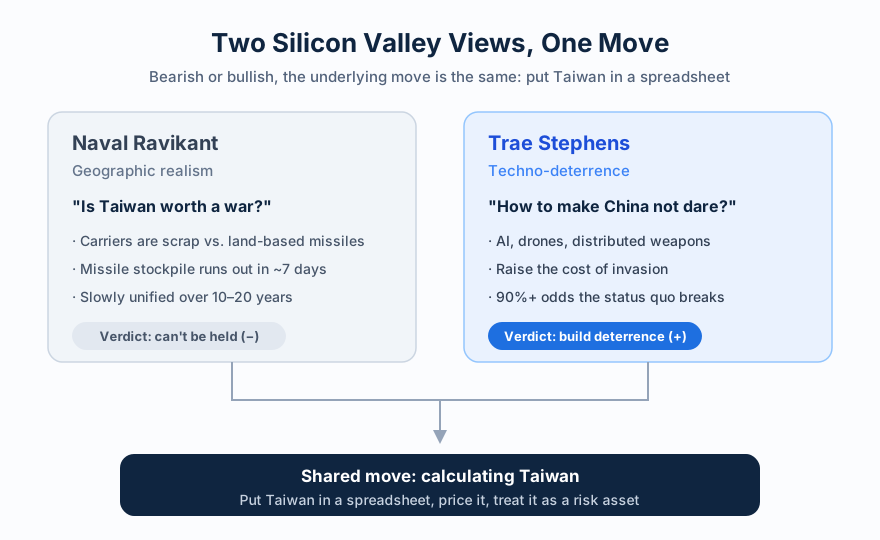
Talking and calculating are different things. When you discuss something, understanding it is still part of the intention. Once you start calculating, the question becomes: what is it worth, how high is the risk, can it be exchanged for something else? Silicon Valley’s relationship with Taiwan is sliding from discussion toward calculation. Naval calculated the cost of defense and concluded it wasn’t worth it. Trae calculated the feasibility of deterrence and concluded it was achievable, and fundable. Their numbers point in opposite directions, but they made the same move: they put Taiwan in a spreadsheet.
That’s exactly what Arendt’s sentence names. The moment you try to articulate who a place is, language pulls you toward describing what it is. Once you begin calculating a place, you tend to fix its “what” first: a cost, a probability, a risk. The “who” (the lives, history, will, and choices of the people there) gets quietly omitted from the model.
This is not an argument against calculation. Every country runs the numbers on every other. The real question is: who designs the model, and who decides which cell Taiwan goes into.
This piece is part of the AI and Human Order series.
Two Silicon Valley Frameworks, One Underlying Grammar
Naval’s position can be called geographic realism. He argued that aircraft carriers are effectively scrap metal against Chinese land-based missiles, that U.S. missile stockpiles would run dry after roughly a week of high-intensity combat, and that defending an island across the Pacific, nowhere near America’s doorstep, carries costs wildly out of proportion to the benefit. His conclusion: over the next ten to twenty years, Taiwan will be gradually unified in a process that lets all parties save face.
The words land hard, but the underlying evidence is softer than the delivery. His picture of Taiwan comes from a narrow circle of Taiwanese he knows: people who have the means to send their children abroad to avoid conscription, who anticipate a Hong Kong-style outcome, who figure they’ll make their money this generation and sort the rest out later. That’s the experience of a particular class. It cannot stand in for the will of 23 million people. He cites no research, no polling. Rounding the dispositions of a small group into a national choice is exactly where this kind of calculation is most dangerous: it makes impressions look like data and biases look like models.
Trae Stephens represents a different posture: techno-deterrence. When asked about the probability of a status quo change in the Taiwan Strait within ten years, he said above 90%. That number deserves scrutiny before you accept it. He bundles three very different scenarios under a single threshold: Taiwan being Hongkongized, the U.S. trading political concessions for supply-chain arrangements, and China launching a full-scale invasion. Define “status quo change” loosely enough, and meaningful change within a decade becomes almost obvious. Ninety percent sounds alarming. The problem is that the definition is too loose.
More rigorous public assessments separate capability, intent, and context. Former CIA Director Burns said Xi Jinping ordered the PLA to have the capability to invade Taiwan by 2027, and he was explicit that this does not mean a decision to attack has been made. CSIS ran 24 wargames of a Chinese amphibious assault; Taiwan survived most scenarios, but at severe cost, and Japanese involvement was often the decisive variable. The gap between possessing a capability and deciding to use it is enormous. Trae’s 90% compresses that gap into a memorable figure. His motivation isn’t something that needs to be guessed at, but it does need context: his company sells the solution to the risk story he’s telling.
Semiconductors: Where Taiwan Currently Can’t Be Rounded to Zero
What’s striking is that two diametrically opposed views converge on the same thing: semiconductors.
Naval acknowledged that companies like Anduril are rebuilding America’s manufacturing base, while noting it’s too slow to matter in a near-term crisis. Trae was more direct. He said America offshored chip manufacturing decades ago and since then has poured money into the “comparatively easy half,” design, while leaving the hard part, manufacturing, unaddressed. If that problem isn’t solved, every other analysis he offers falls apart, including his own vision of Taiwan Strait deterrence.
What Taiwan actually controls is that harder, less replicable half. Taiwan accounts for roughly 60% of global chip capacity, and advanced logic is even more concentrated: TSMC alone manufactures over 90% of the world’s most cutting-edge chips. This is the foundation of what’s been called the Silicon Shield, a term Tsai Ing-wen used in 2021 to capture the idea that global dependence on Taiwan’s advanced chips constitutes a form of deterrence in its own right.
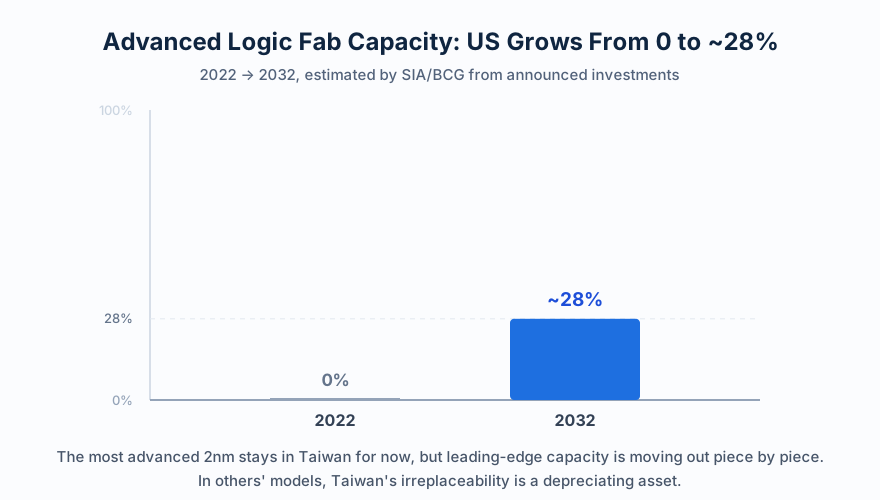
The irony of Taiwan’s renaming lives here. The Silicon Shield is real leverage. But it is being moved offshore, piece by piece. TSMC’s U.S. expansion, based on SIA and BCG projections from announced investments, is expected to bring America’s advanced logic wafer manufacturing capacity from 0% in 2022 to roughly 28% by 2032. The most advanced 2nm processes are still in Taiwan, for now. In someone else’s model, Taiwan’s irreplaceability is not a constant. It’s a depreciating asset. As long as the Silicon Shield holds, Taiwan can’t be rounded to zero. But every advanced production line that moves offshore lays another stretch of road toward that zero, in other people’s risk models. To be fair, dispersing production can also bind allies’ interests more tightly to Taiwan’s fate. When I say “depreciation” here, I don’t mean Taiwan’s capabilities automatically dissolve. I mean Taiwan is being repriced in other people’s risk models.
Strong Narrative, Hard Reality
Anduril is the template for all of this. In May 2026, it closed a $5 billion Series H, doubling its valuation to $61 billion, led by Thrive Capital and a16z. Its 2025 revenue was roughly $2.2 billion. Dividing valuation by revenue yields something around 28x (a rough figure, not the rigorous multiple used in public markets), but the direction is unmistakable: Silicon Valley investors are repricing defense tech. Defense is no longer just Boeing and Lockheed’s territory. It’s being treated as a new asset class you can build at software speed, on venture timelines.
The problem is that a valuation can be declared in a day. A solid-fuel rocket motor production line cannot be built in a day. In the same year as that fundraise, an explosion knocked out Anduril’s rocket motor test facility in Mississippi (reported by Wired in July 2026). More consequential was the schedule: Anduril had planned to begin serial production of rocket motors by July 2025. A year later, production had not started. The company said testing would resume within weeks and that production timelines were unaffected. But several people familiar with the program told Wired that this was among the most serious test accidents they’d seen in recent years.
This isn’t an occasion to take satisfaction in Anduril’s difficulties. Solid-fuel rocket motors are the heart of a missile, only two or three American companies can produce them, and the Pentagon’s stockpile deficit is severe enough that it’s relying on venture-backed startups to fill the gap. That fact alone says something about how hollowed out national industrial capacity has become. The point is the gap between narrative and delivery. Silicon Valley can accelerate certain defense technologies. It cannot grow a country’s complete industrial capability. If Taiwan’s defense planning assumes this Silicon Valley narrative will mature on schedule, Taiwan first needs to reckon with a basic distinction: narrative and production lines are different things.
What Those Two Podcasts Actually Left Out
The biggest gap in both podcasts wasn’t a miscalculation. It was that Taiwan itself was never at the table. Throughout both conversations, Taiwan was an asset being priced by two competing Silicon Valley frameworks: one saying it can’t be held, the other saying deterrence is achievable. But Taiwan’s own voice was absent. There was no room for it to push back.
The actual Taiwan is not this quiet. It is in the middle of a fierce internal argument about how to defend itself. Domestic drone production capacity jumped by an order of magnitude in a year; exports in just the first quarter of 2026 already exceeded all of the previous year. At the same time, a defense special budget of roughly NT$1.25 trillion was cut heavily by the opposition in May 2026, with domestic procurement slashed and U.S. arms purchases preserved; the Executive Yuan then introduced separate legislation to restore what was lost. The Kuma Academy is teaching civilians to operate drones.
These arguments look like noise. They are proof of agency. A society that has genuinely outsourced the question of “how do we survive” to someone else’s model doesn’t fight this hard over domestic production lines, arms procurement ratios, and civilian defense training. Taiwan is still fighting because Taiwan is still choosing.
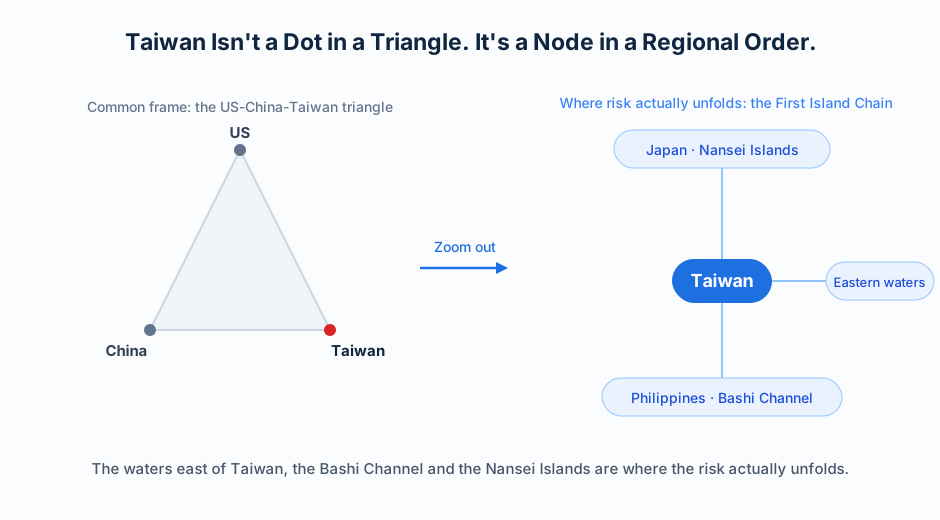
The map was also drawn too narrow. In both podcasts, the Taiwan Strait was reduced to a U.S.-China-Taiwan triangle, with Japan and the Philippines nearly invisible. But the real risk doesn’t unfold only inside that triangle. In June 2026, China’s Ministry of Transport launched maritime patrols in waters east of Taiwan under the banner of “maritime traffic enforcement,” with coast guard vessels in support (see RealClearDefense analysis; the Financial Times reported on China’s broader effort to assert claims over this stretch of ocean). Those waters connect the Bashi Channel, the sea north of Luzon, and Japan’s Nansei Islands. It is the backyard of Taiwan’s defense posture, and the place where the first island chain is under the most strain. Put Taiwan back on that larger map and it is no longer an isolated risk point. It is a node in a regional order. Whether Taiwan speaks of itself in those terms cannot be left to someone else’s model to decide.
Closing
Silicon Valley will keep calculating Taiwan. That’s not going to stop, and it isn’t necessarily a bad thing. Being taken seriously enough to calculate is at least better than being ignored.
The real danger is subtler. When someone else starts pricing you, you may slowly begin seeing yourself in their units: a cost, a probability, a risk. Eventually you forget that outside their spreadsheet, you are still someone.
Taiwan can be priced. It will not be only a price. It is a society that, to this day, is still deciding how it wants to exist. Whether Naval is too pessimistic or Trae too optimistic isn’t something Taiwan needs to spend energy proving. What matters is that the spreadsheet has a column that belongs to Taiwan, filled in Taiwan’s own language, with the equals sign pressed by Taiwan itself.
Takeaways
- Silicon Valley’s posture toward Taiwan is shifting from discussion to calculation. Naval uses risk discounting to argue the line can’t be held; Trae uses deterrence scenarios to argue it can. Their conclusions are opposite. Their move is the same: Taiwan as a priceable asset.
- Trae Stephens’s “90%-plus” bundles Hongkongization, supply-chain deals, and full-scale invasion under one threshold, a figure that’s easy to remember and easy to sell. Serious analysts discuss PLA capability by 2027, which is not the same as intent, and not the same as probability.
- Semiconductors are Taiwan’s current, non-negotiable leverage, but advanced capacity is being actively dispersed. SIA/BCG projects U.S. advanced logic manufacturing will go from 0% in 2022 to roughly 28% by 2032. The Silicon Shield is a depreciating asset, not a permanent constant.
- Anduril’s $61 billion valuation coexists with the Mississippi explosion and missed production timelines. Capital can reprice defense tech. It cannot grow a country’s manufacturing and delivery capability from scratch.
- Taiwan’s agency is real: the drone industry, the defense budget fight, civilian defense training, positioning along the eastern arc of the island chain. Taiwan is not merely a variable in someone else’s model. It is a society still choosing how it wants to exist.
References
- BlockTempo, “Naval: Taiwan Will Eventually Be Unified in 10–20 Years, the U.S. and China Need Not Go to War” (2026-07-04; a summary and commentary on both podcasts, a secondary source). Primary sources: Naval Ravikant Podcast (YouTube
6m-ZZBCiiEE, Taiwan segment from approximately 54:00); Uncapped with Jack Altman, Episode 35 (YouTubeNpUcRftC3k0). https://www.blocktempo.com/silicon-valley-podcasts-naval-anduril-trae-stephens-taiwan-risk-bet/ - Anduril official announcement, “Anduril Announces $5B Series H Raise” (2026-05-13). https://www.anduril.com/news/anduril-announces-usd5b-series-h-raise/. Valuation and revenue figures additionally from TechCrunch and Bloomberg (2026-05-13).
- Wired, “An Explosion Knocked Out Anduril’s Rocket Motor Test Site in Mississippi” (link provided by Paul; facts cross-checked against subsequent coverage). https://www.wired.com/story/anduril-mississippi-explosion-missiles-rocket-motor/
- Waters east of Taiwan: Financial Times, “China Steps Up Claims Over Sea East of Taiwan” (link provided by Paul); the June 2026 Ministry of Transport “maritime traffic enforcement” patrols described in RealClearDefense, “China Is Turning the Waters East of Taiwan Grey” (2026-06-22) and Taipei Times (2026-07-05). https://www.ft.com/content/6ac24ea6-50c2-4e25-92b7-79d52edc0b8b
- CSIS, The First Battle of the Next War: Wargaming a Chinese Invasion of Taiwan; former CIA Director Burns on PLA capability by 2027 as capability, not a decision to attack.
- Taiwan’s Silicon Shield and advanced process concentration: MIT Technology Review (August 2025); Tsai Ing-wen’s 2021 “silicon shield” framing; U.S. advanced logic capacity projections from SIA/BCG, “Emerging Resilience in the Semiconductor Supply Chain.”
- Taiwan drone industry and defense budget fight: The Diplomat (May 2026, July 2026); USNI News (November 2025); The Guardian (May 2026, on Q1 drone exports exceeding all of the prior year).
- Hannah Arendt, The Human Condition (epigraph: “The moment we want to say who somebody is, our very vocabulary leads us astray into saying what he is.”).
Image Credits
- Fig. 1, “Two Silicon Valley Frameworks, One Underlying Move”; Fig. 2, “Advanced Logic Wafer Capacity: U.S. from 0% to ~28%”; Fig. 3, “Taiwan Is Not a Point in the Triangle, It Is a Node in Regional Order”: all diagrams produced by the author. Data for Fig. 2 from SIA/BCG, “Emerging Resilience in the Semiconductor Supply Chain.”
- (Optional) First island chain map: U.S. Department of Defense Annual Report on Military and Security Developments Involving the People’s Republic of China, public domain, via Wikimedia Commons.
- (Optional) Podcast clips: official YouTube embeds (links above).

💬 Comments
Loading...