
TL;DR — Taiwan’s regenerative medicine divides into two paths, “regenerative medicine technique” and “regenerative medicine product preparation,” and the central competent authority under both laws is the Ministry of Health and Welfare. The TFDA and the Department of Medical Affairs are merely divisions of labor within the ministry; neither is the statutory competent authority in its own right. The CDE, which reviews cases every day, is not in either law at all; its authority comes from the ministry’s delegation under Article 16 of the Administrative Procedure Act. So a single matter in regenerative medicine means dealing with several agencies at once. You cannot ask everything at one window. This map places the sources and relationships of these powers side by side, to make it easier to judge which kind of question should go to whom.
Trying to work out where a regenerative medicine document should actually go, and which unit to ask, I read through the Regenerative Medicine Act and the Regenerative Medicine Product Preparations Regulations and drew a map of authority.
Drawing the map with AI is not hard. Regenerative medicine techniques go through the Regenerative Medicine Act, regenerative medicine product preparations go through the Regenerative Medicine Product Preparations Regulations, and each has article numbers to point to. The third box is the CDE, whose legal basis is not in either of these laws. The authorizing provisions of the two laws do not directly name the “Center for Drug Evaluation (CDE).” They say instead that “the central competent authority may entrust its subordinate agencies or delegate other agencies (institutions), juristic persons, or bodies to handle” the work. In other words, the law only authorizes delegation to a certain category of unit. As for who the work is actually delegated to, you have to go back to the delegation regime under the Administrative Procedure Act and to the delegation notices the ministry issues.
That brings us to the question this piece answers: the CDE, which reviews cases every day, what role does it play, and what is its legal basis?
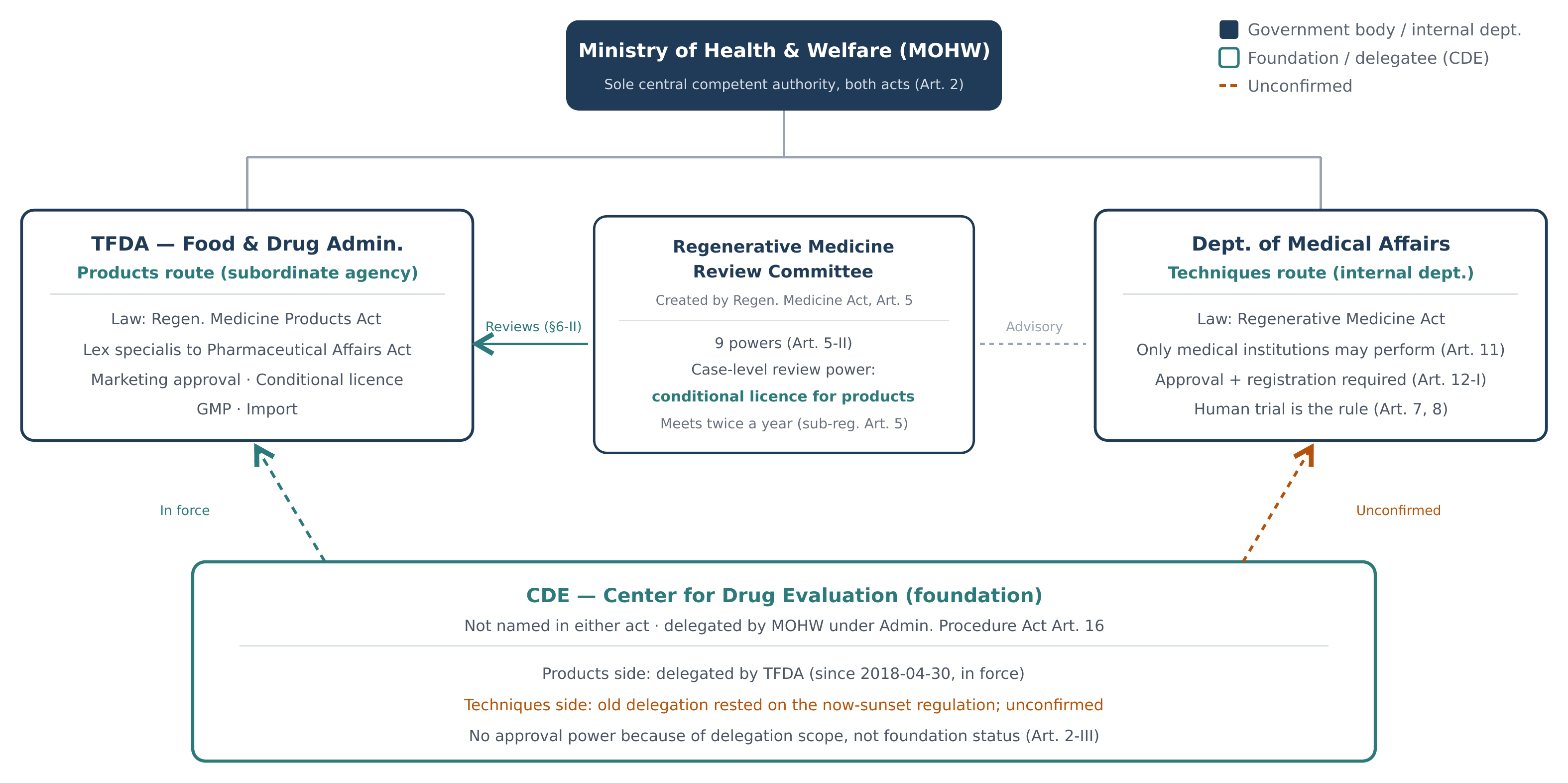
Here is the finished product first. The six sections below are the source for each cell in this map. The cell on the technique side is marked “to be confirmed,” and the reason is in the final section.
Who is the statutory competent authority? Both laws answer: the Ministry of Health and Welfare
Many people assume the TFDA governs product preparations and the Department of Medical Affairs governs techniques, so those are the competent authorities. That is not what the law actually says.
That sentence is right functionally and wrong legally. Article 2 of the Regenerative Medicine Act and Article 2 of the Regenerative Medicine Product Preparations Regulations each say the same thing: the competent authority under this Act (these Regulations) is, at the central level, the Ministry of Health and Welfare.
In other words, the statutory competent authority under both laws is one and the same. The FDA is a subordinate agency of the Ministry of Health and Welfare, and the Department of Medical Affairs is a department within the ministry. Neither is the “central competent authority” in law. When you set them side by side on the map as two equal boxes, what you are drawing is a division of labor, not a division of statutory authority.
The legal basis for that division of labor is clear enough. The latter part of Article 1 of the Regenerative Medicine Product Preparations Regulations says, “matters not provided for in these Regulations shall be governed by the Pharmaceutical Affairs Act and other relevant laws,” and Article 3, Paragraph 2 is even more direct: regenerative medicine product preparations “are drugs as provided under Article 6 of the Pharmaceutical Affairs Act.” In one sentence, regenerative medicine product preparations are pinned into the Pharmaceutical Affairs Act system, so they naturally fall to the FDA. The Regenerative Medicine Act, on the other hand, is the medical side; Article 11 provides that non-medical institutions may not perform regenerative medicine.
What power does the Regenerative Medicine Review Committee have? It sits in the technique law yet reviews product preparations
The most peculiar thing about the Regenerative Medicine Review Committee is that it is established under the Regenerative Medicine Act, yet it is responsible for reviewing conditional approvals under the Regenerative Medicine Product Preparations Regulations.
In other words, it stands where the two laws intersect. It does not belong exclusively to the “technique” line. The intuitive way to draw it is to place it on the Department of Medical Affairs line and label it “committee approval,” and both of those are wrong. Break down the nine categories of authority below and you can see where the error lies.
Under Article 5 of the Regenerative Medicine Act, the committee is organized by the central competent authority, and the statute only says it “shall have a number of members” (the figure of thirteen to nineteen comes from Article 3 of the subordinate Regulations Governing the Organization and Operation of the Regenerative Medicine Review Committee, not from the parent law). Its authority is listed in nine categories under Paragraph 2, seven of which are purely advisory: developing innovation and promoting policy, disseminating correct knowledge and understanding, improving patient safety and medical quality, cultivating talent, managing regenerative product preparations and regenerative techniques, evaluating implementation effectiveness, and other related matters.
Only two carry the word “review.” Category five is “consultation and review of research, development, and incentives and subsidies.” Category seven is review for granting conditional approval of regenerative product preparations.
The difference is that category five deals with subsidies and incentives, while category seven deals with whether a product can obtain conditional approval. The category that actually stands in an applicant’s way is category seven.
And category seven is the product-preparation side. Article 6, Paragraph 2 of the Regenerative Medicine Product Preparations Regulations writes the same thing from the other end: before the central competent authority grants a conditional approval, it must first pass review by the Regenerative Medicine Review Committee.
The “must” here is not a recommendation. It is a mandatory procedure in law. Without going through the committee’s review, no conditional approval can be granted.
The subordinate regulations add a figure. Article 5 of the Regulations Governing the Organization and Operation of the Regenerative Medicine Review Committee says: the committee’s meetings shall in principle be convened twice a year, and extraordinary meetings may be held when necessary.
Twice a year means that for a product going the conditional-approval route, the timeline has to account not just for the number of review days but for when this committee meets. Miss one, and in principle you wait another six months. The same article also requires members to attend in person, prohibits proxy appointments, and requires more than half of all members to attend before a meeting can be held. All of these affect the timeline, but they are meeting-operation rules written into the subordinate regulations rather than the review-timeline schedule, so you have to go dig them out yourself.
Article 7 of the same regulations is worth noting too: under the Freedom of Government Information Act, the preparatory work, the review process, and the names of the members and expert scholars are restricted from disclosure, and only the meeting minutes are made public. This is so that members can review without interference, so the submitting party will not receive a list of names, and you should know about this article going in.
As for a medical institution’s performance of a regenerative medicine technique, the authority to approve rests with the central competent authority, and the committee’s role on that line is only advisory.
The threshold for conditional approval itself, its five-year term, and its non-renewability, piece 3 has already worked through once, and I will not repeat it here.
So on what basis can the CDE review your case?
The answer is not in the Regenerative Medicine Act, but in the Administrative Procedure Act.
The CDE is a juristic person delegated by the Ministry of Health and Welfare to handle specialized review under Article 16 of the Administrative Procedure Act. Neither law directly establishes it. That it is not named in either law does not mean it has no legal basis.
Article 16, Paragraph 1: an administrative agency may, in accordance with law and regulations, delegate part of its authority to a private body or individual.
The CDE is the “private body” in this provision. It is a foundation endowed and established in July 1998 by the Department of Health, Executive Yuan (the predecessor of the Ministry of Health and Welfare), with no establishing statute of its own. There is a logic to this arrangement: the content of specialized review shifts with scientific progress, and allocating it through delegation is more flexible than amending an organic law each time. Article 16 of the Administrative Procedure Act is what provides that flexibility.
Article 16 contains three key phrases that all but determine the CDE’s legal position: “in accordance with law and regulations,” “part of its authority,” and “delegate.”
“In accordance with law and regulations” means the Administrative Procedure Act alone is not enough; there also has to be authorization in an individual substantive law as the basis. Such authorizations do exist in the two laws: Article 12, Paragraph 2 of the Regenerative Medicine Act (technique approval), Article 14, Paragraph 3 (cell-manipulation inspection permit), Article 18, Paragraph 4 (cell-bank permit), and the two advertising-approval provisions (Article 22, Paragraph 2 of the Regenerative Medicine Act and Article 15, Paragraph 2 of the Product Preparations Regulations).
“Part of its authority” means you cannot delegate the whole package out.
And the most crucial thing is the subject of the verb “delegate.” Read through the first three provisions one by one, and the sentence pattern is identical word for word: “the central competent authority may entrust its subordinate agencies or delegate other agencies (institutions), juristic persons, or bodies to handle” the work. The two advertising provisions are phrased slightly differently, using “the central competent authority or the agencies (institutions) or juristic persons it entrusts or delegates,” which presupposes the existence of a delegation rather than granting the power to delegate, but the logic is the same. In other words, what the law authorizes is that the Ministry of Health and Welfare may delegate, not a direct authorization to the CDE.
This is also the biggest difference in legal status among the three units. What the TFDA and the Department of Medical Affairs take on is authority the law directly allocates; what the CDE receives is authority the ministry carves out of its own powers and delegates. The law only says it “may delegate to a juristic person”; it does not say to whom.
Why can the CDE not approve? Not because it is a foundation
Many people assume the CDE cannot approve because it is a foundation. It is not that.
Article 2, Paragraph 3 of the Administrative Procedure Act provides: an individual or body delegated to exercise public authority is, within the scope of the delegation, treated as an administrative agency. In other words, the law does not prohibit the CDE from exercising public authority.
The reason the CDE has no approval power today is not that it is a foundation, but that the scope the ministry currently delegates to it only reaches technical review and consultation. The scope can be changed; the law does not block it.
This distinction matters in practice. Ask the CDE, and what you get back is an opinion. That opinion carries real weight and can decide whether you spend tens of millions to press on, but it is not an administrative disposition. If in the end you want to contest an outcome, you contest it against the competent authority that made the disposition, not against the delegated body that issued the opinion. When planning your timeline, “the CDE gave a favorable opinion” and “the competent authority approved it” must be treated as two separate things.
How do you look up the delegation notices? Findable on the product-preparation side, not found on the technique side
The conclusion first: the delegation basis on the product-preparation side is easy to find; the new notice on the technique side after the two laws took effect, I have not found yet.
Article 16, Paragraph 2 of the Administrative Procedure Act gives you a handle to look this up yourself: upon delegation, the delegated matters and their legal basis must be published and printed in the government gazette or a newspaper. In other words, what exactly the Ministry of Health and Welfare has delegated the CDE to handle is, in principle, findable.
The product-preparation line is clear. Starting April 30, 2018, the FDA delegated to the CDE the review of technical data such as drug clinical trial protocols and registration. In February 2026, the CDE itself even published statistics on the results of the IND, BSE, and NDA technical-data assessments it carried out under FDA delegation for fiscal year 2025, proving this delegation is still running. And because Article 3, Paragraph 2 of the Regenerative Medicine Product Preparations Regulations has already characterized regenerative medicine product preparations as drugs under Article 6 of the Pharmaceutical Affairs Act, this older delegation naturally covers them. Since regenerative medicine product preparations are, by law, drugs, the delegation originally aimed at drug technical review also applies to them. This cell is filled.
The technique side takes more work. What you can find is Wei-Bu-Yi-Zi No. 1081660965A (March 7, 2019), a notice of guidelines related to cell therapy techniques, which states that cell therapy technique review is administered by the Ministry of Health and Welfare and delegated to the Center for Drug Evaluation foundation to handle related matters, later amended to the January 2022 version. The CDE’s own website also says it accepts delegation from the Ministry of Health and Welfare to conduct review work.
The problem is that the legal basis of that delegation was the Special Management Regulations, which have sunset along with the two laws taking effect.
I did find one technique-side delegation notice from the new-law era: Wei-Bu-Yi-Zi No. 1151662584 (March 30, 2026), delegating, under the Regulations Governing the Management of Regenerative Medicine Techniques and Designated Product Preparations, the handling of certification work related to clinic regenerative medicine. But the delegated party in that notice is the Joint Commission of Taiwan, not the CDE.
As for whether, after the two laws took effect, the Ministry of Health and Welfare has re-published a delegation of regenerative medicine technique review to the CDE, I have not found it. Not finding it does not mean it does not exist; the notice could be tucked into a corner I have not turned over. But leaving this cell blank as it stands is more honest than filling it with an answer I reasoned my way to.
Why it is so hard to trace a document back to its legal basis
In the course of our dealings with the competent authority this year, we sent over questions about GMP and GTP, and the reply we got was that this was not within their purview and that we should ask the FDA. In the same reply, they cited the CDE’s opinion on what level a clinical-trial phase should reach.
There is nothing wrong with the reply itself; the two things each have their own basis. Manufacturing standards for product preparations belong to the Pharmaceutical Affairs Act system and were never on the medical-technique line, so pushing them back to the FDA follows the law. The CDE’s opinion appears here because it serves both sides, and what it gives is an opinion, not an approval or rejection, to begin with.
The difficulty lies elsewhere. A document answers you only within its own scope of authority; it will not, in passing, explain which cell the thing it pushed away and the opinion it cited each stand in. This is no one’s oversight. That is simply how official documents are written, and each unit can only speak to the part it governs. But it means no one is obligated to piece together the cross-unit map for you. You have to go back and read the provisions and the notices one by one yourself. That is what this map is doing.
Where the power comes from decides who you should ask
What this map really draws is where each unit’s power comes from, not who matters more than whom.
The TFDA’s and the Department of Medical Affairs’ authority is written into the law; changing it takes a legislative amendment.
The CDE’s authority comes from administrative delegation; it can be adjusted by notice.
This difference directly affects two things: who a document should go to, and what the answer you get back represents. Send a question that was only after a technical opinion to the competent authority, and what you usually get is an administrative-procedure reply. Conversely, take the CDE’s technical opinion as the competent authority’s approval, and you still will not clear the formal approve-or-reject hurdle in the end. Half a year into the two laws, the CDE’s position on the product-preparation side has the Pharmaceutical Affairs Act behind it and is quite stable. If you really need to confirm the technique side, asking the handling unit directly is faster than reasoning backward from public records.
I only wanted to know where a document should go, and I ended up redrawing the entire structure of authority.
One cell on the technique side is still blank; for now I cannot find a delegation notice from the new-law era, and rather than guess, I would rather leave it empty. When I find it, I will fill it in.

💬 Comments
Loading...