TL;DR
Large language models turn the regularities in language into numerical relations, but this does not mean they have grasped the full meaning of language in life. Seen through Wittgenstein’s language games, digital fortunes are not about letting AI answer life’s questions on our behalf. They let model-generated text pass through human judgment, interface ritual, and user interpretation to return to concrete life.
This piece is part of the “Intelligence and Order” series.
I graduated from seminary in 2003. On one hand I worked as a text editor at the Bible Society in Taiwan, and on the other I did financial trading with friends. Back then we greatly admired Soros. At the London School of Economics, Soros had chosen Karl Popper as his mentor, and his trading philosophy was deeply shaped by Popper’s thought. To understand Soros, we forced our way through Popper and some related philosophical works, and from there we eventually read all the way to Wittgenstein.
What began as a wish to understand how Soros viewed markets gradually stretched into a larger question: how do people know the world, and how do they use language to describe the world they know? We believed the Holy Grail of trading was to be found here.
Wittgenstein’s view of language underwent an important shift between his early and later periods. That shift happens to be useful for thinking about large language models: have we actually “turned language into mathematics,” or have we only “turned certain regularities in language into a computable form”?
In the early Tractatus Logico-Philosophicus, Wittgenstein understood language as a picture of the world. A meaningful proposition can describe the world because the proposition and the fact share a certain logical form.
If I say “the cup is on the table,” the sentence is meaningful because it depicts a state of affairs that may or may not hold.
At this stage, Wittgenstein was concerned with the logical limits of language: what can be clearly stated, and what merely looks complete grammatically while having no corresponding fact? The task of philosophy is to clarify the logical structure of language so that people are not misled by its surface forms.
This kind of thinking is close to a certain image people have of artificial intelligence: as long as we can decompose, encode, and formalize language, we might convert human thought into mathematical computation.
Large language models have indeed accomplished a large part of this. Text is split into tokens, tokens are represented as vectors, and the relations between sentences are computed through vast numbers of parameters and probability distributions.
But there is an important correction here. Large language models do not fully translate natural language into “mathematical logic.” They mainly convert the statistical relations in language into numerical structures, then predict the probability of the next token appearing in a given context. What they grasp is an extremely complex set of linguistic regularities, which is not the same as having grasped the full meaning of language in life.
This difference is precisely the problem that the later Wittgenstein cared about.
Meaning Lies Not Only in Signs, but in Use
By the time of Philosophical Investigations, Wittgenstein no longer believed that all language could be reduced to a single logical structure. He began to turn his attention from “how language corresponds to the world” toward “how people actually use language.”
The meaning of a sentence cannot be determined by its literal wording, syntax, or truth conditions alone. To understand a sentence, one must also know in what situation it was said and what the speaker was doing.
For example:
It’s cold outside.
This sentence can be a weather report, or a reminder to put on a coat. It might be a hint to close the window, or a roundabout way of saying one would like to go home. The sentence does not change, but it accomplishes different actions in different situations.
Language, then, is not merely a set of signs for describing facts. Speaking may also be commanding, inviting, warning, comforting, promising, praying, joking, testing, or bidding farewell. Wittgenstein reminds us not to rush to ask for the common essence behind all language, but to observe what language actually does in human life.
This is the basic direction of “meaning as use.” It does not say that a word can be used arbitrarily, but that word meaning exists within a set of recognizable, learnable, and correctable practices. The Stanford Encyclopedia of Philosophy’s account of Wittgenstein also notes that language games are not a closed set of definitions but a way of understanding language from concrete use.
For me this was never merely an abstract philosophical problem.
I worked as a text editor at the Bible Society in Taiwan for about ten years, handling large amounts of New Testament and Old Testament text. A single word often had to be traced back to Greek, Hebrew, and English, examined through several rounds of cultural investigation, checked against the commentaries at hand, and only then decided by the editorial team as the Chinese rendering best suited to convey it.
But returning to the original text does not mean the meaning will surface on its own. Word meaning, context, the tradition of commentary, and the editorial team’s understanding all take part in the final expression. Language does not take a fixed meaning out of one container and pour it into another. Translation is itself a language game with rules, judgment, and shared practice.
Over the past half year, interacting heavily with large language models every day, I have felt another side of this. As I use the models to work on text, I am also reshaped by text. Once a question is phrased differently, its shape may change with it. The same matter placed in a different narrative shifts my understanding and judgment too.
Yuval Noah Harari, author of Sapiens, argues that humans can create and collectively believe in stories, which lets them organize large-scale cooperation. But this ability has its flip side: this story-telling organism is also bound by language. We understand the world through stories, and we may only be able to see the world that the story’s frame permits us to see.
Language Games: Speaking Is Also an Action
Wittgenstein used “language games” to describe how language is interwoven with activity. He called them “games” not because language is unserious, and not because all speaking is entertainment, but because language, like a game, can only be understood within some set of rules and practices.
A chess piece, taken away from the board, the rules, and the activity of playing, is merely a block of wood. Likewise, a word entirely detached from the situations in which people use it is only a sound or a sign.
The character “籤” (a divination lot) is one example. Apart from its cultural background, it may be just a strip of paper or wood with writing on it. Once it enters the language game of drawing lots, it can become an omen, a reminder, a comfort, a warning, or a medium for rethinking a problem. Its meaning is determined not by its material, but by how people draw, read, interpret, and respond to it.
Different language games also have different criteria. In scientific research, a claim requires evidence, method, and reproducible verification. In poetry, a line may hold power through its imagery and multiple meanings. In a situation of comforting someone, what matters may not be whether a proposition is precise, but whether it makes the other person feel understood.
If we judge poetry by the rules of a scientific report, or judge a medical diagnosis by the rules of poetry, we confuse the language games.
This is also the line the fortune site must hold. If a fortune is taken as a verifiable prediction of the future, it easily falls into disputes over truth and accuracy. But if it is understood as a reflective language game, the questions change:
・How does this sentence interrupt the user’s existing train of thought?
・How does it give provisional form to a question not yet clearly stated?
・And how does the user carry an unfamiliar sentence back into their own life?
A Language Game Is Not Only Rules, but Also a Form of Life
A language game cannot stand on a rulebook alone. It always rests on a larger fabric of culture, habit, and shared living. Wittgenstein called this background the “form of life.” People know what a promise, an apology, a plea, or a joke is, not merely because they learned word meanings, but because they live in a world with corresponding relationships, institutions, feelings, and behaviors.
Drawing lots is the same. It includes not only a fortune poem but also such activities as “coming in with a question,” “settling the mind,” “drawing,” “reading,” “interpreting the lot,” and “carrying the words back into life.” Together these steps constitute the form of life of drawing lots. If only the fortune text is kept while the process of asking, waiting, and interpreting is removed entirely, the character of the language game changes accordingly.
The digital fortune site rearranges an existing form of life:
- The temple space becomes a digital interface.
- The shaking of the lot container becomes clicks and animation.
- The randomness of the lot cylinder becomes programmatic selection.
- Traditional allusions are converted into quieter, modern plain speech.
- The role of the lot interpreter is shared among human editors, algorithms, and the reader.
So it does not transplant traditional lot-drawing onto the internet unchanged. It creates a digital language game with a “family resemblance.” It resembles traditional lot-drawing, yet is not entirely the same.
Rule-Following: Do Models Really Understand Linguistic Rules?
Language games lead further into Wittgenstein’s famous problem of “rule-following.”
If someone acts according to a certain rule, how do we know that they truly understand the rule rather than happening to produce the same result? Any finite series of behaviors seems to be interpretable by different rules. A rule itself does not, like a railway track, automatically determine every correct future step. It must be applied, judged, and corrected in ongoing practice.
This problem becomes especially interesting when applied to large language models.
A model can complete sentences, imitate styles, answer questions, and in most cases produce text that fits grammar and situation. Judged by outward performance, it can clearly take part in human linguistic activity. But its “correctness” comes mainly from training data, feedback mechanisms, generation conditions, and human evaluation. A model cannot, on its internal numbers alone, permanently decide what counts as appropriate, honest, offensive, comforting, or wise.
In other words, a model can carry on the regularities in language, but it cannot establish language’s public criteria on its own. What counts as a good answer, a mistaken reading, or dangerous advice still has to be judged by human practice.
I tried generating fortunes with different models. Some texts were logically coherent yet read awkwardly in the original Chinese (for example, Fortune No. 200: 「看他們睡得多不客氣。」— roughly, “Look how impolitely they sleep.”). The models would even fabricate words of their own, forming sentences that do not match the feel of everyday Chinese.
This shows precisely that text which is probabilistically possible has not necessarily entered shared human linguistic practice. What human editors do is not merely to polish the text, but to judge whether a sentence can hold up within our language game. Humans are not decoration outside the generation process. They are part of what sustains the rules of this language game.
But Fortune No. 381, 〈老農疏果〉(“The Old Farmer Thins the Fruit”), is an interesting example. It is the original text kept entirely as the model generated it, in the original Chinese:
青果滿枝粒粒惜
老農一剪七成空
粒粒盡留粒粒小
留三分力過寒冬
(Roughly: “Green fruit crowds the branches, each one dear; one snip of the old farmer clears seven in ten; left too full, each fruit stays small; keep a third of your strength to pass the winter through.”)
The heart of the fortune is a single line:
數一數,你的枝頭掛幾粒。
(Roughly: “Count them: how many hang on your branch?”)
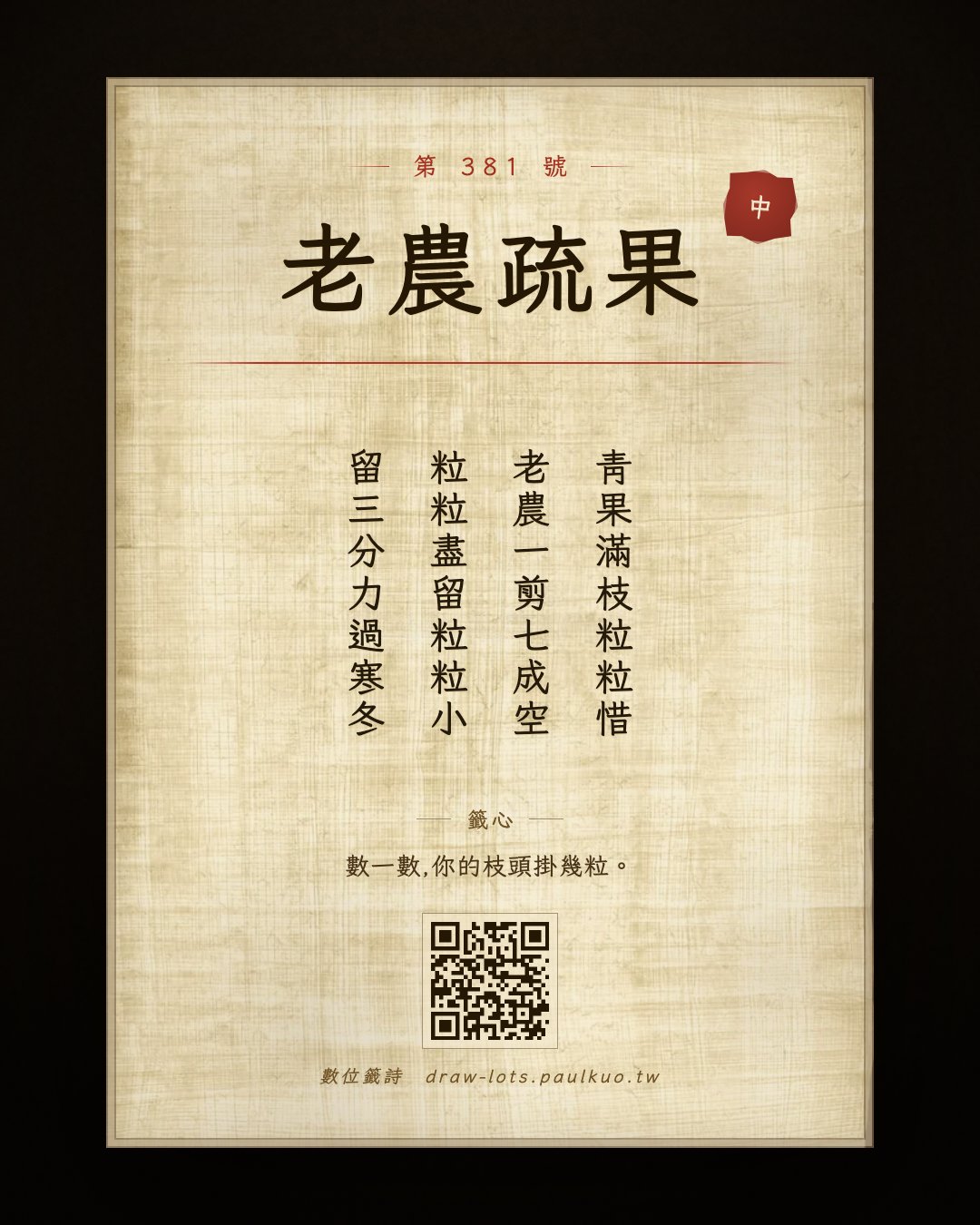
A friend, uncertain about the direction of his life, drew this fortune, and after reading it told me: “Very accurate.”
This “accuracy” cannot prove that the model understood his life. The model did not know what he was facing, nor did it choose a direction for him. What happened was that the metaphor of “thinning the fruit” entered his situation: if you cannot bear to let anything go, perhaps not a single fruit on the branch will grow well.
The fortune did not carry in advance an answer belonging only to him. It offered a linguistic form that let a question not yet clearly stated become visible. This is exactly the concrete moment in which “meaning forms in use.”
Digital Fortunes as a Language Game Played Jointly by Human and Machine
From Wittgenstein’s angle, what is worth discussing about digital fortunes is not whether the machine can prophesy, but how the machine is placed within a linguistic activity that humans already have.
A large language model converts past language use into numerical relations, then generates new sentences from those relations. But the meaning of a fortune is not sealed inside the model’s parameters. It has to wait until someone comes in with a question and passes through pausing, drawing, reading, and association before it takes effect in concrete life.
The forming of meaning is therefore not one-directional:
Human language → mathematical representation → model computation → fortune text → user interpretation → back to life
The first half is the computation of language; the second half is the use of language. The model deals with how language might continue. The person deals with how this sentence deserves to be understood at this moment.
The experiment this fortune site carries out is not “letting AI answer life’s questions,” but this:
When human language is converted into mathematical relations, then recombined by a machine and sent back into human life, where does meaning happen anew?
Seen from the standpoint of Wittgenstein’s language games, the answer lies neither inside the model nor solely in the fortune text. Meaning happens where people, machines, cultural rules, interface ritual, and actual life meet one another.
This is where digital fortunes take on philosophical significance, and it is also the surprise I found in designing this site. Everyone is welcome to come and play.

References
- Ludwig Wittgenstein, Tractatus Logico-Philosophicus, especially proposition 4.01.
- Ludwig Wittgenstein, Philosophical Investigations, especially sections 23, 43, 201, and 202.
- Stanford Encyclopedia of Philosophy: Ludwig Wittgenstein
- Yuval Noah Harari: Why humans run the world
- George Soros on Karl Popper’s influence on him
- Digital Fortunes: About
💬 Comments
Loading...