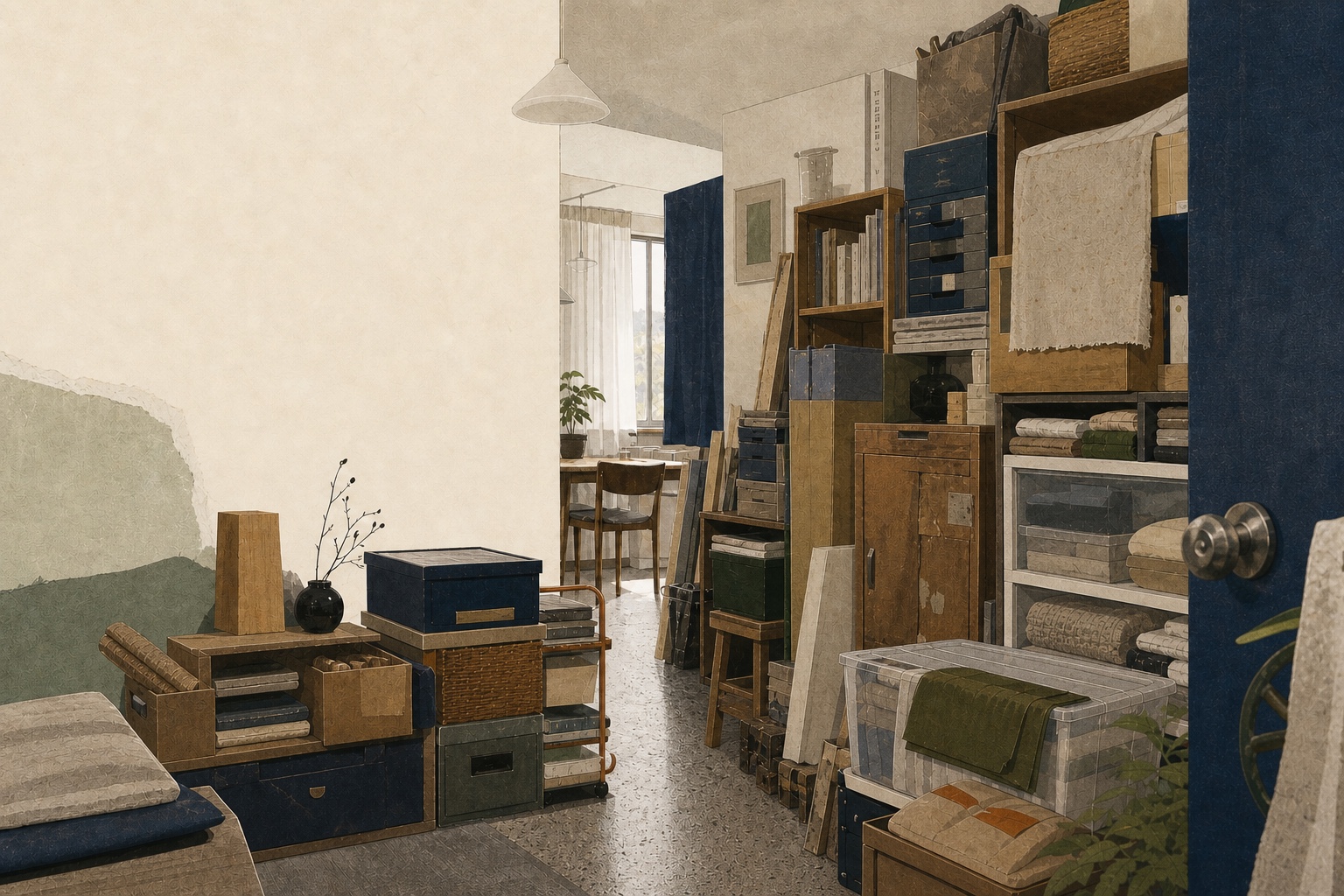

A father had bought more than ten books on storage. He himself supervised the building of a four-story townhouse. There were five people in the household, yet far more rooms than they actually needed. He had truly followed the books and tried, and had once stayed up all night organizing. The next day, looking back, the house “didn’t seem much improved.” Later he brought in a professional team, who came in over several visits, before the floor was cleared.
This case cannot by itself prove that storage knowledge is useless, but it can first rule out a common assumption: a home becoming messy is not necessarily because people do not know the methods. When the quantity of objects exceeds what the space can bear, knowledge, floor area, and willpower may all fail to close that gap.
Extra rooms only mean hitting the wall later
When people see clutter, the first instinct is usually that “things have not been put away properly.” Following that instinct, the solution becomes adding cabinets, buying storage boxes, and learning how to fold clothes. This set of methods works when the quantity of objects is still below the capacity of the space. Once quantity exceeds capacity, the logic reverses.
Storage products themselves are also objects. When a shelf unit is placed in a room, the usable space of the room first loses a piece; if the things being stored have not decreased, the result is only that “things don’t fit” becomes “things don’t fit, and there is one more cabinet.”
Homes with extra rooms do not escape this rule; they only postpone the moment the problem is noticed. Extra rooms offer more corners for “put it here for now,” but they do not automatically make people buy less. Once things are scattered across floors, they may also lose a fixed place: today here, tomorrow moved to another room, until every room becomes a new dumping point.
A surplus home grows new dumping points on its own
After objects exceed capacity, a household often forms a very stable set of behaviors. The wardrobe is full, so clothes hang on the doorknob; clutter piles in front of the cabinet doors so they will not open, so the clothes needed soonest are moved to the bedside; the bedside will not hold more, so another drawer unit is bought, and stacking continues onto the top of the cabinet.
One four-ping room followed this path to the end. A single bed, a storage cabinet stuffed with clothes, a wardrobe that would not open, clothes hanging behind the door, plus a chest of drawers and two three-tier cabinets: objects stacked nearly to the ceiling. The door was blocked by the cabinets behind it; a person had to turn sideways to enter.
It was not that no storage behavior had occurred in this room. Bags went on the chair, papers on the bags, towels over the papers, clothes stacked on top, and on the very top small things bought at the market. Each layer had once been a serious attempt to organize; together they made a door that would not open.
Reduction first, then storage can take effect
Storage skill is not the enemy; only the order must not be reversed. In a family workshop that had been closed for years, the organizing team did add four chrome steel racks, but the racks came in only after large furniture had been cleared in volume and circulation paths had been readjusted. In the first four days this household produced twenty-three bags of trash, including eleven large pieces of furniture. If the racks had been bought first, they would likely have become only a fifth dumping point.
Another homeowner, who had just ended a long period of caregiving and was herself after chemotherapy, found after organizing that the study’s original two shelf units were no longer needed, took them down, and left the wall empty without rushing to add new storage products. That inventory recorded twenty-eight bags of trash, thirty-six bags of recyclables, and fifty-eight bags of items given away, plus one and a half truckloads of haul-away. When total object volume fell, the need for storage products fell with it.
These figures come from individual organizing cases, not a sample survey of ordinary households. What they can support is an observation about sequence: deal with total object volume first, then judge how many containers are still needed; if a solution increases the total number of objects in the home, it is hard for it to truly solve surplus.
Manage what comes in the door first, then talk about where it goes
After a home has been organized, what is most easily left behind are “put it back when you finish using it” and “every object has a place.” These rules address stock already in the home and depend on everyone carrying them out every day. Another rule closer to the root is not repeatedly buying things with the same function. It addresses flow that has not yet entered the door, and one person can decide at the moment of purchase.
This is not a demand that people refuse all new objects. It is that before an object comes in the door it first pass one judgment: does the home already have the same function? Will this thing actually be used? If the answer is unclear, not adding one more piece is often more effective than later buying another box.
The first site of the circular economy is in fact before objects have been thrown away. It first asks us to see what the home already owns, then decide which objects to keep, repair, pass on, or return to the material stream. Storage deals with location; reduction and circulation deal with the fate of objects.
A home becomes truly usable not because every object has been hidden, but because what remains has a clear use, and what leaves has a next destination. Cabinets can help, but they should not be used as a substitute for deciding.

💬 Comments
Loading...