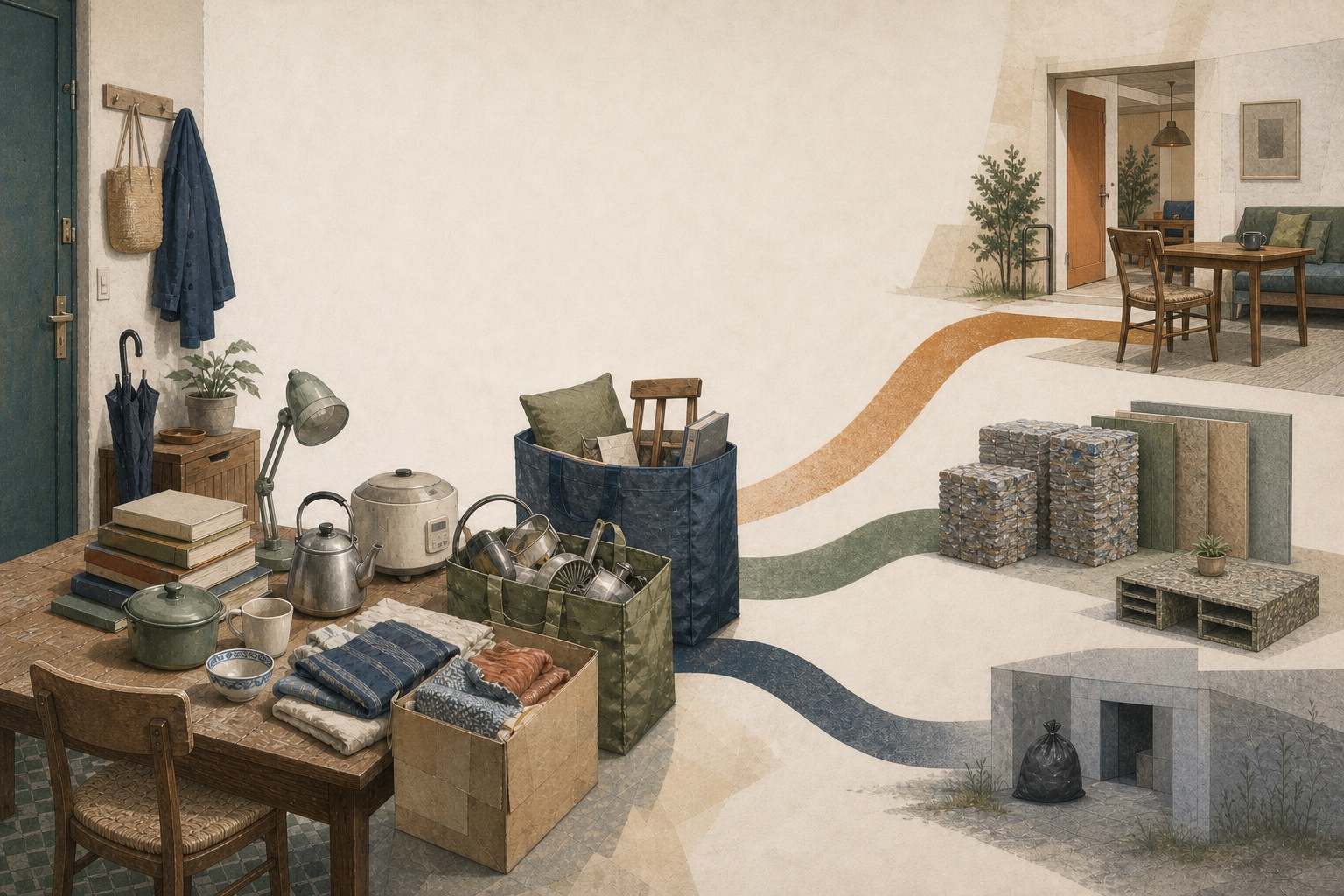

After ten households finished decluttering, the lists added up to five hundred eighty bags. Trash: two hundred nineteen bags. Recycling: one hundred sixty-six bags. Items for reuse: one hundred ninety-five bags. Converted, trash was about 37.8 percent; recycling and reuse together were about 62.2 percent.
These figures cannot stand in for ordinary households. All ten were cases with a professional organizer on site, and the sources, household structures, and scope of work were not the same. They can, however, open a distinction that is often missed: items described as hoarded do not all have to go on the garbage truck.
The one hundred sixty-six bags of recycling had mostly finished their original use and could only return to the material stream. The one hundred ninety-five bags for reuse still had a chance to keep being used in someone else’s life. Both left the original home, but they represent different states of the object.
Hoarding does not only occupy space; it also cuts off circulation
When people say a home is hoarded, they usually think first of narrower hallways, things that cannot be found, rooms filled up. Those are costs the occupant is already bearing. From a resource view there is another ledger: a still-usable object left in place is not being used, and it is not substituting for a new purchase.
The object has already consumed raw materials, manufacturing energy, and transport. Once it enters the home, if it is only pushed inward and stacked higher, its value is as if temporarily frozen. In the first years of sitting still it may still be intact; only after it sits long enough do chemical, specification, and environmental wear gradually take away its reusability.
So “keeping it is greener than throwing it away” holds only when the object will still be used. If something has not been opened again since the day it came through the door, the difference between keeping and discarding may be only that the trash appears a few years later.
The household with the most reuse bags left behind intact things
The household with the highest reuse volume was a long-term caregiver’s home. After the mother died, the occupant cleared fifty-eight bags of items for reuse, including a television, a TV cabinet, unused kitchen goods, excess consumables, and small appliances that had not been used for a long time. Many things were well kept, packaging still on; the home simply had no adequate outlet after years of accumulation.
Another household with three children cleared fifty-four bags for reuse, including large furniture and a basketball hoop. There were twenty or thirty boxes of assembly toys, some still unopened. For these objects the problem was not immediate damage; the household’s need to use them had already ended.
An four-ping room yielded eighteen bags for reuse, including six bags of clothing and fifty umbrellas; trash was only four bags, recycling one. A family workshop that had been closed for years donated large quantities of stickers, printer paper, and complete encyclopedia sets to a nonprofit. In place they were clutter; in the next use setting they became resources again.
This does not mean every object can be sent on smoothly. It only means that between “still usable” and “already without value” there is still a circulation process that has to be handled.
Sending things on requires a recipient, a channel, and time
For an object to re-enter circulation, at least three conditions are needed: someone willing to take it, a suitable channel, and the transfer completed while the object is still usable.
A room sealed for years yielded fifty-one bags of trash, zero bags of recycling, and one bag for reuse. The occupant was extremely reluctant to discard; the children’s textbooks and workbooks were all kept, yet after years of sealing most items had lost usability. The scope of this decluttering was also limited: the occupant would not allow items to be moved freely, and the site did not have enough conditions for a complete sort. Zero bags of recycling therefore cannot be read as this home having no recyclable material at all.
In another case, a young occupant sorted two large bags of items, almost all of which were checked by a cohabiting mother and taken back to her own room. On the list they were recorded as reuse, but they never left the building. Changing rooms is not completing circulation; the object must actually leave its original pile and keep being used in the next place.
So the combined 62 percent across ten households cannot automatically be translated as “62 percent became someone else’s resource.” It is only the classification record these ten households left at that decluttering, at that point in time. Reuse proportions varied widely among the ten; the total cannot replace each household’s actual conditions.
Circulation begins by finding the object a next node
Home decluttering often hands the last step to the garbage truck. That is efficient, but it flattens every difference among objects before they leave the house. Furniture that still works, unused goods still in packaging, clothes that can be passed on, and things that are already moldy or expired should not sit in the same judgment.
Real circulation needs someone to inventory first, then arrange destinations by the state of each object. What is fit for reuse seeks a recipient; what has finished its function but still has material value returns to the recycling system; only what is unfit to pass on goes to final disposal. The order is not so that every object is kept, but so that every object, before it leaves its place, receives one appropriate judgment.
Circular economy is not turning “don’t throw it away” into a new moral pressure. What it has to handle is whether, while an object still has value, the household has a visible outlet; and whether, after it truly loses use value, there is a responsible material or disposal path.
An object remaining at home does not mean it is being cherished. Whether it can, while there is still time, reach the next place that needs it is the evidence that cherishing actually happened.

💬 Comments
Loading...