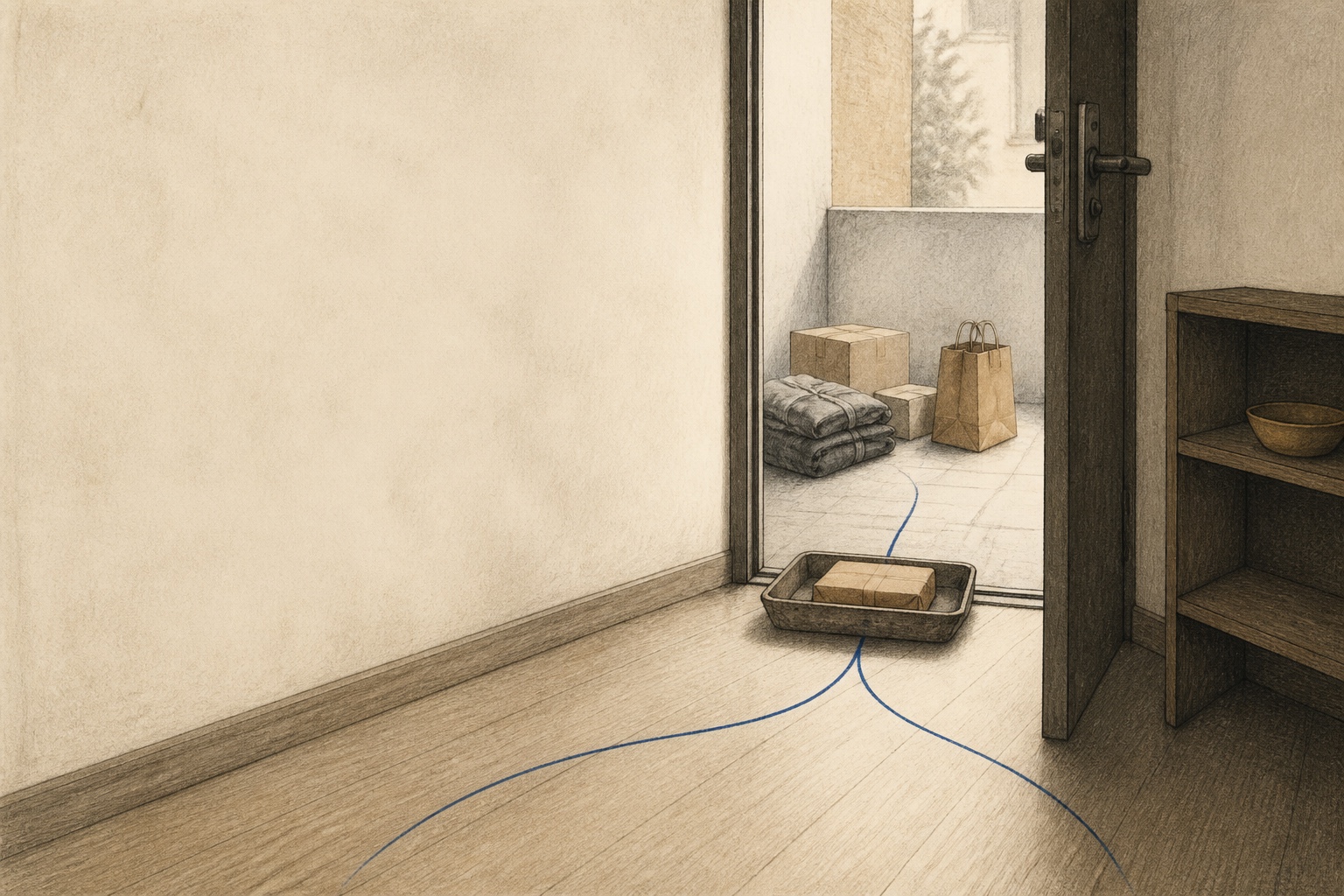

When many people start organizing, the first impulse is to find a larger cabinet, a better box, or to set aside a full weekend to reclassify what has already entered the home. These methods sometimes help, but they treat stock, not flow. As long as new objects still come in the same way, organizing becomes periodic rescue.
So besides asking “how should we store this,” it is worth asking first: “what is allowed to come in?” This is not turning the home into a checkpoint, and it does not require every object to pass a strict review. It is leaving one judgment point that can be looked back on before the object enters.
The entrance decides how much management cost you pay later
After an object comes through the door, it usually needs more than a place to sit. It may need cleaning, upkeep, searching, moving, and finally a decision to pass on, reuse, recycle, or discard. At the moment of purchase the price is most visible; the later costs are scattered through daily life and are hard to see together.
The source material compiled a household-object case: ten households together sorted out five hundred eighty bags of objects, and only a portion was finally judged to be trash. That figure cannot be generalized to every household, and it cannot endorse any organizing method. It does offer a useful angle: when a large volume of objects leaves a home, they are not all worthless trash; some simply were not used in the space they occupied.
If purpose, quantity, and place are asked clearly at the entrance, there is a chance to decide before the cost spreads. For things meant as gifts, confirm the recipient and the timing first. For things meant to replace something old, arrange an exit for the old object first. For extra quantity that arrives only because of a discount or “might be useful later,” pause first.
Household rules are not about controlling every person
The entrance management in the source is not one person supervising everyone. It is letting people who live together know how objects come in, where they go, and when they will be checked again. Ages, needs, and habits differ; the same ruler is not required. Shared space still needs a shared understanding.
For example, a child’s gift can first be checked against similar objects already at home, or when something new comes in, something no longer used can be arranged to leave at the same time. This is not asking a child to trade a gift for throwing something away. It is letting “receiving” and “space” be seen together. For adult items, the intended occasion and storage place can be written down first. If even those two points cannot be stated, after entry the problem often waits for the next organizing session.
The entrance is not only a door. Online orders, gifts from relatives and friends, things brought home from work, and things children bring home are all inflows. Identifying the entrances first shows which step to adjust, instead of putting all responsibility on storage.
Each entrance also needs a different rule. An online order can pause before payment. A gift can first confirm whether the home actually needs it. Things brought from work need a temporary place and a time to leave. These are not a rigid code. They let a household see the cost of different ways objects arrive. When a rule can be explained and adjusted, objects do not have to be absorbed silently by one person.
Give every object a next question
Reducing inflow is not refusing life. It is thinking a little further along an object’s full path: who uses it? when? where does it go? where does it go when it is not used? The four questions do not have to be written down every time, but at least some of them should have answers.
When a household starts making these small judgments at the entrance, organizing is no longer only hiding things well. It gradually adjusts the speed of objects. One fewer object coming in may mean one fewer search, one fewer move, and one fewer last-minute discovery that it cannot be used. Circulation is not making things stay forever. It is using them in a suitable place, and having a clear next stop when they no longer fit.
Try one entrance that happens most often. There is no need to change everyone’s shopping habits at once. Record for a week which objects come in, then see which quickly find a place and which stay in the entryway or in cardboard boxes. The record is not for blaming who bought what. It is for finding the nodes the household actually needs to design. When the entrance is clear, later organizing has a chance to stop being only a chase.
Organizing can start with the cabinet. Lasting change often happens before the object has come through the door.

💬 Comments
Loading...