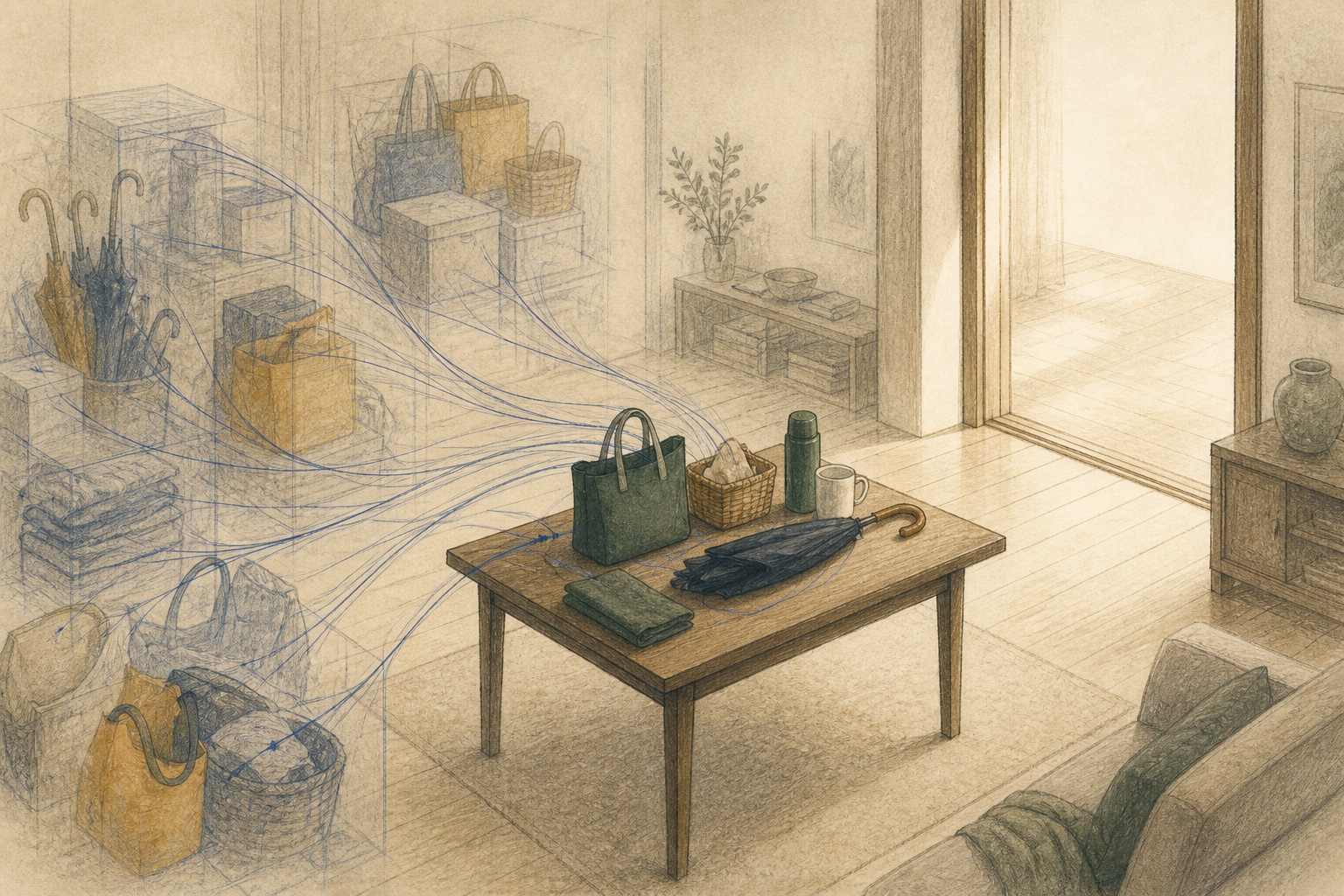

Live in a place long enough and you adapt to it. One more bag each day, one more carton each week; you detour when you walk and shift one item when you reach for something. After a while it no longer feels like change, only like “it has always been this way.” That need not first be explained as laziness or a lack of judgment. It can first be seen as daily life slowly replacing the baseline.
What a home often overlooks is not one especially striking object, but the same kind of things scattered behind doors, in cabinets, in bags, and beside the bed. Each umbrella or box, taken alone, can be given a reason. The total never appears in a single field of view.
An outside view is not there to score you
Someone who has never lived in that environment may walk in and see obstacles the resident has already grown used to. The value is not that the outsider understands living better. It is that they have not yet treated detours, sideways steps, and temporary parking as natural.
Photographs can offer a similar distance. Shooting from the doorway, hallway, or tabletop fixes in the frame the obstacles the body usually slips past. A photo is not proof that the householder did something wrong. It puts a space daily life had ignored back in front of the eyes. If it is used together to answer “which stretch is most inconvenient,” it can become a starting point for redesign.
Gathering makes scattered objects visible
Without an outsider, you can still begin with a small gathered inventory. Choose one category, take out every matching item scattered through the house, place them on the same tabletop or floor, and take one photograph. The first time, you need not decide what to discard. You only need to know the total, the condition, and where things were scattered.
This action turns “each piece is not much” into a whole that can be compared. It may also show that spare stock is already enough, so there is no need to buy again because something could not be found. You can mark, in passing, what is in use, what is clearly spare, what awaits repair, and what awaits handover, so different outlets are not mixed together. The point is not to reach zero. It is to make keeping a choice made after seeing the total.
After seeing, then discuss where things go
Once the total is visible, objects can be sorted into temporary states: in use, clearly spare, needing confirmation, ready to hand over, needing repair, or entering the matching material path. Categories are not permanent labels. When life changes, they can be judged again. At least objects no longer have only one state: “left there.” For items you cannot yet decide, keeping a period of observation is also an arrangement. You need not pretend you already have an answer.
During inventory you can handle only one category and set a time when you may stop. First put visible items together, note the current user and condition, then keep items that need confirmation in a separate area. The aim is to turn a vague “should tidy” into one observation that can be finished. If disagreement appears along the way, you can keep things as they are first, and not make irreversible decisions while tired.
Outside eyes need not always belong to an organizer. Family returning for the first time, photographing the present state before a move, or even clearing one corner for a while can all offer a new baseline for comparison. What matters is not who looks, but that after seeing, the user still holds the decision.
If you ask someone to look with you, you can first say the task is observation only: where people detour, which category is scattered, which spot is used for temporary parking every day. Do not comment on the householder’s personality first, and do not treat one photograph as proof of a long-term state. After observation, the user still decides whether to keep, hand over, repair, or leave it for now. Only then does an outside view not become another form of control. The purpose of seeing is to increase choice, not pressure. If you can handle only one corner this time, that is already enough for the next judgment to have a basis. Seeing clearly first, then deciding whether to change, is usually more stable than rushing to process.
What a home most needs to see again is usually the corner that has gone unseen the longest. Starting from what is already visible also gives a shared picture that can be discussed. When the total is seen, objects have a chance to leave their original places and enter a more suitable path of use, handover, or processing.

💬 Comments
Loading...