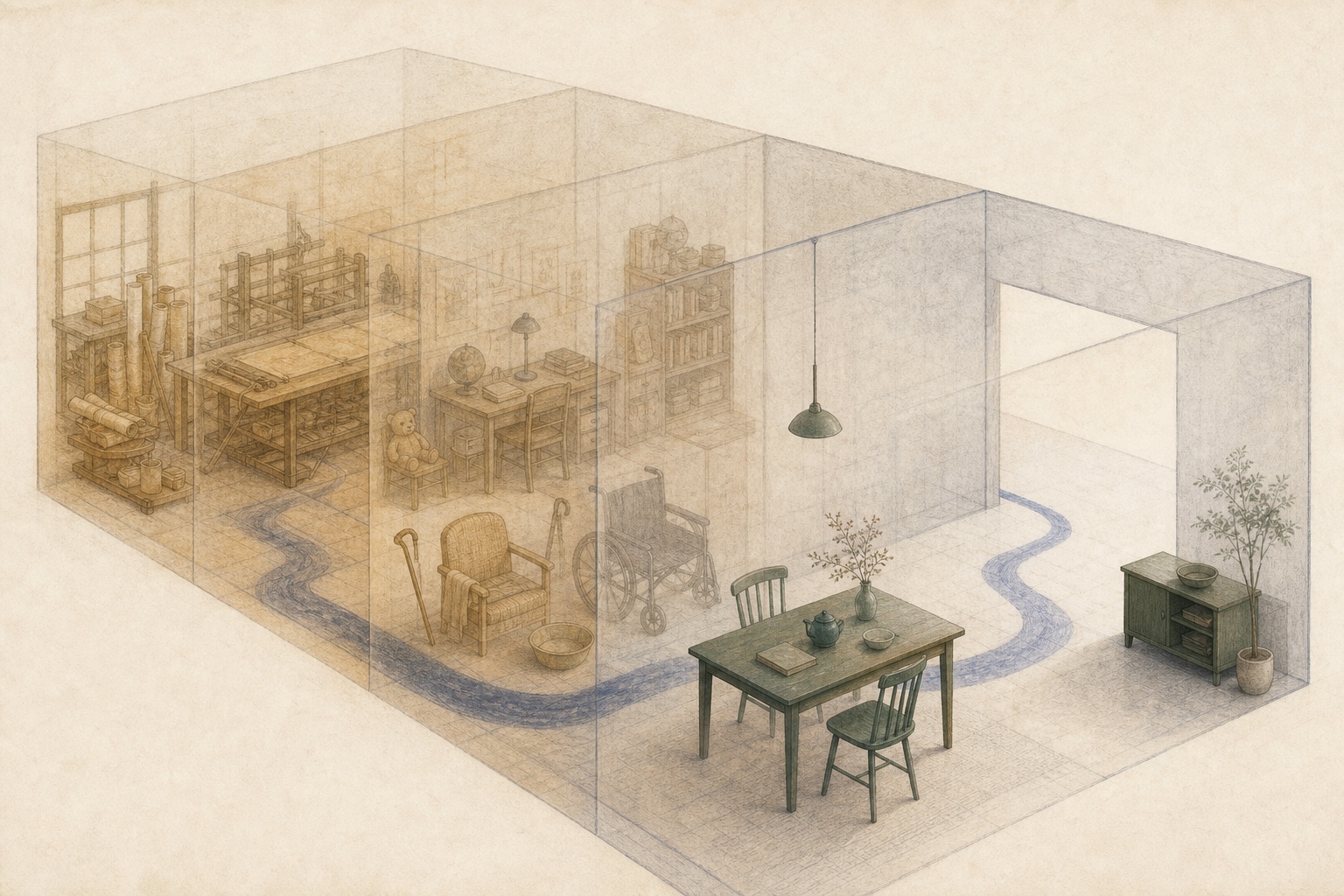

Some homes are not simply too full of things. The space is still serving a life that has already ended. Work has stopped, yet equipment and supplies stay in place. Children have grown, yet teaching materials and clothes remain. Caregiving has come to a close, yet the room has not been reassigned. Objects do not stay on their own. They stay because no one arranged an ending for the previous stage.
Life changes usually have no formal ceremony. Family members move out gradually, work is wound down gradually, new routines form gradually, and the space keeps yesterday’s layout. Only when the dining table, hallway, or living room is occupied by objects from the past do people notice that those living here now are still accommodating a life that no longer exists.
Not throwing things away, but settling a stage
In the source material there are homes that still keep work equipment and materials after a business has closed. Those things once had a function. The problem is not that they were used. It is that after the function ended, no one arranged a next stop for them.
The same pattern appears with household objects: teaching materials from a growth period are never returned to the person who used them; after caregiving ends, related items remain scattered; household size changes, yet furniture stays exactly as it was. Each object can be said to be “maybe useful later,” but the space as a whole is already telling us that users and uses are changing.
Four trigger points that reopen the case of space
Change can be listed as four trigger points: household size increasing or decreasing; children growing and routines changing; work pattern, retirement, or closing a business; and caregiving beginning, ending, or shifting. A trigger point does not mean every object must leave. It reminds us not to keep adding things onto the old layout.
When rechecking, ask: Who lives here now? What activities does each person need? Which uses of space have already changed? Which objects serve only the past, yet occupy the main positions of the present? The last question often points to large, fixed, long-unused objects that are easiest to overlook.
After answering, give objects a concrete deadline for judgment, rather than putting everything into “later.” Confirm who will use something and when, what needs repair, and whether anyone is willing to take it on. Objects without a clear next step go first into a to-be-confirmed area. Only objects with a clear user and time return to the present flow of daily life. What remains is then something that can be arranged, not merely a postponed decision.
Rearranging space also rearranges relationships
Resetting space is not only changing furniture. When roles change, the people who decide about objects and the people who use them may also need to change: equipment can be put to another use, or handed to the next user; objects once kept by one person can be discussed again as to who will use them.
Before rearranging, sketch a simple use map of the space: Who enters this room now? Which activities must be finished each day? Which objects need to stay at hand, and which are used only at particular times? The map need not be precise, and it is not meant to assign value among family members. It lets the needs of the new life be spoken first, then looks back at whether old objects still occupy necessary places.
The process should allow exceptions. Keepsakes need not serve daily function. If their number and placement can be shared, they need not be handled in a hurry. What truly needs rechecking are tools, teaching materials, and clothes still described as “usable,” yet without a clear user. If use, time, and a recipient can be named, keeping is an arrangement. If only a vague “later” remains, it is worth finding an exit.
For a home to answer present life, past layouts must be allowed to end. When space is reassigned, objects no longer hold places for roles that have left; things that can still be used also have a chance to be received in the new life. Tidying is not a denial of the past. It is a way to keep what the past left from blocking the present. When this can be said clearly, family members have a better chance of moving forward together, and of making tidying shared work.

💬 Comments
Loading...