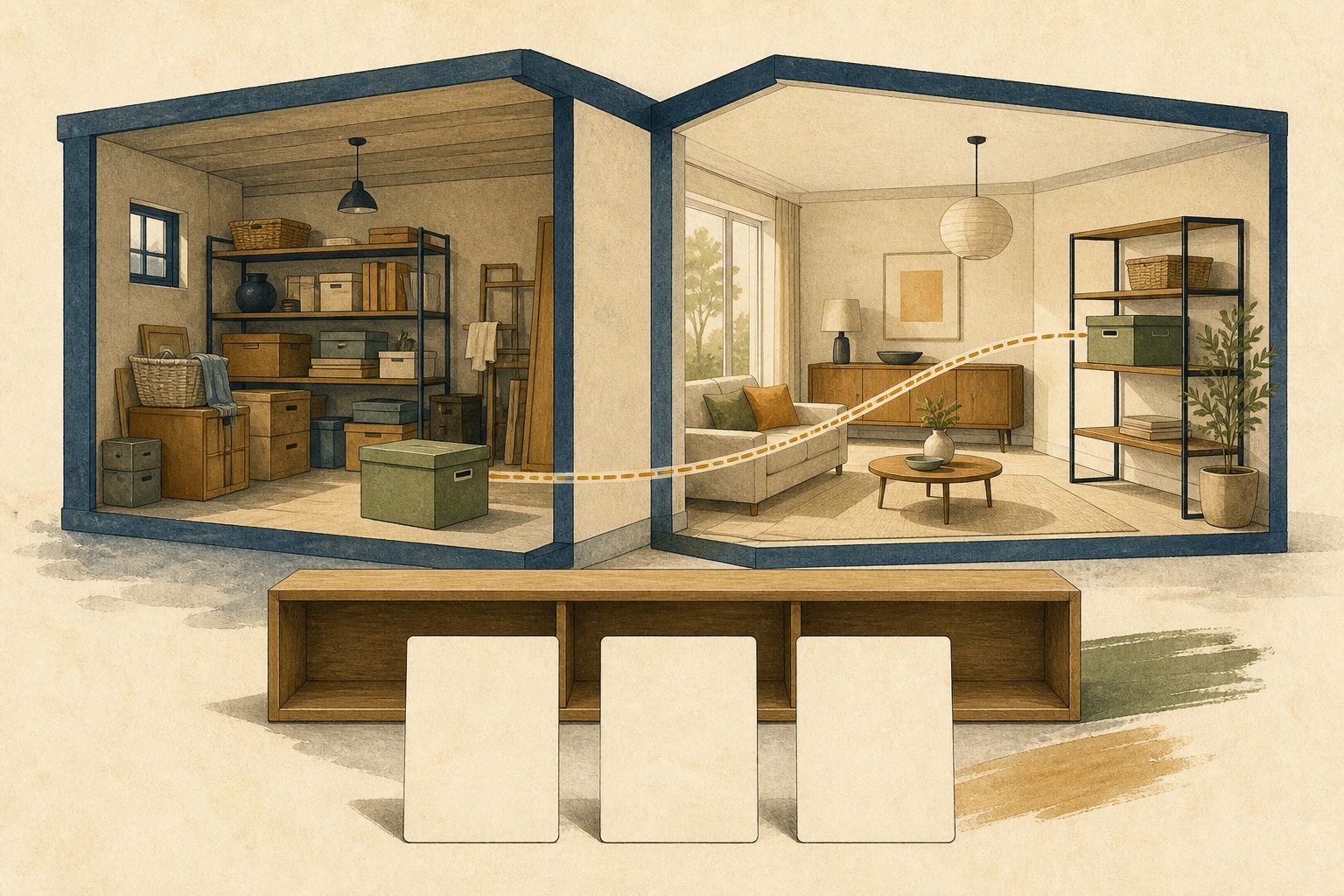

One person bags two bags of things and the household total does not fall. That is not a shortage of tidying skill. After objects leave one room, someone else checks them, brings them back, or sets them down elsewhere. They have only changed place. There is output from tidying, but no shared household judgment.
Order in a home is shared; the work of keeping it often lands on one person. That person finds the problem, decides what stays, moves the objects, and still lives with what happens when others set things down again. Over time, the surface anger is about things in the wrong place. Underneath, responsibility keeps returning to the same pair of hands.
Separate four kinds of responsibility first
Household tidying involves at least four different jobs: who decides whether an object stays, who moves and handles it, who puts it away after use, and how often it is checked again. They need not be done by the same person, and they should not, without discussion, default to whoever cares most about order.
For example, personal things are decided by their owner; shared things are confirmed together by those who use them. Large objects may need enough people to help; everyday small things are put away by whoever took them. Division of labor does not mean everyone does the same amount. It means the work lines up with who actually uses the thing.
Before assigning, write down the three situations that happen most in a week: where objects enter the home, where they stop after use, and who notices when something needs handling. That finds real gaps more easily than asking everyone in the abstract to “help more.” Someone may be suited to looking things up and making contact; someone knows where things are used; someone can move things at a fixed time. Match ability to situation so responsibility does not stay a spoken promise.
Consensus has to become rules people can follow
“We want the house tidy” is a shared wish, not yet a rule. A household can start with a smallest agreement: where things go when finished, which areas cannot hold long-term temporary piles, when to confirm before buying another object that does the same job, and who raises a renegotiation when a rule no longer fits.
Fewer rules are easier to watch. Try one shared spot for a few days. See whether people know where an object lives, whether they can put it away after use, and who still has to finish the leftover work. If only one person remembers the rule, the problem may not be follow-through. The rule may never have been jointly understood.
Different household members can also keep their own zones. Some want everything visible; some need things gathered into a cabinet. As long as shared activity is not blocked, personal space can have different standards. Shared maintenance is not turning everyone into the same kind of user. It is making the necessary shared boundaries clear.
Do not blame every snag on method
If one person finishes tidying and objects soon return, look at four things first: did someone not take part in the decision? Are the conditions for moving or handling missing? Is the put-away spot too far from where the thing is used? Was there never an agreement on when to reopen the talk? Those questions point to a next step more clearly than swapping storage products or buying another book.
Household members may also hold different standards for “still usable.” Write the disagreement down and let the object enter a to-be-confirmed area, so the same piece is not argued over every time. When personal belongings, jointly owned things, health, care, or living safety are involved, the relevant rights-holders and appropriate professionals still decide. A household rule cannot replace consent.
One person can notice a problem without having to keep the whole household cycle alone. Separate deciding, carrying out, putting away, and reopening the talk, then try it in one small place, and a household can see which link is actually stuck. Tidying is not one emptying. It is making sure objects that enter, stay, and leave have a next step others can keep.
After the trial, keep only the rules that work and drop demands no one can meet. If a spot still fails again and again, adjust the location, the use flow, or the assignment of responsibility. Do not charge the whole result to one person’s attitude. Shared maintenance is not more supervision. It is making sure that the next time something is set down, everyone knows who can decide, who takes over, and when to negotiate again.

💬 Comments
Loading...