
When family members quarrel over belongings after a death, the talk soon slides into who has more feeling. The one who keeps more is said to be unable to let go; the one who clears quickly is said to be cold. Those judgments may come too soon, because each person’s readiness to face memory, responsibility, and life now need not arrive together, and there is no single correct sorting speed.
For the same object, one person first sees a story, another first sees space; one needs to leave it a while longer, another must first make the room usable in order to go on living. Speed can be a difference. It cannot by itself prove how much someone cared.
Take speed out of the judgment first
When sorting belongings after a death, the family can first list what each person cannot handle at once. This is not to defend anyone. It makes “cannot be moved now” a clear state. Someone may want to keep a batch of manuscripts; someone may want only a few representative pieces; someone may, for now, only want things gathered where they do not affect daily life. All of that can be recorded first.
If one person handles things quickly, that cannot be used to decide they care less. If another is not yet willing to handle them, that cannot be used to demand that the whole household stay frozen forever. Rather than argue whose speed is right, ask first: which objects must not be moved? which can be gathered first? who will keep them? when will we look again?
Let different degrees of readiness exist at the same time
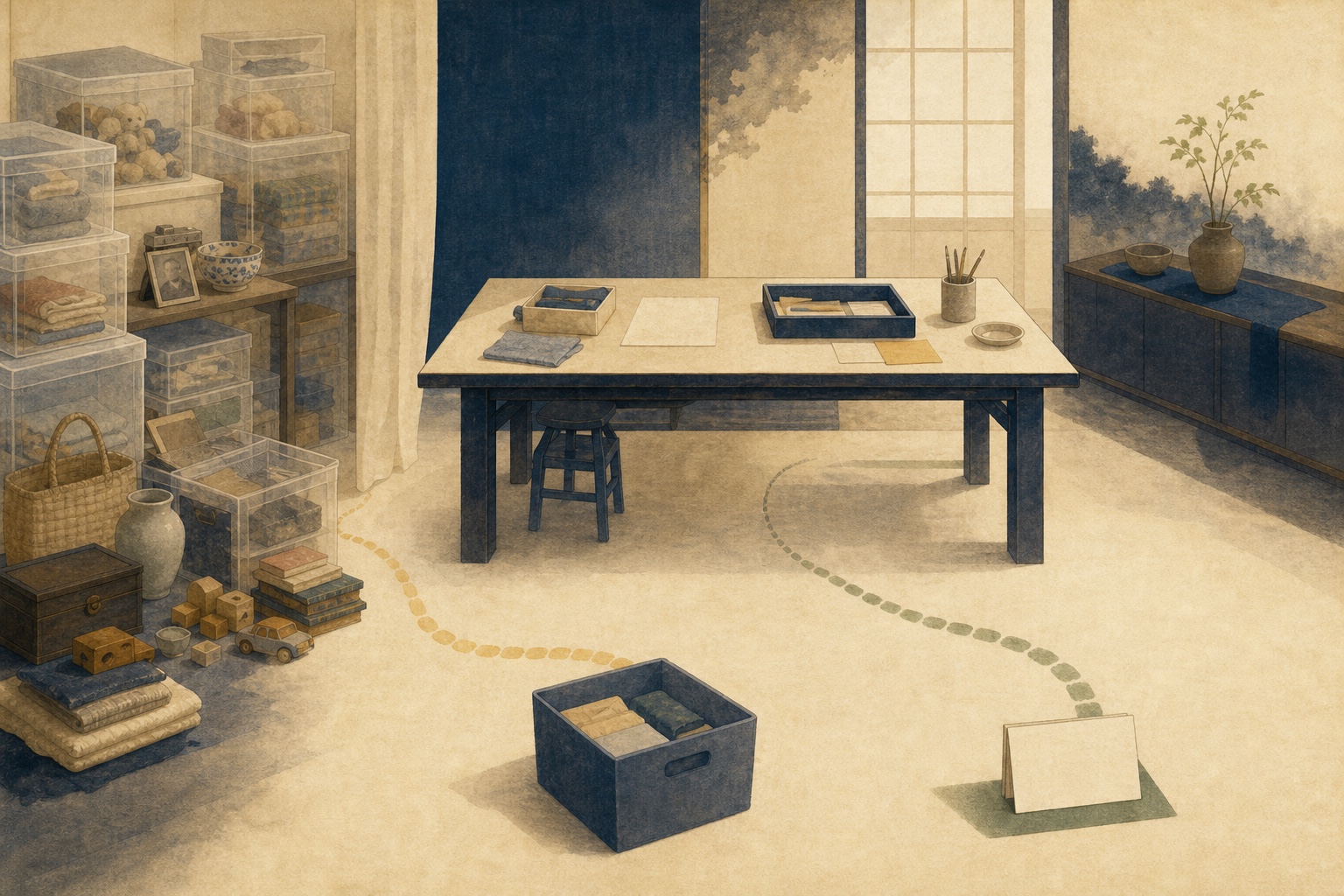
One workable approach is to divide the belongings into three zones: jointly kept, decided by an individual, and still to be confirmed. Jointly kept items need a stated storage place and rules of use. Individually decided items go back to the person with the right to decide. Items still to be confirmed are gathered in one place, so waiting does not keep occupying the main paths of daily life.
Temporary storage is not hiding the problem. A temporary zone needs a custodian, a defined range of access, and a date to look again, which can be postponed if needed. The date is not there to hurry anyone into letting go. It lets everyone know when the decision will be opened again, so the same quarrel need not repeat every day.
When looking again, the only question need not be “keep or not.” You can check together whether the objects are still safe, whether the temporary place obstructs daily life, whether the custodian still has capacity, and whether new rights-holders or family views have appeared in the meantime. If conditions have changed, re-zone. If they have not, you can postpone again. An arrangement that can be revised holds different degrees of readiness in a family better than one permanent answer.
For space that affects life now, you can handle “place” before “memory.” Moving boxes off a walkway into a place that can be kept safely, or giving representative objects a clear location, does not mean everything else must leave at once. When space is usable again, judgments about feeling have more stable time.
Slow speed has a cost that still needs to be seen
Keeping things slowly is not wrong, but occupying shared space for a long time does make others bear the cost of passage, activity, and custody. So the family can talk about concrete conditions: where things will first be gathered, who will keep them, who may open them, and when the next joint review will be. Writing the costs down is more useful than scoring one another on filial piety or coldness.
If shared property, inheritance, health, or care arrangements are involved, ordinary sorting advice cannot decide for the family. When needed, obtain the consent of the relevant rights-holders and seek appropriate professional help. This article offers a framework for negotiation, not legal, psychological, or medical judgment.
Sorting belongings after a death need not require everyone to arrive at the same answer on the same day. Gather first, keep the boundaries, name a custodian, agree on a look-again date, so different speeds have a place to rest. Memory need not be emptied all at once, and the past need not occupy present life forever.
Before a joint discussion, you can also confirm who needs to be notified, who actually keeps the things, and which objects should not be handled privately by a single member. The point of the conversation is not for one side to win. It is to put memory, space, and later responsibility into one arrangement that can be followed. When everyone knows when the next talk will be, silence need not be read as consent.

💬 Comments
Loading...