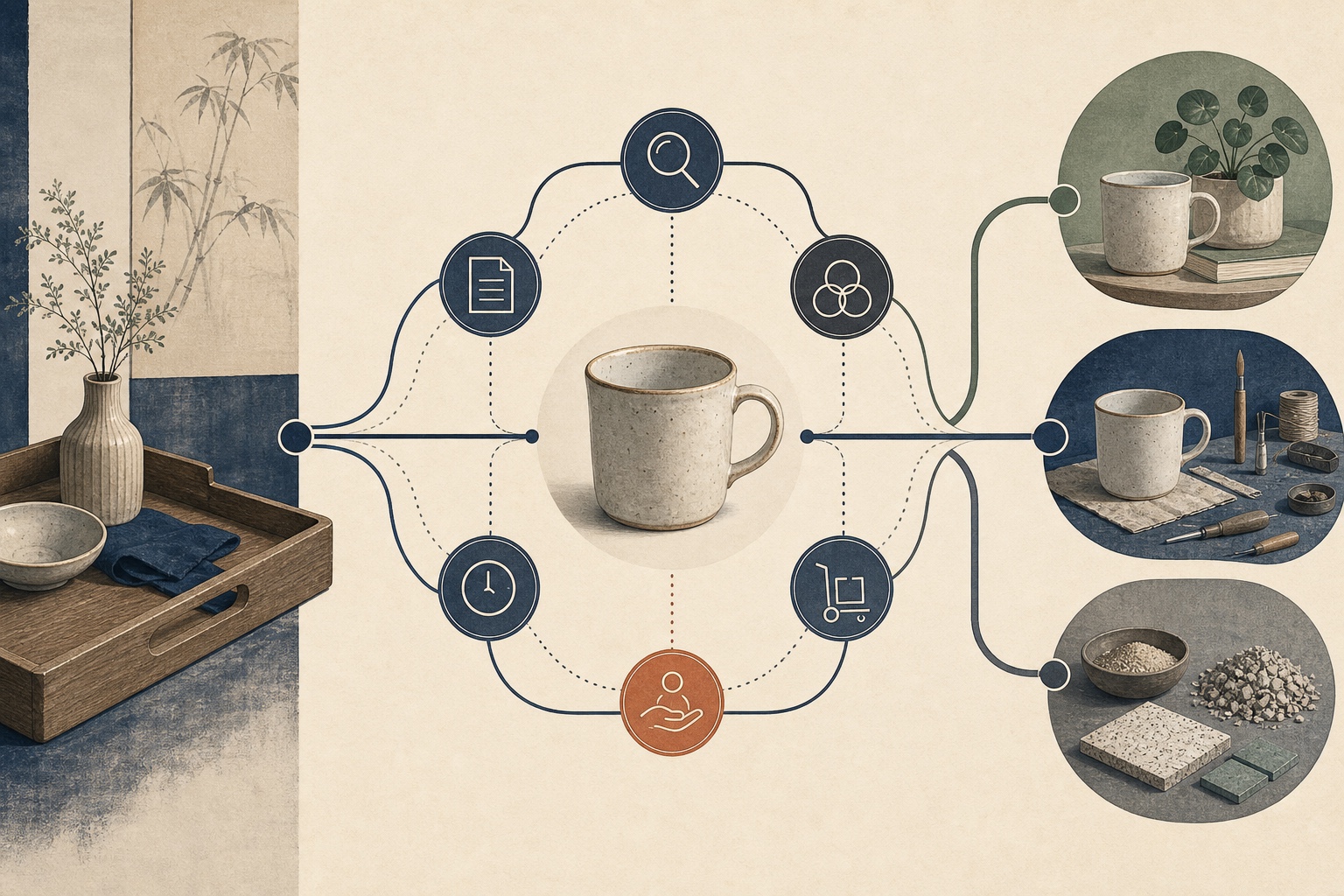

When objects leave a home, people often imagine only two paths: sell what is new, throw away what is broken. What actually gets stuck is what still works, but no one especially wants. It is not damaged enough to process as waste, and not good enough to find a buyer on its own, so it stays until its condition worsens.
The costs of the middle stretch are often invisible
For something “no longer needed at home” to become “usable by someone else,” someone has to check its condition, describe its use, find a next owner, answer questions, set a time, and hand it over. Large items add moving and safety responsibility. None of this appears on a price tag, but it takes real time.
So residual value does not mean easy circulation. The owner sees “it still works.” The receiver has to decide “do I need this now.” The mover faces “how to get it there safely.” If those three questions never connect, the object stays put.
Still usable is not the same as worth passing on
Reuse cannot rest only on whether an object still functions. Unclear condition, missing parts, hard-to-clean surfaces, or specialized repair can mean sending it on merely shifts the handling cost. If the receiver feels awkward saying no, the object may pile up in another home.
Responsible sorting means stating condition, use, missing parts, handover time, and moving terms. Then a next owner can decide with full information, and goodwill does not become forced burden. Circulation does not require every object to be kept. It requires that the next use situation can actually take it.
Supply and demand have to meet in time
Many objects are not unwanted forever; they simply cannot find the right person at a given moment. Seasonal goods, items for young children, office furniture, and specialized tools can have a short demand window. By the time demand appears, the object may be damp or damaged, or the owner may have chosen the simplest disposal.
Time is therefore part of circulation. A listing place is not enough. Information has to be easy to see, demand has to be able to answer, and waiting needs a clear deadline. Without a deadline, temporary storage can become another long-term pile.
Sorting needs someone in charge
A service that wants to support reuse can start by asking: who judges whether an object is fit for reuse? Who completes the description? Who confirms the receiver? Who handles temporary storage and moving? If handover fails, where does the object go back? These are not decorative features. They are the basic responsibilities that decide whether an object can leave its place.
Households cannot always carry the full process. If a community or other service fills the gap, it has to state intake scope, time windows, item limits, and handling costs. “If you need it, come get it” leaves the risk with both sides.
For those offering a service, the point is not to take in every object. It is to say clearly which objects belong on which path. Fuller descriptions make matching more likely early. Clearer limits keep receivers from discovering after delivery that they cannot handle the item. These small arrangements reduce friction in each transfer.
The middle stretch also needs a result that can be reviewed. A successful handover is one result. Failure to match, need for repair, or a decision to exit also need to be recorded and explained. If every destination has a responsible next step, objects need not wait endlessly between “send it out” and “throw it away.”
Only results that can be seen give a chance to keep correcting the service process.
And only when the process can be corrected does circulation become stable.
Connect the middle stretch, and circulation does not depend on luck
Recycling equipment can increase, and collection can speed up. If still-usable objects still depend on the owner finding an outlet alone, the system is missing a stretch. When someone confirms condition, matches demand, and manages time, an object may reach a next place before it loses usability. Circular economy does not require every thing to stay forever. It means that among different destinations, there is a path that does not depend on personal luck to finish.

💬 Comments
Loading...