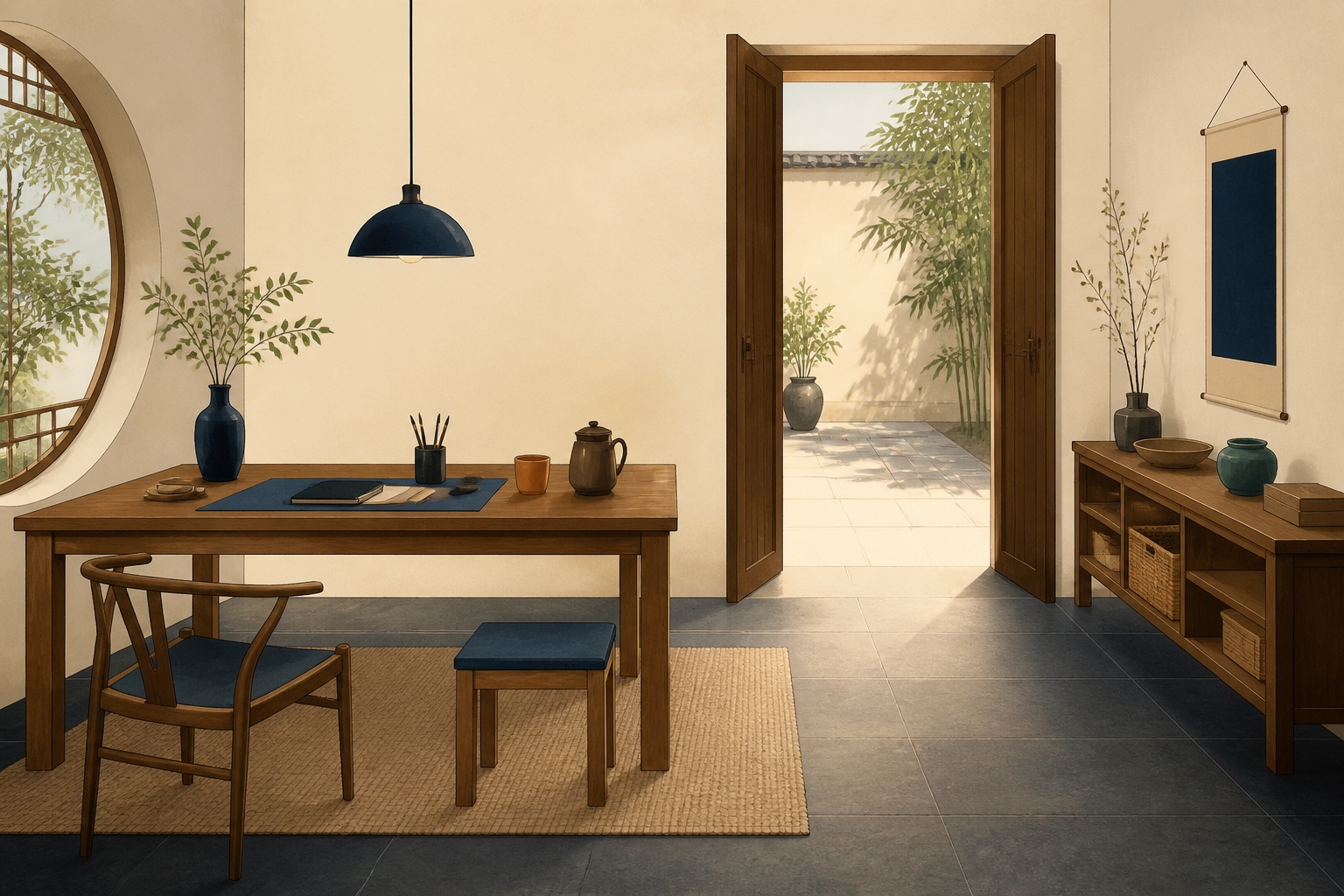

“From now on I can ask classmates over.” The sentence sounds like praise for organizing, and even more like a moment when living conditions are finally seen. Whether a child can invite classmates home depends not only on willingness to ask, but on whether the home has a place for that to happen.
Disorder first appears as loss of function
When there are too many objects, what usually disappears first is not neatness but function. A child may have no fixed place to sleep, may have to clear a surface before homework, and may have to detour around piles to pass through shared areas. These situations may not at once be named as living problems, yet they change what each day can hold.
Organizing need not begin by making the whole house look good. It can begin with questions: Is there a stable place to sleep at night? Is there a surface where homework can be finished? Can frequently used objects be found? When family members pass through shared areas, do they have to avoid piles? The answers sit closer to life than “tidy or not.”
A home is not only shelter; it is also a place for sharing
Besides sleep, meals, and storage, a home also carries the function of letting a child bring classmates in. When there is no space to sit, talk, or play together, a child may choose not to invite friends. That need not be read as shyness. Sometimes the child simply knows the home has no conditions for receiving guests.
When objects are given places again, passages reopen, and tabletops can be used, what changes is not only the look of the rooms. A child’s sense of what the home can do also changes. That function is worth seeing, even if it does not happen every day.
Do not hand a system problem to the child
A child can take part in putting their own objects back. Room count, furniture placement, the use of shared space, the speed at which objects enter, and who decides what stays are mainly not things a child can decide alone.
If a child has no fixed place yet is asked to keep order; if family members keep putting objects on shared surfaces yet only the child is told to put things away, the cost of the system is given to the person with the least say. Adults should handle household layout, entry, and shared safety. The child takes part, within a suitable range, with their own objects.
The question is not a score for the family
“Can classmates be invited home” is not a comparison among families, and it does not require every child to host friends. Some people prefer to meet outside. Some need quiet. Some households are not suited to receiving guests. The value of the question is to ask: if the child really wants to invite someone, does the home have conditions that support it?
The same kind of question can be asked: Can the family eat at the table? Can the child find their own books? Can an elder walk safely to the bathroom? These questions bring organizing back from appearance to use, and they bring circulation back to whether objects still support people’s lives.
If a child really wants to invite classmates, begin with one concrete use situation rather than first requiring them to organize everything. Which places need to stay clear for passage? Which objects must stay within reach? Which areas belong to the whole household and need joint coordination? When the scope is clear, the child knows what they can take part in, and adults can see which work should not be given to the child.
This arrangement also gives objects a new way of being judged: not only whether they can stay, but whether they hinder sleep, study, circulation, and sharing. If an object has long gone unused and also occupies a place life needs, it is worth checking again. If it does have a function, it should be placed where it is easy to reach and does not block others.
Organizing is therefore not pushing responsibility onto one person. It is rearranging the places of objects and people.
First give life a place; then talk about long-term upkeep
When space becomes usable again, the problem is not all over. Object entry, ways of putting things back, and shared rules still need adjustment. The child also needs to know which matters they are responsible for and which adults take on. Asking whether a child can invite classmates home reminds adults that living quality finally returns to whether life can happen. When a child can sleep, study, and play, and can also bring friends in when they want to share, objects have truly returned to serving people.

💬 Comments
Loading...