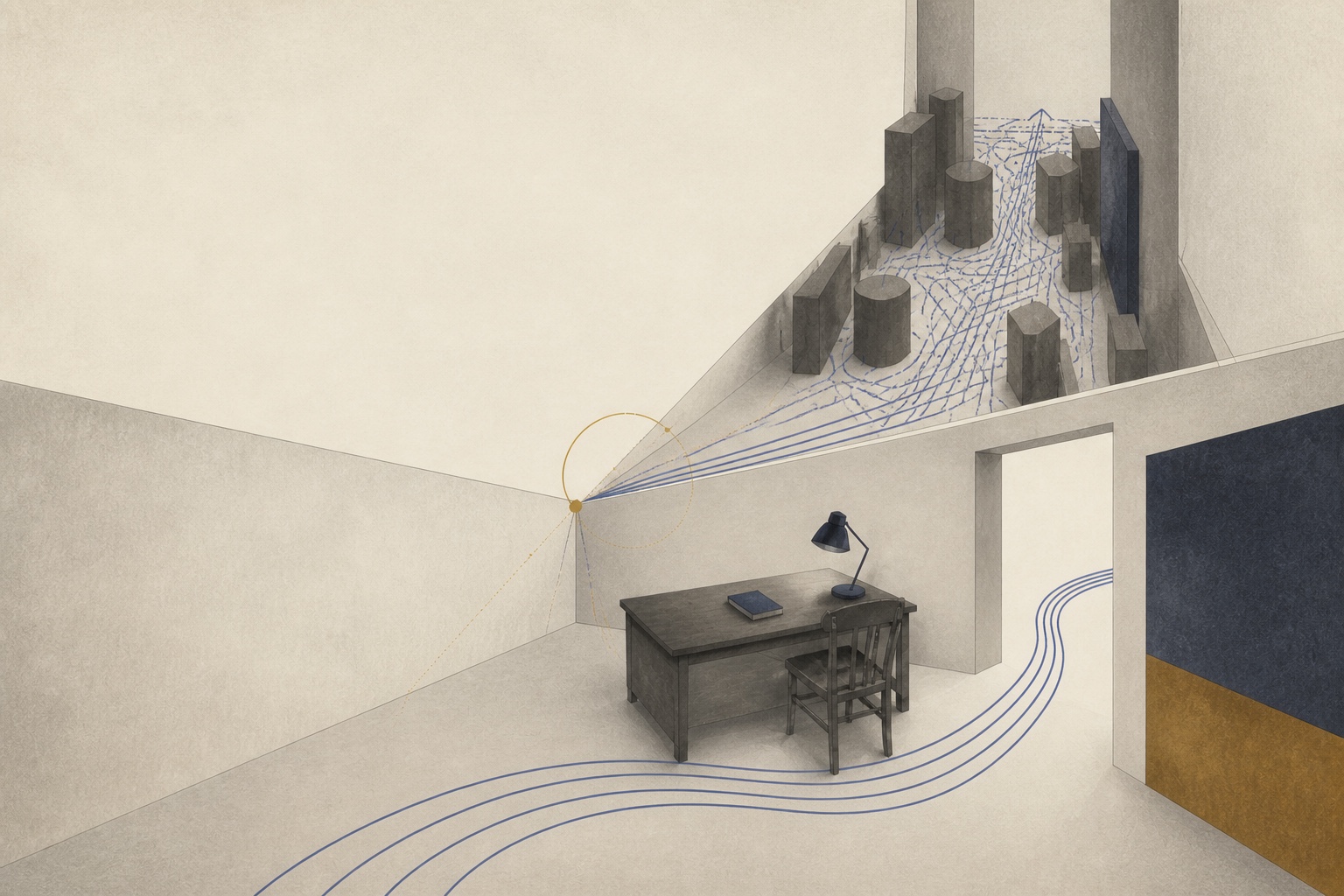

A desk sat in the prettiest corner of the room, its surface neatly cleared. The resident had lived there a year, yet each time she sat down she wanted to leave within five minutes. Focus was poor, and she could not say why.
Later she turned the desk from facing the wall to facing the doorway, with a full bookcase behind her. Same desk, same room, same person—and she could stay seated. No timer was added, and the desk was not replaced with a larger one. Only the relationship between the desk and the space had changed.
Before an action starts, space has already added a cost
This case can only show that after the desk’s orientation changed, the person’s experience of using it changed as well. It does not prove that the cause must be an entrance at her back, nor that everyone would react the same way. The original material left no research source or year for related claims, so this article treats them as a working hypothesis for understanding the site, not as a psychological law.
Rather than first interrogating each person’s inner state, look at one thing: whether this location makes the action awkward. A desk beside the living-room entrance may also become a place to wait for people, drop things, and pass through. When a child sits down to study, attention may still be split among people coming and going and activity nearby. That does not necessarily mean the child is not trying. The location itself may have raised the cost first.
The kitchen is similar. When the counter is taken over by clutter, cooking begins with moving things aside. Chopped ingredients have nowhere to go; mixing bowls and pans keep being shifted. Bags and boxes on the floor force a detour. Delivery then becomes the lower-resistance option, yet the conclusion the resident often reaches is “I don’t like to cook.”
A small space is not the same as being unable to act
A snack shop’s kitchen is narrow, with several people working at once. Frying, boiling, and serving each have a place; the movements are fast without chaos. This example cannot be used to demand that a household copy it, because a commercial kitchen has division of labor, training, and fixed procedures. It can remind us of only one thing: insufficient floor area cannot by itself explain why behavior gets stuck.
Home layout can start with frequency of use. Everyday tableware within easy reach; baking tools gathered in one bay; seasonal items moved higher. In a child’s room, separate the study area from the sleeping area, and leave on the desk only what is in use. Return each person’s things to the floor where they are mainly used, so the whole household does not have to cross the same path to find them.
These adjustments usually happen together with reducing volume. When the total of belongings already exceeds what the space can hold, turning a desk or changing a spot can only help briefly. For layout to work, circulation needs room. Buying one fewer new cabinet, or first removing things that do not belong in that room, is sometimes more direct than adding another set of self-discipline tools.
Layout can lower the cost; it cannot replace a decision
This is closer to interface design than to a personality test. A good interface does not ask the user to climb over resistance with willpower every time. It makes the next action visible, reachable, and walkable. The tables, pans, and paths at home also arrange default options without speaking. Layout is not fate, but every day it lowers the cost of some behaviors and adds friction to others. This view can also remind us that when an action stalls, adjusting the environment first is not necessarily an evasion of responsibility. It can be a search for a more sustainable way to begin.
Rental partitions, plumbing in an old house, and differing opinions among family members are limits that cannot be pretended away. When a wall cannot be opened, a screen, taller plants, or a small divider can be tried first. When a large renovation is impossible, one piece of furniture and one stretch of circulation can still be adjusted, then watched to see whether the cost of the behavior falls.
Be careful not to treat layout as destiny. After a position is improved, the work does not finish itself. It only makes the necessary task easier to handle, and makes it less necessary to bring home extra objects that were not needed. The next time you feel you cannot do something, you can ask first: “Is it that I have no willpower, or has the space put every step in the hardest place?” Check the layout before you decide to blame yourself.

💬 Comments
Loading...