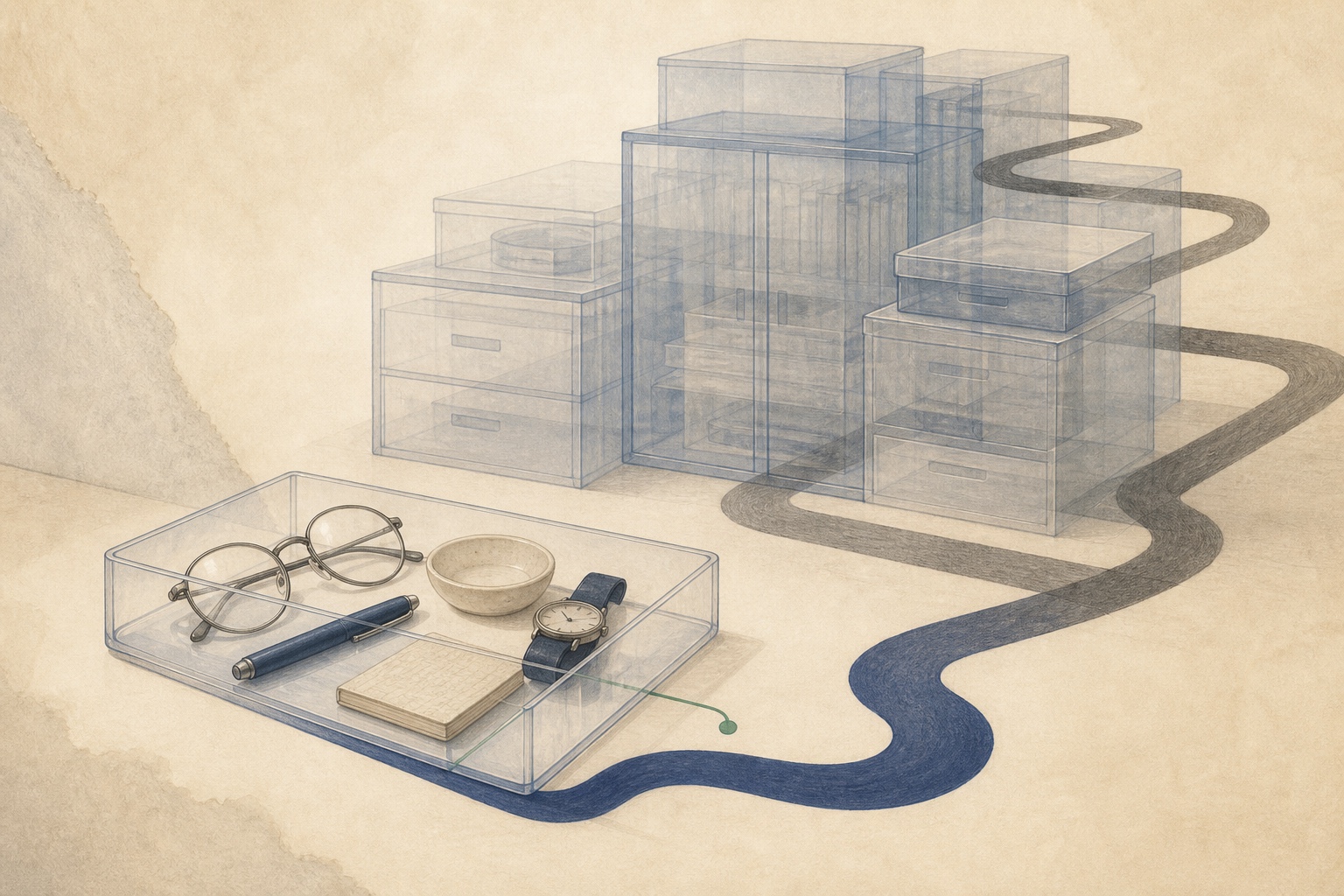

The same storage box can last someone for years, while someone else soon leaves things outside it. The difference is not necessarily who is more self-disciplined. Whether the method matches the user often matters more than how complete the method is.
Many suggestions start from the house: where there is space, which cabinets to buy, which grid should hold which category. Those questions still need answers, but the order can be reversed. What does the person who looks for things every day rely on to remember a location? How many steps will they accept? Which items must stay visible? If those conditions are not understood first, even a handsome system can become an obstacle.
Finding things follows different cues
Some people find things by memory: they remember drawer levels and cabinet cells. Others find things by picture: they remember the last time an item appeared on a table, in a basket, or on some surface. Neither path is superior, but they call for different storage. The same person may also change cues depending on the object, the setting, and how the day is going.
In one organizing consultation, the homeowner had already bought storage products and sorted items into categories, yet the room still did not feel restful. The problem was not that the categories were too coarse. Each retrieval meant opening a door, pulling a drawer, and lifting a lid, then repeating the same round to put the item back. For someone who can accept those steps, closed storage may be convenient. For someone who needs to see items directly, the tabletop may become the least effortful holding place.
Being able to see is a use need
Some people will not put everyday small items into a drawer, because what they cannot see they easily forget to use. If the demand is simply that the tabletop stay empty, the items will still return to the table. A transparent box or a shallow tray that groups what is used every day can keep both visibility and a boundary.
Visible does not mean spread without limit. The point is to give items a range that can be seen, so they can return to that same range after use. That range might be a transparent box, an open shelf, a bag carried along, or a holding zone that does not need further subdivision. Understand the cues first, then choose the container, and organizing will serve daily life.
Ask about the person before deciding on furniture
Before designing a storage system, a small test can help: ask the user to demonstrate the items they look for most often, and watch whether they find them by location, picture, label, or touch. Then note how many actions retrieval takes, and where things usually land after use. This is not a quiz. It is a way to find friction between the system and the life around it.
It also helps to watch where putting things away most often stalls. Is the container too far from where the item is used? Does the category require another round of thinking? Must something else be cleared before the item can go back? Those details point more clearly to what the system needs to change than “you should be more disciplined.” If the same spot keeps becoming a holding zone, treat it first as design feedback, not as evidence that the user has failed.
Then look at the space: which positions are within easy reach? Which things need to stay together? Which containers block the line of sight? If an item needs to be seen, there is no need to force it into a closed box. Items used rarely need not occupy the main surfaces of daily activity. Fit is not a license to rationalize every demand. It is a way to spend limited space on the paths that actually happen.
The system also needs ways to exit and adjust. Unused containers need not keep occupying space because they were already bought. Labels that became too fine can be merged when life changes. Looking back from time to time at which items still stop on the table, and which cells stay empty, shows whether the system is helping or only asking the user to obey a fixed answer. That is also a checkpoint against buying more in order to keep storage going.
Life will keep changing, and a system that once fit may need to change with it. Good storage is not buying everything at once. It is letting the system update with the user. When a person can find things, take them out, and is willing to put them back, objects will not leave their containers because the method does not fit, and then become the starting point of the next tidy-up. A system that actually works should reduce everyday friction, not add another set of rules that must be obeyed. That is where storage returns to living.

💬 Comments
Loading...