
TL;DR: Nobody predicts humans will live to 120 by 2036, but if the optimists are right, people born in the ROC Year 60s have only reached the equivalent of 27 to 32 in the old framework. Retirement, homebuying, marriage, parenthood, health investment: every rule written for a 70-year life needs recalculating. This letter lists what will break.
Tonight I gave an AI an arithmetic problem: if humans can truly live to 120, and someone born in ROC Year 60 is 55 years old today, how old would they be in the equivalent of a 70-year-lifespan world?
The answer was 32.
In the old script, 32 meant just married, carrying your first mortgage, getting your first promotion. Yet here we are, this generation of ours, holding identity cards that read somewhere around 50, thinking in 50-year-old ways: close enough, time to settle down, spend what’s left carefully.
If 120 is real, that entire way of thinking is wrong. Not slightly wrong. Wrong from the premise up.
Nobody Predicts 120, but Nobody Dares Rule It Out
Taiwan’s Ministry of Interior 2025 Abridged Life Table puts the national average lifespan at 81.27 years: 77.93 for men, 84.75 for women. Taiwan has been gaining roughly 0.15 to 0.2 years per year over the past two decades. The National Development Council’s 2026 medium population projection puts 2036 at 83.5 years; the UN’s 2024 projection is 82.9 years. IHME’s global forecast published in The Lancet is similarly cautious: global average lifespan rising from 73.6 years in 2022 to 78.1 years by 2050.
No actuarial institution projects humans living to 120 by 2036.
The voices on the other side, though, are getting louder. In his essay “Machines of Loving Grace,” Anthropic CEO Dario Amodei wrote that sufficiently capable AI could compress decades of biomedical progress into five to ten years, and he considers doubling human lifespan a plausible goal. Kurzweil places longevity escape velocity, the point at which science extends life by more than one year per year, between 2029 and 2032. These are visions, not forecasts. But the people saying these things are the ones actively building toward them.
There is a point that often gets confused here. “Average lifespan” is a demographic statistic: it measures how long a baby born this year is expected to live. Even if a genuine age-reversal therapy emerged in 2030, that number would take decades to reflect the change. The figure that actually matters to us is different: how many more years can a 50-year-old expect from today? That number could jump with a single breakthrough.
If the optimists are right, how much do those of us in this generation need to change?
Age Inflation: Every Age Needs to Be Repriced
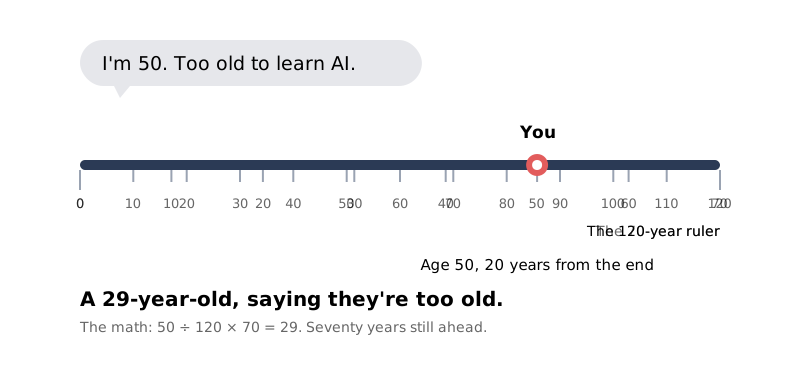
People born in the ROC Year 60s, meaning between 1971 and 1980, are 46 to 55 this year. Measured on a 120-year scale, they have completed 38% to 46% of their lives. Mapped back to a 70-year-lifespan world, that is 27 to 32 years old.
Even without using 120, a more conservative 90 years, assuming some progress in longevity science but not escape velocity, puts age 50 at only the equivalent of 39 in the old framework. On 120 years, we are still in the first half of the middle act. On 90 years, we have barely crossed the midpoint.
I call this age inflation: the same number of years buys less of a lifetime than it used to.
The problem is that every rule we live by was written for a 70-year life. The age to settle down, the age to buy a home, the age after which you should not change jobs, the age after which learning something new is wasteful. Nobody states these numbers explicitly, but they hide inside every decision. Swap 70 for 120, and they fail, one after another.
Here is what I think will break.
The Three-Stage Life Will Break First
The old script: 25 years of school, 40 years of work, 15 years of retirement. A single straight line, no going back.
A 120-year life cannot hold that script. It becomes five or six acts, each lasting 15 to 20 years, with pauses between them and the possibility of starting over. Lynda Gratton and Andrew Scott called this the multi-stage life in The 100-Year Life, and their assumption was only 100 years.
Several consequences follow from this.
“It’s too late” shifts from a source of anxiety to a category error. Changing careers at 40 leaves only 25 years in the old script. In the new one, it leaves 80. The anxiety inverts: locking yourself in at 30 means using one quarter of your life to determine the other three quarters.
The half-life of a professional specialty is roughly 10 to 15 years. A 120-year life requires five or six career reinventions. Your university major becomes “the first major.” Experience accumulated thirty years ago may be a liability in the AI era, because old habits have to be dismantled before new ones can form. The resume shifts from “what have you done” to “how quickly can you learn something new.”
A career is no longer a single peak to summit. The second mountain at 50 is only just beginning to be climbed. Starting a company at 60 will move from being a feel-good news story to an ordinary event: the experience, capital, and networks are all there, and there are still 60 years left to absorb the risk of getting it wrong.
There is one corner that tends to get hidden behind longevity statistics. Living longer does not automatically mean wanting to live longer. Japan’s elderly suicide rate has declined in recent years, but 4,497 people aged 70 and above still died by suicide in 2025. The reasons behind those deaths are complex and cannot be reduced to boredom or lack of purpose. Still, when we begin imagining a much longer life, the question “why get up in the morning” deserves to be taken as seriously as “how do we extend lifespan.” If 70 more years remain, a sense of meaning stops being a pleasant bonus and becomes a genuine survival need.
| Year | Suicide Deaths, Age 60+ |
|---|---|
| 1995 | 7,739 |
| 1998 | 11,494 |
| 2005 | 10,894 |
| 2015 | 9,883 |
| 2025 | 6,903 |
Retirement, Mathematically, Does Not Survive to Age 120
This is where the disruption is most severe and most irreversible.
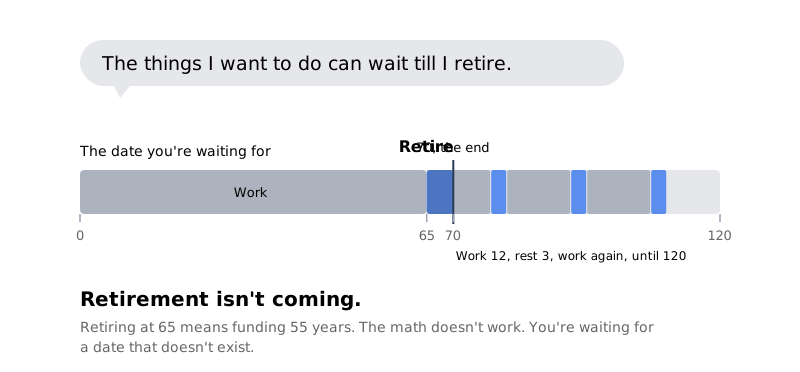
Retiring at 65 means funding 55 years without income. No reasonable savings rate sustains that. So “retirement” as a concept disappears, replaced by repeated sabbaticals: work for 15 years, rest for 2, then work again. Current pension systems are built on actuarial assumptions of 15 to 20 years of payouts. Payouts lasting 50 years would collapse the system outright.
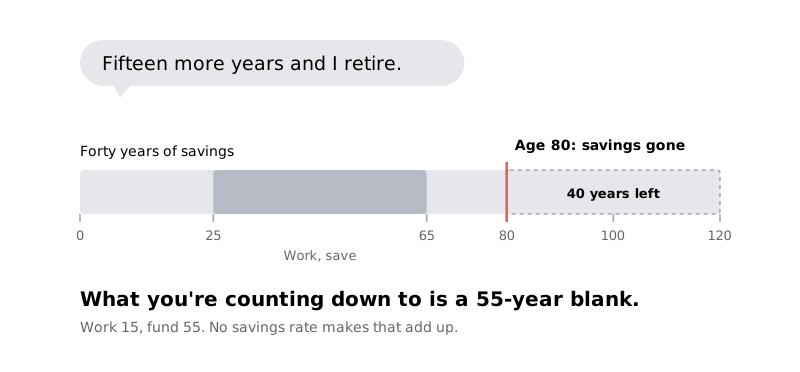
Compound interest becomes a genuine superpower. Money set aside at 30 has 80 years to compound by age 110. The same logic runs in reverse: a serious financial mistake at 30 follows you for 80 years. Using leverage when young requires more caution than ever before.
The logic of inheritance reverses. If your parents live to 110 and you inherit at 85, you are already planning your own later years. Intergenerational wealth transfer will be forced to shift from post-death inheritance to gradual transfers during life, or simply two generations managing assets together.
Housing: a 30-year mortgage covers only one quarter of a 120-year life. The assumption of living in the same home for a lifetime gives way to changing where you live once per act. Buying a home moves from being the ultimate life goal to being one option within one chapter.
Finally, the most frightening financial risk changes identity. The old fear was dying too soon, leaving family without support. The new fear is living too long, running out of money. Actuaries call this longevity risk. It will move from a footnote in a textbook to the central concern of every individual financial plan.
A Lifelong Marriage Means 90 Years
Old script: married at 25, children at 30, empty nest at 55, gone at 70. One marriage lasting roughly 45 years.
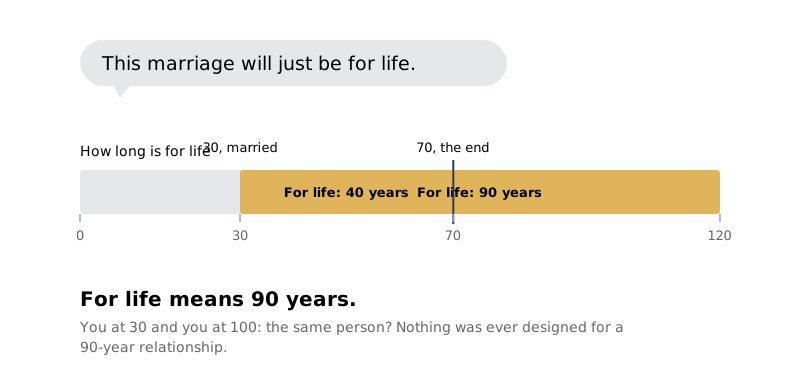
Replace 70 with 120, and “till death do us part” becomes 90 years. Is the person at 30 and the person at 100 still the same person? This pressure will produce new forms: serial marriage becoming normal, time-limited partnership contracts, or revisiting and renegotiating the same relationship several times over. I do not know which of these is right. I am certain that a relationship designed for 45 years is very likely to strain under 90.
The fertility window does not extend with lifespan unless reproductive technology advances in parallel. This creates a profound asymmetry: children still need to be born before 40, which is only one third of the life. After raising them, 80 years remain without that role. Parenthood shifts from the central axis of a life to an intensive project within one act. The empty-nest period grows from 15 years to 60. No existing life script addresses that stretch.
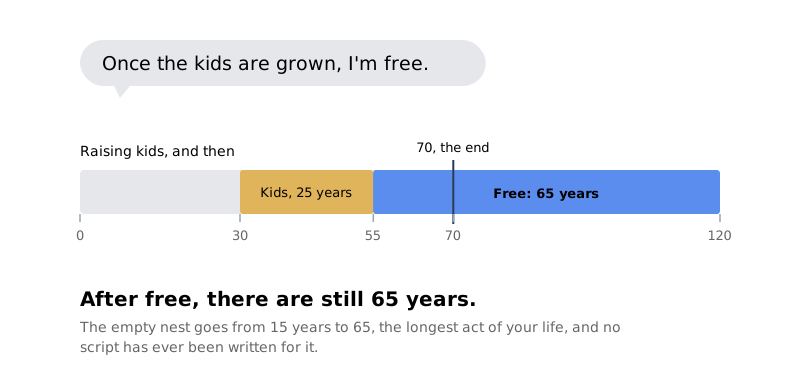
Five generations living simultaneously. When you are 80, your parents at 110 may still be alive, and your grandchildren may already be 30. Caregiving responsibilities reach both upward and downward at the same time, and the upward stretch could last 30 years.
Friendships will cycle through several complete turnovers across a lifetime. An “old friend” will come to mean someone you have known for more than 50 years. Most friends will be friends of a particular act. Loneliness will become a greater threat than most diseases.
The Body Is a Container Meant to Last 120 Years
Old script: treat your body carelessly when young, start taking care of it around 50, exit around 70. The timing just barely works.
The new script changes the metric. Even as average lifespan extends, National Taiwan University public health scholar Chen Hsiu-hsi estimates that Taiwan’s years spent in poor health may lengthen to an average of eight years. Living to 120 with the last 40 years bedridden is a punishment, not a prize. The number that actually matters is healthspan.
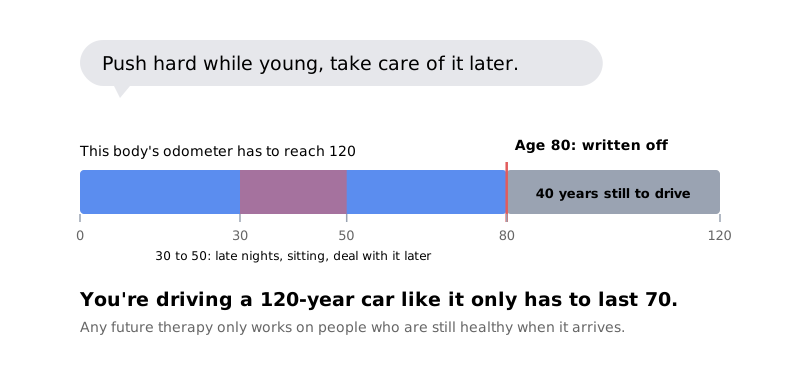
Your body today is a container that needs to last more than 70 years. Muscle mass, bone density, cardiorespiratory fitness, metabolic health, cognitive function: every investment made at 50 in these areas has a 70-year payback horizon. I cannot find any investment with a higher return. Preventive medicine shifts from an optional luxury for the wealthy to a core requirement, and the goal of medicine shifts from treating illness to ongoing maintenance.
There is also a threshold logic at work here. Future therapies will only benefit people who are alive and healthy enough to receive them. Whether you collect the dividend from longevity science depends on whether you can stay healthy long enough for it to arrive. It is a race to hold on until reinforcements come, and nobody knows when they will arrive.
A Script Nobody Has Written Yet
Psalm 90 says: the days of our years are seventy, and if by reason of strength they reach eighty. Those words were written roughly three thousand years ago. Taiwan’s average lifespan did not first cross 80 until 2013, and it has hovered near that mark for the decade since.
For three thousand years, the human imagination of “a lifetime” has barely moved. Every institution, from retirement ages to marriage vows, grew up around the scale of seventy years. The generation born in the ROC Year 60s stands precisely at the line where that scale is about to change.
I stand on that line too. Over the past year, AI’s rapid development has meant I am almost daily in a kind of contest with models: I get a grip on one approach and something new appears that needs learning. The feeling is oddly like being back in junior high, in class every day, always running into questions I cannot answer. After so many years of doing things, I find myself, somehow, a beginner again. My eyes already need reading glasses, but I still want to know what the next model update will bring and how to weave the latest frontier capabilities into the industries I care about.
The position of this generation is genuinely awkward: the old script says you should be settling down; the new script says you are only just beginning. There is no precedent. Our parents never faced this. The generation after ours will take it for granted. Only we have to rewrite the rules while walking, rewriting as we go.
Society will rewrite more slowly. Retirement ages, pension systems, and labor insurance all need recalculation, and these are among the hardest things to move politically. They will become the central battleground of generational conflict. A 70-year-old with 50 years left to live will not give up a board seat. The generational flow of power will seize up badly. Universities will transform from a place you go once at 18 to a place you return to every 15 years. Taiwan carries an extra layer on top of all this: a falling birthrate colliding with extreme longevity, an aging population that persists longer with no new cohort coming in behind it. No country has lived through this structure before.
Identity will need rewriting too. The question “who am I” will need answering several times over, and each act’s identity will have to be released when the act ends. For those currently at 50 who have fused themselves with their professional titles, this is the sharpest disruption of all. The time horizon for reputation extends as well: what you do at 30 follows you for 90 years. Reputation may be the only asset you can carry across every act.
For Those of Us Born in the 1970s
If humans might truly live to 120, then we need to think carefully about what our current age actually means.
At 50 or 60, is it still reasonable to learn something new, to commit to something whose results take ten years to appear? If decades still lie ahead, many ideas we have quietly filed away as “too late to start” are worth pulling back out.
Of course, 120 is only a possibility. Average lifespan describes a trend across a population; it makes no promise to any individual about tomorrow. Accidents and illness do not wait until we are ready. So the possibility of living longer cannot be used as another reason to keep waiting today.
For me, this possibility makes me willing to think about certain things over a longer horizon. If I want to still be capable of useful work in ten years, I have to take care of my body today. If I want to still understand this world in twenty years, I have to keep learning now. Even if I do not reach that age in the end, those investments will make the days in front of me better.
I am willing to pursue things whose results take ten or twenty years to arrive. And I know that time starts counting from today.
By the time we reach this age, we have accumulated real experience and, inevitably, real regrets. But as long as there are still things we want to understand, things we want to do, people and causes we want to love, there is no need to say we are close enough to finished. There is still much in this life to participate in directly, to create, and to write in our own hand.

💬 Comments
Loading...