
TL;DR: While clearing out a drawer, I came across a seminary student ID from 2000, and it carried me back to those years when I placed calling above income. When I was young I learned not to worship money, even cutting my giving down to keeping only one-tenth of my income; in middle age, after stepping into entrepreneurship, I learned not to fear money. My conclusion about financial freedom keeps getting simpler: the point isn’t whether the money is enough, but whether I’ve let it decide who I am, how I live, and what I live for. Money must be pursued, but it has to serve something higher: conscience, calling, relationships, and commitment.
While clearing out a drawer, I came across a student ID from more than twenty years ago. The plastic sleeve had yellowed, and the corners bore the marks of years of wear. The me in the photo still looked so young. It was a student ID from China Evangelical Seminary.
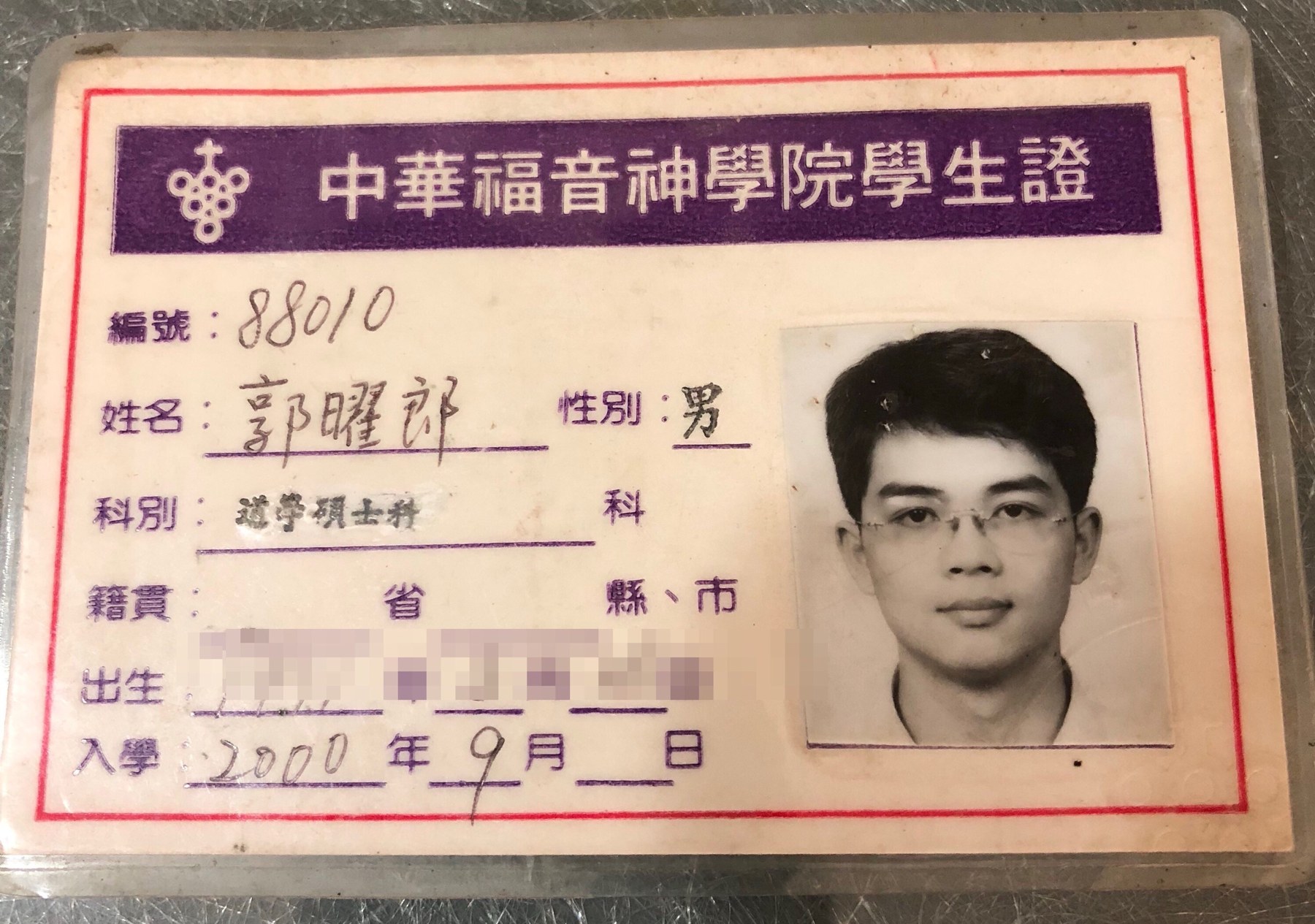
Looking at it, I remembered how, a few weeks ago at the Trio bistro, some friends at the next table were chatting about which seminaries there are in Taiwan. They had simply brought up the topic naturally, but those names, those years, and that familiar language from within the church carried me back to memories of my youth.
It wasn’t just a memory of studying. For me, it was a long stretch of waiting, testing, and confirmation. From my baptism at eighteen, to later entering seminary, more than ten years of examination — I kept asking myself: have I truly been called? Am I willing to entrust my life to a path that does not center on money, fame, or worldly achievement?
“Financial freedom” has always been a hot topic, a keyword that has stayed in vogue for years in bookstores and on social media. Some understand it as no longer having to work, some as having enough assets, some as finally being able to live the life they want. All of these are valid, except that for me, whenever financial freedom comes up, what I think of is not the rate of return on investment, nor some financial figure, but that yellowed student ID — and the road I once walked in my youth: how a person faces money, how they understand calling, and how, between reality and conviction, they explore what kind of person they want to become.
A Stress Test About Money
When I was young, I believed I had been called by God. I entered seminary in 2000 and graduated in 2003 (after graduating I didn’t go into pastoral ministry at a church; my first ministry job was editing a study edition of the Book of Galatians for the Bible Society in Taiwan). Looking back on those years, it was a deep examination of how I ordered my life’s values.
During that time, I did experience a special kind of freedom. Anyone with a little understanding of Christianity knows that tithing is a very concrete part of the life of faith. The young me once tested very earnestly just how dependent on money I really was. At the time my monthly income was about thirty-some thousand NTD, and I tried giving away nine-tenths of it, forcing myself to keep only one-tenth as living expenses. That wasn’t romanticism, nor was it a performance — it was simply a test of myself: if money was not the core of my sense of security, could I hold steady? After stress-testing it for a while, I finally found a boundary I could bear, and in the end the monthly giving I could accept was around fifteen thousand.
There is a verse that influenced me deeply: Set your minds on things above, not on earthly things. The young me carried out this conviction very faithfully. I wasn’t just paying lip service; I participated in almost every form of service the church offered. I was either at church or on my way to church; from Monday to Sunday, there was service every single day.
Faith was not my performance, nor a slogan to boast about to others, but a real condition that once existed within my life. I gave money, and I gave time, paying out in concrete ways. What I received was a sense of freedom rooted in confidence about life. That sense of freedom came not because I already possessed a great deal of money, nor because I had mastered some financial model, but because I knew clearly what I lived for. When a person is gripped by a sense of calling, money’s power to dominate recedes into the background. There is something higher in your heart that makes you unwilling to place money at the center of life. For more than ten years, I lived this way. It still shapes me to this day.
An Ideal Without the Practical Capacity to Carry It Is Another Kind of Naivety
Many years later, looking back on this journey, I can better understand what financial freedom truly means, and I can also see how naive I was back then. An ideal without the practical capacity to carry it can sometimes become another kind of naivety, even a kind of willfulness. When I was young, I sincerely believed that having a calling was enough; only later did I understand that for a calling to leave a mark in the world, it also needs resources, systems, capabilities, a team, and long-term commitment.
Financial freedom is not simply “I have enough money, so I don’t have to work.” On a deeper level, financial freedom is “no longer letting money decide who I am, how I live, and what I live for.” If a person merely has money but is still controlled by fear, comparison, vanity, desire, and the eyes of others, they may not actually be free. Conversely, even if someone is not extravagantly wealthy in material terms, if they know what they live for, and know which things cannot be traded and which lines cannot be crossed, they may be closer to freedom than many of the rich.
Aristotle noted that wealth is not the true good that life pursues; it is merely useful, existing for the sake of other ends. Money itself is not evil, but it cannot become the ultimate end. When money becomes life’s highest aim, a person slowly loses their judgment: everything can be calculated, everything can be exchanged, everything can be compromised. In the end, a person may have earned a great deal, yet not know what exactly they have lost.
So financial freedom is not only the freedom of external assets, but also a freedom of inner order.
Not Worshipping Money, and Also Not Fearing It
I don’t deny the importance of money. Having left ministry work and later entered the world of entrepreneurship and business, I understand the rules of reality better than I did in my youth. For a calling to land in the world, it needs resources; for an ideal to last over the long term, it needs systems; for goodwill to have impact, it needs organization, cash flow, expertise, and the ability to execute. Merely saying “money doesn’t matter” can sometimes be a sign of immaturity. Because a calling without resources easily remains nothing more than a fleeting moment of being moved; an ideal without experience and capacity in governance is easily worn down by reality.
I enjoy treating others, not because I have money, but because I treasure the feeling of sharing, and I treasure every genuine relationship. For me, money is not only for accumulating a sense of security; when it can be used to care for relationships, support others, and create a bit of warmth, it is no longer just an asset, but a flowing blessing.
When I was young, I learned not to worship money. In middle age, I began to learn not to fear money, and to hone the ability to earn, to govern resources, and to create value. These two things must come together for there to be maturity. Merely looking down on money will leave a calling unable to land; merely chasing money will leave the soul without direction.
Putting Money Back Where It Belongs
Putting money back where it belongs is a hard lesson: it is not God, not identity, not the only source of security; it is a tool, a responsibility, the infrastructure through which a calling can enter the world.
After starting a family, financial management is no longer a matter for oneself alone, but a principle of living negotiated together by husband and wife. Harvard’s Study of Adult Development, spanning more than eighty years, tracked the sources of human happiness and pointed out that good relationships have a profound impact on health and well-being. This resonates with my own felt sense too: the steadiness of life lies not in how many assets you’ve accumulated, but in whether you have lived as a person worthy of trust, whether you have held fast to your relationships, conscience, and commitments, and whether, at the critical moment, you refrained from trading away your character and your sense of duty for gain.
Financial Freedom Is Actually Life Sovereignty
So when financial freedom comes up, what I want to talk about is not a financial goal, but life sovereignty.
Financial freedom is a person not being driven by the fear of survival, nor manipulated by desire; they have the ability to use resources without being used by resources; they can enter the world of business without letting the logic of business devour the soul; they can build an enterprise while remembering why they set out in the first place.
I once lived through a stretch of years in which I held money very lightly. During that time, my focus was on serving the world that God called me to serve. That was a discipline of the inner self. Later I entered a more complicated world, facing enterprise, partnership, interests, risk, and responsibility, and only then did I painfully understand that the road to maturity is not the negation of money; learning the ability to be profitable is another kind of training. I learned it slowly, and I learned it late.
Looking back, every job I’ve held bears some trace of an ideal. Whether in FinTech, SaaS, agricultural startups, healthcare, sustainable business models, or various stages of entrepreneurship and partnership, in my heart I have always hoped that my work would be not only about profit, but could also contribute a little strength — responding to the world’s pain, or easing the suffering people bear.
I once set aside the worldly path for the sake of a calling, undergoing a long period of testing between faith and reality. So the me of today will not place gain above character, nor wealth above duty. It’s not that I want to prove anything to anyone, but that those years of life have left this character within me. I like this version of myself.
When a person reaches a certain age, they no longer much care how others see them, but rather whether they themselves are clear about it: which things may be pursued, and which may not be sold; which things may be lost, and which, once lost, are no longer easily found again.
For me, wealth must be pursued, an enterprise must keep being built, resources will surely accumulate, and influence will expand. But all of this must serve something higher: conscience, calling, relationships, commitment, and faithfulness to one’s own life. The grace received from Heaven is also to be given out generously, to care for more people. What we are able to give is more than we ourselves understand.
This is the financial freedom I understand.
💬 Comments
Loading...