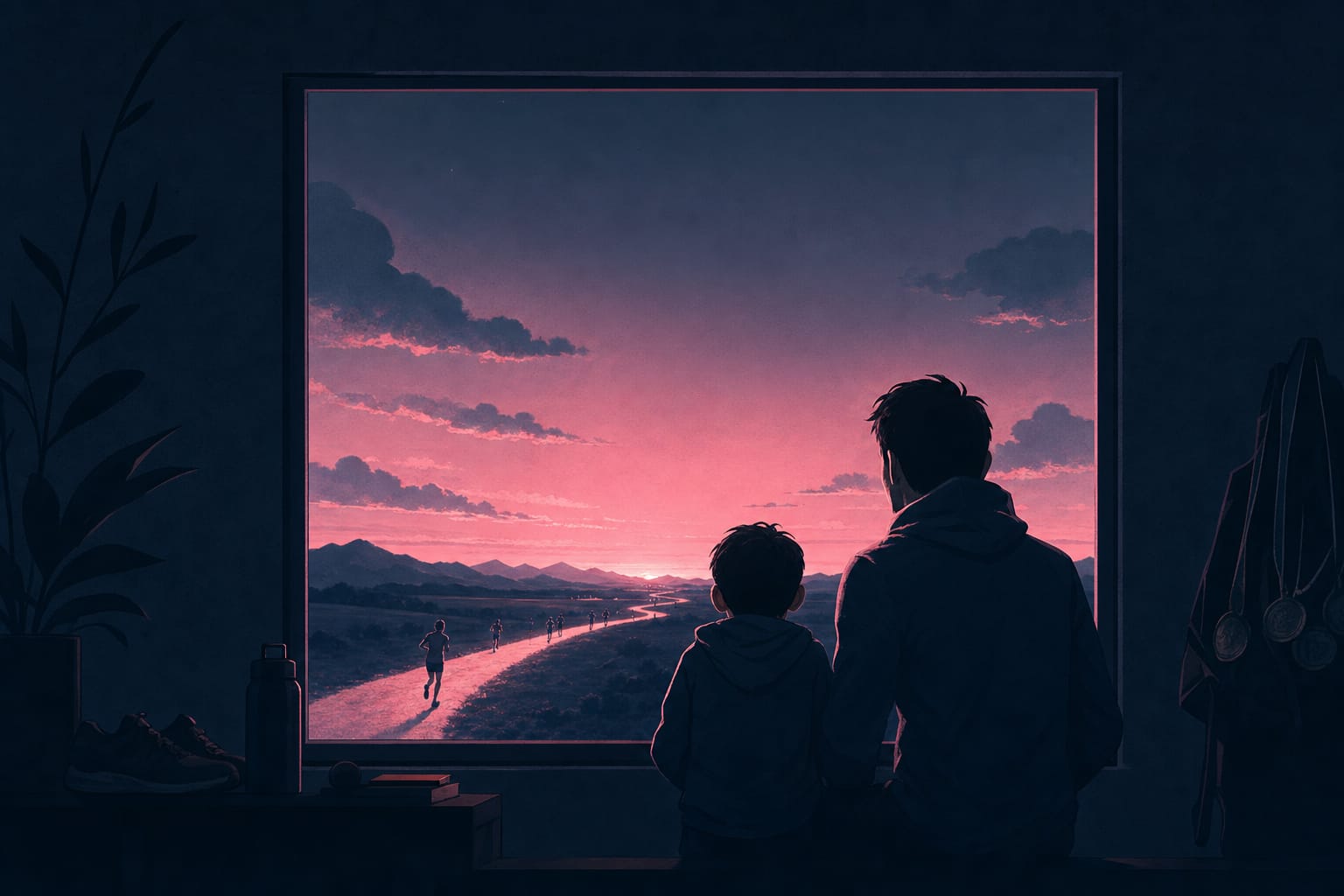
TL;DR: Our homeschool curriculum included PE, but I wanted my son to have more opportunities to build real fitness, so over five years we entered twenty races together. From swimming a single relay leg to each completing a full 51.5K triathlon, I was on the start line every time. Looking back, what stays with me isn’t the finishes. It’s the hesitation before every registration.
Every time I registered us, I wrestled with it. I kept asking myself: does my son want to race, or do I want him to race? If he was only saying yes because I’m his father, the event would carry no educational meaning at all.
And then, in that unsettled state, I clicked submit. Going back through his learning portfolio, I counted the races: twenty events from 2017 to 2021. Road races, marathon relays, ultra-cycling challenges, triathlons.
Every one of them, I entered too.
Someone once asked why I needed to compete myself.
My thinking was straightforward. I didn’t want to ask my son to do something I wasn’t willing to do. And I needed to remind myself not to make his life an extension of mine.
If I believed exercise mattered, it should show up in my own life first. If I believed authentic tasks build a person, then I should accept what authentic tasks demand of me. When parents ask children to do something while remaining on the sideline themselves, the child may never quite believe it matters. I held myself to both word and example.
I came to think, slowly, that being a model isn’t about persuasion. It’s about carrying something together.
PE in a Homeschool
A bit of background: our homeschool institution did have PE. The teacher was genuinely committed. During the pandemic she designed a group game called “Sports Bingo” to keep the subject alive over video calls. My son wrote honestly in his end-of-year report: “The rules weren’t complicated, but running it over video turned into complete chaos! … I barely knew what I was doing for the entire class.” The problem wasn’t the teacher. It was the structural ceiling of the format: however inventively you design scheduled PE, you get those few periods. During the pandemic, those periods were behind a screen.
I’ve written elsewhere, in The End of the Solo Traveler, about how physical education tends to be treated in Taiwan as a supporting subject to academics. I wanted more for my son’s fitness than the timetable could provide.
Our approach is something I recorded in my parent self-assessment in the 2020–21 academic year report, unchanged: “I didn’t develop consistent exercise habits myself until I was past forty. Exercise has improved my energy and complexion, and it’s how I decompress. So we’ve built strength training and race participation into our homeschool framework as physical education.”
Competition as Authentic Task
This series has examined the five conditions of authentic tasks: purpose, audience, time constraint, a required outcome, and the genuine possibility of failure. Remove one, and the task regresses into simulation.
Going back through these pieces years later, I realized what had drawn me in wasn’t triathlon specifically. It was the authentic task itself. Triathlon was just one form it could take.
A race already has purpose, a deadline, an outcome, and real stakes for failure. It doesn’t need a parent to engineer the scenario or a teacher to set it up. The moment registration is complete, the world starts making demands. I remember one race where I had no way to confirm whether my son had made it through the swim and onto the bike. I was riding my own course, sick with worry, afraid he might have run into trouble in the water. It wasn’t until I saw him in the run segment that I knew he was safe. For those two-plus hours I couldn’t concentrate on my own race at all. I kept thinking: if something has gone wrong, I’m the one who brought him here.
The finish line is the purpose. The race organizers, the timing chips, and the thousands of other athletes on the course are the audience. The gun and the cutoff times are the constraint. The results sheet is the outcome. DNF (Did Not Finish) is the failure option that actually exists. There’s nothing to design. Submit the entry form, and the task is real.
The training schedule builds itself. You don’t need to tell your child to get up for a morning run; the cutoff time will make the case for you. During the pandemic year, my son wrote in his report that he was out the door for training between 4:30 and 5:00 a.m. most mornings, running at least 2K. The coach at the gym who worked with him on strength training was only a few years older. Their sessions had the feel of an older brother showing a younger one the ropes. Once the training was professionally structured and placed on a schedule, it got done.
Twenty Races Over Five Years
2017: the National Triathlon Championship at Meihua Lake in Yilan, sprint relay. He took the swim leg: 0.75K. Three people, one race.
2018 was the year things expanded. He moved from the swim leg to the run leg in the relay, completed his first 21K half marathon, and added the Standard Chartered 10K, a railway marathon relay, and the SEIKO City Run. The same year brought two ultra-cycling challenges: the 300K Hualien Huanluan, and the 520K Taiwan Longitudinal Challenge.
From 2019 to 2020, the half marathon became a regular distance. In 2020 we stood on the start line of Challenge Taiwan for the first time: the full 51.5K standard triathlon, 1.5K swim, 40K bike, 10K run, completed by a single athlete. Both of us finished. We returned in 2021 and finished again. No relay partners this time. One person, all three disciplines. The distance from three people sharing one race to one person completing the whole thing.
In the first half of 2021, races stacked up into something that was literally a timetable: five trail run events within a ten-week span, plus the Fenggui Mouth National Marathon.
The long record was useful in a practical way: every race produced a chip time, a finisher’s certificate, and an official result. When those records went into his university application, I didn’t need to vouch for any of it. The documentation had always been public.
On the Start Line Every Time
The series introduction describes the adult’s role as designing the environment, asking the hard questions, providing resources, and holding the boundaries. In this particular course, I pushed that role one step further: I wasn’t on the sideline.
I wasn’t his coach. He had a coach for that.
I was another bib number in the same race.
That changed a great deal. The course levels the power between a father and a child. Cutoff times don’t care about family structure; the clock doesn’t ease up because you’re someone’s parent; the aid stations treat everyone the same. The father he saw out there had stepped down from the role of life-planner. What was left was a man in his mid-forties, breathing just as hard as he was.
In the parent section of his application materials I wrote: “I competed in every race alongside him. Beyond treating it as PE — building physical fitness and mental toughness — it was also time together away from the ordinary rhythms of work and school.” Looking back, the second sentence may be the more important one.
The 520K Day: Each of Us Racing Our Own Race
The 2018 Taiwan Longitudinal Challenge (520K in a single day, from the northern to the southern tip of the island) is the event I return to most often when I think about what we did together. He was in ninth grade. The finish line was at Eluanbi in Pingtung.
He made it to Tainan before his leg gave out. He decided on his own that he couldn’t continue, rode on to Kaohsiung, and stopped there to wait for me.
I kept going. I finished the route, then took a car back to Kaohsiung to get him.
That day he didn’t finish. I did.
There are a few ways to tell that story. The inspiring version says he showed grace in defeat. The critical version asks why I didn’t stop with him. I want to offer a third version: he made the right call. When you’re injured, you stop. That’s not giving up; it’s judgment. I wrote in I Can’t Prove This Was the Right Path that a child must have an exit that carries no blame. The race course is no different. DNF has to be an option a person can choose with their head held high; otherwise finishing isn’t the child’s choice, it’s obedience.
As for why I kept riding: that was my race too. We were on the same course, but the finish line was always each person’s own. Still, my son’s injury stayed with me the whole way.
I didn’t ride those last kilometers in any peace of mind.
I knew that respecting his decision mattered more than stopping alongside him, but being his father made it impossible to simply let go of the worry.
The Doubt Doesn’t Go Away. You Just Learn to Be Honest About It.
Which brings me back to that moment before clicking register.
Twenty races over five years, and the doubt never lessened once. I was always afraid he was simply going along with me. In the reflection piece for this series I asked myself whether I had been mistaking his cooperation for his consent. The question is sharpest here, because the hand that submitted the entry form was mine.
I don’t have a clean answer. I have checkpoints: he could say no, and I would mean it; he could stop if he got hurt, without being blamed. And I have one piece of evidence that surprised even me. In his own application materials, he wrote: “Every time I’m in the middle of a race, I swear I’m never doing this again — and then after it’s over, I register for the next one.”
The person who swore off racing was him. The person who kept registering was also him. The distance between those two sentences is what this PE class actually taught.
What This Course Costs
Following the convention of this series, the costs deserve a clear accounting: entry fees, equipment, transportation, discipline across many early mornings, and the real risk of injury. There’s one cost that tends to go unmentioned: the father has to train. I didn’t develop consistent exercise habits until I was past forty. Not every parent wants to pay that price.
So this isn’t an argument that every homeschool family should race. It’s the physical education version of the point the series introduction makes: group experiences need to be designed intentionally and placed on the schedule. You can’t wait for them to appear on their own. The way we put physical education on the schedule was to use Taiwan’s race registration system.
At the end of the triathlon piece I wrote that training together carries far more educational weight than the metabolic benefits alone. After twenty races across five years, I want to add one more line: for a father and a son, sharing a start line means more than any results sheet.
Twenty races later, I didn’t come away with a method anyone could copy.
What I find myself coming back to is a question I keep putting to myself: the hardest thing in education isn’t arranging the right experiences for a child. It’s asking yourself first whether you’re willing to become what you hope your child will see.
I can’t promise he’ll love sport. I don’t know whether, grown up, he’ll look back on these choices and think I got it right.
But at least for those years, every time we stood on a start line together, we were both learning the same thing: people move at different paces, no one can run your race for you, and a parent shouldn’t be the one to decide where your finish line is.
Looking back now, what five years and twenty races left behind isn’t a record of results. It’s the days we spent moving through the same world at the same time. The one who got an education wasn’t only my son. It was me too. Whether every call I made back then was right, I still can’t say with any confidence. Being a father, I suspect, is probably like running: you’re not meant to be sprinting the whole way. You’re meant to keep adjusting your pace.
💬 Comments
Loading...