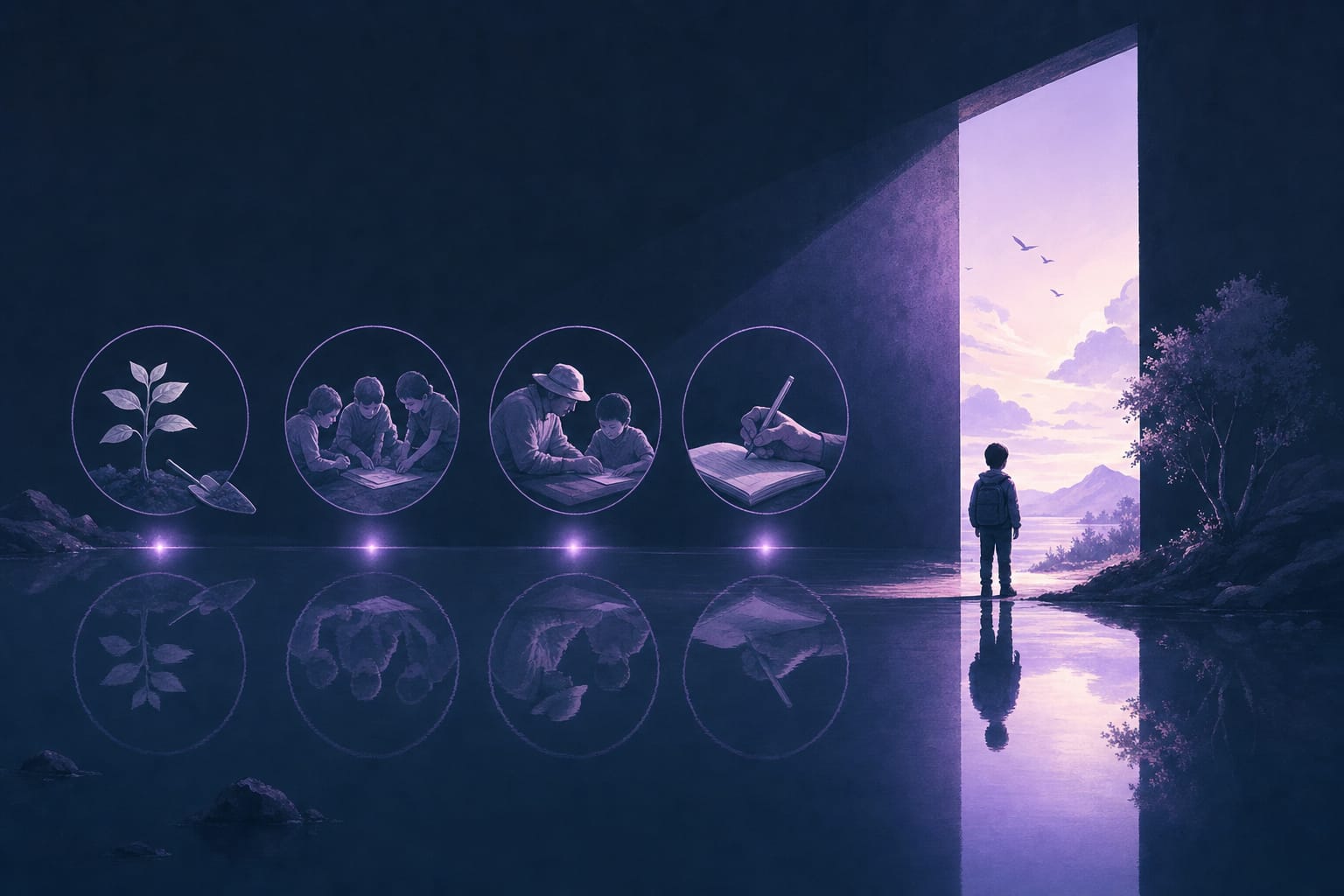
TL;DR: I organized ten years of self-directed education materials into a single folder: more than 2,300 files, from lesson designs and assignment briefs to mentor contracts, insurance receipts, Seesaw learning records, and university application portfolios. This overview essay is my answer to those ten years. The value of alternative education lies not in leaving school, but in redesigning how a child encounters the real world. Four conditions must hold simultaneously: real tasks, collaborative community, adult facilitation, and long-term documentation. Without any one of them, education drifts toward slogans and activities.
Recently I gathered ten years of self-directed education materials into a single folder. More than 2,300 files: mentor contracts, insurance receipts from field visits, learning records logged one by one on Seesaw, an e-commerce website built by four middle schoolers, a travel assignment from the Kumano Kodō, and a complete university application portfolio.
Looking at these files, I found I had only one question worth answering: across these ten years, what actually made learning happen?
This article is my attempt at an answer, and the entry point for the education series on this site. The conclusion first: the value of alternative education lies not in whether a child leaves school. It lies in redesigning the way a child encounters the real world. For that redesign to hold, four conditions must be in place at once: real tasks, collaborative community, adult facilitation, and long-term documentation. Without any one of them, education tends to collapse into slogans or activities.
Does School Still Serve a World That Moves This Fast?
Conventional schooling excels at handling standard problems in a stable world. It segments knowledge into subjects, growth into semesters, and outcomes into scores. This system once worked, because society needed large numbers of people who could follow rules and perform reliably within established organizations.
The problem is that the world children will grow into looks less and less like the world that system assumed. Knowledge is updated faster, industry boundaries shift, and work is fragmenting. AI has made answers cheap; asking good questions, exercising judgment, and taking responsibility have become scarce. Once a child can look up any answer in seconds, education cannot stop at “knowing the right answer.” It has to push further: Can the child define the problem? Can they turn a vague idea into an executable plan? Can they work with people whose expertise differs from their own? When they face unfairness or failure, can they work out where they stand and then act?
The folder holds ten years of educational materials. Every file grew, slowly, out of those questions. Sorting through them produces no ready-to-copy SOP, and no success story in the familiar sense. It reads more like an archive of an experimental family, recording how one family, alongside teachers and mentors, found its way through trial, correction, and sustained accompaniment. It is also, on a more personal level, my own record of ten years spent alongside my children. Those years were not only an educational experiment. They were, in the limited span of my life, ten deeply precious years.
Flipping Opens a Path; Climbing Gets You Through It
The pairing of “flipping” and “climbing” comes from two kinds of educational practice I have watched over these years. One spends its energy helping children open alternative paths outside the system. The other stays beside the child once they set out, accompanying them step by step through real difficulty.
Flipping opens a path. Climbing is how you get through it.
Both are necessary. With only flipping, education stops at departure from the original road. Climbing is what begins to answer the harder question: after leaving that road, what did the child actually grow into?
Ten years ago, this kind of choice was uncommon in Taiwan. Today it is a global movement. Tracking data from Johns Hopkins University shows that homeschool enrollment in the United States grew nearly 5% in the 2024–2025 school year, roughly three times the pre-pandemic growth rate, with more than a third of states reaching all-time highs. Yet the language of this movement mostly stays at the flipping stage: choice, funding, leaving the system. Far less is said about the climbing that follows.
International education discourse has flipped classrooms, agency, and resilience, but no word yet captures the full arc of opening a path, then climbing through real difficulty, then translating that growth into language institutions can understand. This series tries to supply that gap with the concept of climbing.
What Real Tasks Teach That Classrooms Cannot
In July 2018, I worked with four middle schoolers to build an e-commerce website over a single summer. The opening weeks were rough: back-to-back working sessions, and at the end of them the site had not moved. Then, about a month in, a fully presentable result appeared: a website that genuinely impressed at the final showcase. It confirmed something I had underestimated: children’s capacity to learn.
The early stalling was not wasted time. It was a necessary stage. What looked like a progress problem turned out to be a conceptual one. The students were rushing to build pages before they had answered the most basic business questions: Who are we? What do we offer? Where is the value? How does a customer actually complete a purchase? Without those answers, any design was just decoration with nowhere to land.
In a conventional classroom, students can move through discussions using abstract vocabulary (branding, marketing, business model) and the words all seem understood. But when they had to turn those words into a functioning homepage, product pages, and a purchase flow, every vagueness surfaced immediately. A test cuts the problem into pieces, draws the boundaries, and prepares the expected answer. A real task throws technology, narrative, commerce, and collaboration together all at once, and the child cannot answer just one part. Everything has to be integrated into something that actually works.
So the website project was never really about learning tools. Tools were just the vehicle. What demanded to be learned was systems thinking: working backward from purpose to structure, submitting intuitive ideas to rational review, fitting personal contributions into a team process, and collaborating deeply with people who think differently. I wrote the full account of that summer’s thinking in System vs. Intuition in Planning.
The results are often rough, sometimes very rough. The point of the education is not whether the first version looks polished. The point is that the child has to understand: a working outcome requires clear thinking behind it.
Why EQ Has to Be Practiced Where Other People Exist
Modern educational language tends to frame the child as an individual: my interests, my gifts, my portfolio. This framing seems to honor the person, but it quietly removes a crucial arena: the group.
After ten years I am increasingly certain: the relational capacities within emotional intelligence, including collaboration and a sense of responsibility, require practice in a world where other people are present. To learn to work with others, a child has to actually work with others. To learn to compromise, they have to actually encounter disagreement. To learn accountability, they have to be in a situation where their choices visibly affect someone else. These capacities are difficult to build through instruction alone. They require context and friction, shared goals, and adults nearby who can intervene at the right moment to turn a conflict into learning material. That is what social-emotional education actually looks like.
Why camps, team projects, and relay sports (nominally “extracurricular activities”) are in fact the central arena: I made the full case in Emotion Happens in Relationship and The End of the Solo Runner.
Homeschooling Is High-Density Educational Design
Homeschooling is often romanticized, as though leaving school naturally leads a child to discover their passion. That framing undersells what is actually involved. Homeschooling is more like a joint venture.
The parent’s role shifts from grade monitor to learning environment designer, and that role is heavier and harder. You think together with the child about which tasks fit, what resources are needed, how to pace the schedule. You face setbacks, organize outcomes, and handle the logistics of interfacing with external institutions, much of it in territory where you yourself are learning as you go. I wrote about that experience in The Truth About Homeschooling, and the resource-war dimension in The Brutal Test of School-at-Home.
The least romantic files in the folder are, ironically, the most revealing: timetables, holiday plans, mentor recruitment documents, contracts and appointment letters, insurance receipts from field visits, project cost and time logs. These look like administrative work. They are actually the structural foundation that makes education possible. Without them, alternative education easily becomes an accumulation of activities: the child attends many experiences without forming a coherent thread of capability; produces many pieces of work without reflecting on them.
Mature alternative education does not mean less management. It means shifting management from standardized control to individualized design.
How Do You Prove a Child Is Actually Growing?
The answer, stated plainly: through a long-term accumulation of capability evidence, and you have to start saving it from day one.
In the conventional system, grades are the most legible proof: compact, comparable, sortable. But the capabilities of alternative learners are often invisible to scores. A child may have completed projects, planned a journey, received mentor feedback, written reflections. All of these are genuine evidence of capability. Without organization, they remain scattered files.
The folder holds years of Seesaw learning records, semester feedback reports from 無界塾, project outcome reports, and eventually a 特殊選才 application portfolio. Laid out in sequence, the nature of a learning portfolio becomes clear: it is an evidence base for capability. A strong portfolio answers specific questions. What tasks has this child faced? What choices did they make? What difficulties did they encounter? What did they produce, and how did they reflect on it? What capabilities do those experiences, taken together, demonstrate?
This is especially important for alternative learners. A child who did not take the standard path needs, all the more, to translate that path into language institutions can read. The 特殊選才 application and its supporting portfolio are fundamentally a conversation with an institution: the child uses work and records to tell the outside world, I grew differently, and here is capability you can examine.
Educational Innovation Cannot Be Romanticized
Among the most worth preserving in this archive, alongside the ideals, are the constraints.
Alternative education depends heavily on family resources: time, money, networks, administrative capacity, and emotional resilience. Lacking any one of these, the design does not last. Not every family can sustain this level of investment over the long term. Ignoring that turns educational innovation into a success myth belonging only to families with ample resources.
It also depends heavily on the quality of the adults involved. A skilled teacher or mentor can open the world to a child; an immature adult can cause real harm. That is simply the nature of the real world. When children enter it, they will encounter people who are unfair and unreliable. Education cannot pretend otherwise. It has to teach children to recognize such situations, name them, negotiate, and when necessary, push back, firmly, but with civility.
Privacy governance is also required. Making an educational philosophy public is not the same as publishing a child’s life records. Learning records, assessments, application materials, and photographs all need to be sorted into distinct versions: for internal family use, for anonymized research, for public articles. This article and the entire series makes public the methods, structures, and reflections. Details that could identify individuals stay within the family.
Finally: one family’s success cannot be copied directly. The value of a case study is the set of design principles it makes available for thinking. Every child’s path still has to be designed from the beginning.
Five Design Principles Worth Keeping
One: Give children real tasks. Real tasks have a purpose, an audience, a deadline, concrete deliverables, and the genuine possibility of failure. Simulations do not supply these.
Two: Put freedom inside structure. Open exploration needs rhythm, documentation, feedback, and revision. Without structure, freedom tends to become looseness. All structure with no freedom is just standardized control under a different name.
Three: Design group experience deliberately. Children need to practice collaboration, compromise, and accountability in a world where other people are genuinely present. Social-emotional development is core training for future capability. Schedule it rather than waiting for it to appear on its own.
Four: Let adults be learning environment designers. The work of parents, teachers, and mentors is to design the setting, ask the pressing questions, provide resources, hold the boundaries, and help children, at the right moments, turn experience into understanding.
Five: Begin saving capability evidence from day one. Work, records, feedback, and reflections need sustained organization. Going back to assemble a portfolio at application time is too late. A compelling learning history is built by accumulation.
The Whole Sky Is Yours
In 2017 I wrote an article on flipping and climbing with the subtitle “Growth is like flying — the whole sky is yours.” Looking back ten years later, I would make that sentence a little more honest: the sky is yours, but you have to fly through it yourself, and there will be turbulence.
Clearing every obstacle for a child is not education. Education is designing a path with enough real challenge and enough support that, after one climb and then another, the child gradually comes to know who they are, what they can do, and what they are willing to be responsible for.
This is the first article in the education series. The ones that follow will open out from here: the summer e-commerce website project, an unexpected international assignment on the Kumano Kodō, the design of the mentor program, and how a non-standard path can be made legible to university admissions. For more on education and the broader arc of life: Reflection and Memory → Education.
💬 Comments
Loading...