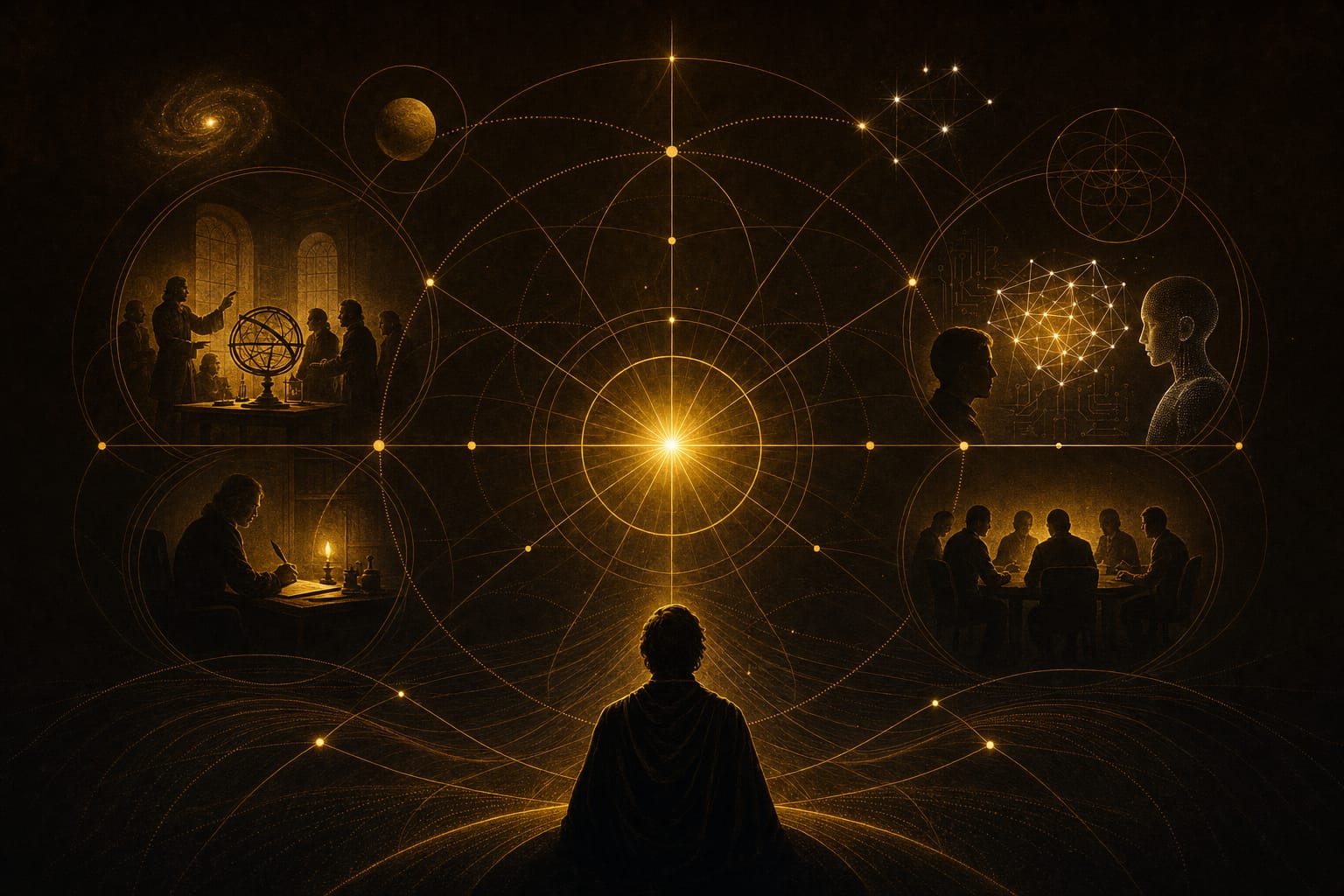
TL;DR — The opposition between “science and faith” was not there from the beginning. That boundary was drawn only gradually, in the nineteenth century. In 1665, the Royal Society’s generation regarded the study of nature as worship; Oldenburg’s Philosophical Transactions lit the institutional intuition of separating creation from judgment. Three hundred sixty-one years later, Anthropic lets AI submit to independent evaluators, using the very same ancient principle: take nobody’s word for it, including your own. The debate over AI theology that churches in Taiwan face today is not a new problem, but the sequel to this long-running conversation.
March 6, 1665, London. A German named Henry Oldenburg dug into his own pocket to print the first scientific journal in human history: Philosophical Transactions. He probably did not realize that what he had casually invented was not merely a journal, but a mechanism for separating “generation” from “judgment.”
Three hundred sixty-one years later, Anthropic built that same boundary into AI; and in Taiwan, some churches are arguing over whether to let AI help write sermons.
If you think these three things have nothing to do with one another, that is exactly what I want to talk about. Because they are one and the same conversation, spread across more than three centuries.
The Boundary Between “Science and Faith” Was Drawn Only in the Nineteenth Century
Let us first dismantle an assumption modern people almost never question. We are used to imagining science and faith as two separate, even opposing threads. On one side: reason, evidence, falsifiability. On the other: revelation, authority, the invisible.
This sense of opposition feels so natural. So natural that when we talk about AI, we automatically map it on too: technology over here, faith over there, a river running between them, each side shouting across. The problem is that this ditch was dug rather late.
The word “scientist” was not coined until 1833. The people of 1665 were not called scientists; they called themselves “natural philosophers.”
And the framework of “science and religion in conflict with each other” has a name among historians: the conflict thesis. It is a product of the Victorian era, popularized by two bestsellers, Draper’s in 1874 and White’s in 1896. Contemporary historians of science abandoned this simplistic account long ago.
Here I need to explain clearly, or it will sound like special pleading. Where exactly did Draper and White go wrong? They told two thousand years of history as one long war of religion suppressing science. But later historians of science checked the record item by item and found that most of this “war’s” signature stories were cherry-picked, exaggerated, or even fabricated out of thin air.
The easiest to spot is “medieval people thought the earth was flat.” This is simply not true. Educated Europeans had known the earth was a sphere since ancient Greece; the astronomy textbook of the medieval university, Sacrobosco’s De Sphaera, opens by explaining exactly this; even the cosmos in Dante’s Divine Comedy is round. The story that “the Church forced everyone to believe in a flat earth” was dramatized only in the nineteenth century: Washington Irving embellished it vividly in his 1828 biography of Columbus (in fact, what Columbus argued with scholars about was how large the earth was, not whether it was round), and it was later amplified by Draper and White into a template for “science against the Church.”
The Galileo affair is the same; laid out in full, it is not so clean. Heliocentrism did genuinely conflict with the Church’s biblical interpretation at the time, and there really was a ban issued in 1616, so that part is no fiction. But it is far from “reason against superstition.” Galileo initially had the Church’s backing, and Pope Urban VIII was once even his friend. Part of why the falling-out happened was that in his Dialogue Concerning the Two Chief World Systems, he put the Pope’s arguments in the mouth of a character called “Simplicio” (a name taken from an ancient commentator on Aristotle, but read as a pun on “simpleton”), and the Pope felt he was being cast as a fool; add to that the political climate of the Counter-Reformation and the enemies Galileo had made along the way.
More crucial is the reverse side: the medieval Church was in fact the biggest patron of science at the time. Europe’s earliest universities largely grew out of the Church’s cathedral schools; the Church funded astronomy for the long term in order to calculate the date of Easter. And it holds looking forward, too: Copernicus himself was a cathedral canon, Mendel the father of genetics was a monk, and Lemaître who proposed the Big Bang theory was a priest.
This is a consensus in the history of science, not one person’s private revisionism. The new orientation that succeeded the conflict thesis has a name: the complexity thesis, made classic by John Hedley Brooke’s Science and Religion in 1991. Its point is this: the relationship between science and faith was never a war, but more like a relationship, at times tense, at times mutually nourishing, entangled over several centuries.
In other words, the “science versus faith” ruler we reach for today to measure AI is itself a nineteenth-century invention, and one that professional historians have already returned to the manufacturer.
You might think: but doesn’t everyone still take it this way? Yes, and that is precisely the point. Professional historians sent that ruler back a century ago, but it got stuck in popular culture and never updated. When we casually pick up “science versus faith” to measure AI, we are using an expired product the maker itself has recalled.
So what was the situation in 1665? The Royal Society was founded in 1660 at Gresham College in London and received its royal charter from Charles II in 1662. Its founders, men like Robert Boyle, Christopher Wren, and John Wilkins, explicitly framed the study of nature as “manifesting the glory of God and benefiting humanity.”
Boyle left money in his will to establish a series of lectures dedicated to defending Christianity. Newton privately wrote a vast body of theological manuscripts; by some estimates, they exceeded a million words, more than his writings on physics.
For them, opening the book of nature was, like opening the Bible, worship of the Lord. The study of nature was not the rival of faith; it was once a form of faith.
In 1665, What Exactly Did Oldenburg Invent?
So what exactly did Oldenburg do that is worth revisiting more than three centuries later? What he did, in today’s terms, was invent “submission.”
When someone sent him their research, he would not publish it directly. Instead he first sent it to members of the Society who understood the subject, to be read and evaluated, before deciding whether to publish it. This act is widely regarded as the prototype of the modern scientific journal, and of peer review.
Of course, this is not to say that fully institutionalized peer review existed in 1665. The historian of science Aileen Fyfe notes in her research that the three centuries from 1665 to 1965 look more like a prehistory of peer review. Genuine institutionalization came much later: the Royal Society did not establish a Committee of Papers until 1752, did not have formal written referee reports until 1832, and did not add specialized sectional committees until 1896.
Oldenburg in 1665 merely lit that intuition. But that intuition is the point, and its meaning is: you cannot be the judge of your own case.
The Royal Society cast this into a motto, a line of Latin: Nullius in verba. The phrase comes from the ancient Roman poet Horace, and the official translation is “take nobody’s word for it.” It is a discipline: for a claim to count, it must first pass a check by someone other than its author. Even the author cannot vouch for it on his own confidence alone.
Newton took this lesson firsthand. In 1672, he submitted his new theory of light and color to Philosophical Transactions. Robert Hooke raised criticisms within about a week, and also disputed priority with him. The young Newton was furious.
But that is exactly how this mechanism works: the author is responsible for generation, others for judgment. Truth is drawn out in the tension between the two, rather than established by one author’s confidence alone. The right to create and the right to judge were deliberately separated. This is the invention that truly mattered in 1665.
Why Does AI Need a “Judge”?
Back to 2026. Watch how AI companies build their agent systems, and you will find they are reinventing Oldenburg.
In its engineering document Building Effective Agents, Anthropic describes a workflow called evaluator-optimizer: one model is responsible for generation, another for evaluation and feedback, the two forming a loop. In multi-agent systems, they also deploy dedicated “verification subagents,” whose task is to check whether what other agents produce is correct.
This is the separation of the right to create from the right to judge. Only this time, both sides of the separation are machines. Why do this? Because a model has trouble reliably judging the quality of its own output.
Here I want to be more careful than the excited claims: this is more like a directional observation, not yet a law. On hard reasoning and planning tasks, especially when external signals are lacking, a model’s self-assessment is indeed unreliable; but on certain tasks, methods like self-consistency still work.
Incidentally, treating “a model will overestimate itself the way people do,” the so-called Dunning-Kruger effect, as a general rule for AI does not really hold up. Research in 2026 found that Claude, relative to the consensus of other models, systematically underestimates itself instead. People can fail to know what they do not know; a machine’s flaws need not take the same shape.
Set aside these details, and the core intuition is the same as in 1665: you cannot be your own only judge. Three hundred sixty-one years later, humanity has written this line all the way from the journal’s refereeing system into the agent architectures inside silicon chips. This thread has never once broken.
This is not merely a question of engineering design. For the church, what it really touches is a theological question: when generation becomes easy, to whom should the right to judge be handed?
To Ask “Will AI Replace God” Is to Ask the Wrong Question
While engineers rebuild this boundary inside machines, churches in Taiwan are colliding with the same conversation from the other end. Only much of the time, they may be asking in the wrong direction.
Open the Christian media of these past weeks and you will see headlines like this: “Theology versus AI,” “Do not let AI replace God,” “Will AI replace pastors?” This framing is itself a straw man.
“AI replacing God” is a category error. God is not a function, not a job opening an AI has a chance to fill. To set up a threat that no one is actually building, and could not build, and then knock it down, is to wrestle with a shadow.
What holds up this straw man is a binary way of thinking: technology on one side, faith on the other, a life-or-death battle line running between them. This skeleton is precisely the one dismantled at the start of this article: the nineteenth-century conflict thesis that set science and faith against each other, now wearing a 2026 clerical robe.
And binary opposition leaves people with narrow options. Put AI in the position of an enemy, and it becomes easy to demonize it, as if it were a false god come to steal the faithful; put AI in the position of a savior, and it becomes easy to accept it uncritically, as if it could finish preaching the gospel for us. Both make a tool out to be bigger than it should be.
Of course, serious pastors and scholars speak far more subtly than these headlines. Wang Tao-wei of Tsinghua argues that the church should intervene early and treat AI as a tool, and even, from a “theology of hope,” proposes that the church should use it for “the common good,” improving the quality of communication between people; Elder Pu Cheng-ning goes further, saying the church can train its own dedicated model, feeding in biblical commentary, sermons, and theological materials to safeguard the accuracy of how the faith is told; Pastor Zhang Jun-ming warns against letting members rely only on the spiritual resources AI provides and stop investing in the real community, hollowing out the church’s cohesion.
But looking one layer deeper, I still sense a shared undertone running through them: defense. Whether it is intervening early, building one’s own model, or protecting the community, at bottom all of them treat AI as an external, encroaching opponent, and the church’s task is to fend it off. This is still binary opposition, only with the volume turned down.
The people of 1665 did not view nature this way. They did not feel they were at war with nature; the study of nature was itself worship. With no battle line, there is nothing to fend off.
Two voices have stepped out of this frame. One says: AI will not replace pastors; what is truly changing is the order of faith. This amounts to admitting that “replacement” is the wrong question. When a person grows used to asking AI first, and God and their brothers and sisters second, the danger lies not in how powerful AI is, but in how a person hands themselves over without noticing.
The other voice does not get tangled up in “is AI a threat,” but turns back to ask: on what grounds does a person have worth at all? An article from CCCOWE approaches it through imago dei, the “image of God”: a person’s worth is not grounded in ability, but in the fact that “the human being is made in the image of God.” This cut lands exactly where AI presses in hardest. If worth equals ability, then the day ability is overtaken, the person is devalued; imago dei replaces the entire foundation of worth, placing it where ability cannot reach. However powerful AI becomes, it cannot move that foundation.
Both of these voices return to that older question: what is the core that cannot be handed over, and where should the right to judge stay. So when I put these voices together, what I hear is neither panic nor “technology has arrived, faith is finished.” It is that intuition from more than three centuries ago, speaking again within the church.
Take Nobody’s Word for It, Including the Machine’s
My own thinking is this. I have a background in theological training, and I am also an entrepreneur who uses AI heavily every day. My daily workflow is itself a system of “separating generation from judgment,” this very piece included. I never let the same AI both generate and judge its own work. I have different roles review one another and catch each other’s errors, and in the end I make the call myself.
It was only in preparing this article that I realized what I do every day is, in effect, applying Oldenburg’s line of Latin to AI agents: take nobody’s word for it, including no single model’s word, and including not even my own. This is also a thread I keep circling back to under the theme of “Civilization and Humanity.”
This gives me a perhaps rather different reading of that church debate. Back to the question at the start: should we let AI help write sermons? Follow this thread, and the answer is not a simple yes or no. You may well let AI generate a draft, help you look up passages, sketch a structure. What cannot be handed over is the judgment: whether this sermon is faithful to the truth you know, whether it serves the people before you. That judgment must stay within the intermingling dialogue of the pastor, the community, and the Bible. It cannot be outsourced to a model.
A sermon is not merely a piece of content. It is also the way a community judges its own situation. This is why the question is not only “who writes it,” but “who carries this narrative.” Read in the spirit of Byung-Chul Han’s The Crisis of Narration, our age is not short of stories. It has too many of them, and too few narratives that can settle people down.
A story can catch your attention; a narrative has to carry a life. AI can help organize, polish, and draft a sermon. But faith cannot be outsourced, testimony cannot be ghostwritten, and a pastor cannot hand his own wrestling before God over to a machine. AI can help you say things more clearly, but it cannot believe for you. It can generate content, but it cannot generate a community’s shared memory, pain, hope, and burden.
In the information society, everything becomes fragments: news, data, posts, takes, stories, short videos. Information is fast, narration is slow. Information seeks immediacy, narration needs to settle. Information answers “what happened,” narration answers “what this means for us.” Han holds that when the world is cut into pieces by the flow of information, it becomes hard for a person to live within a time that has before and after, inheritance, and shared memory. And preaching is precisely the gathering-up of fragmented information and the Word of God, back into a stable community of narrative.
I wrote in “The Real Context of the Reformation” that Luther’s success in 1517 was inseparable from printing. Printing terrified the Church at the time too, because it broke the Vatican’s monopoly on the reproduction of knowledge. Five hundred years later, we call it a liberation.
The same structure is playing out again. For the transmission of faith, AI may well play the role of this generation’s printing press. It will surely change the way faith is passed on. The question was never whether it can be blocked, but this: what is the core that cannot be handed over?
The people of 1665 demonstrated an attitude. Facing a powerful new tool, they neither demonized it nor rushed to embrace it blindly. What they did was: first place it within a checking mechanism of “take nobody’s word for it,” and then decide how much to trust it.
They did this with nature. We today can do this with AI. Handing the right to judge over to a checking mechanism that transcends individual confidence does not diminish faith in the least. It is itself deeply built into the faith of the Royal Society’s founders. They studied nature because they believed there was a Designer. They took no one’s word, including their own, because they knew they were not that Designer.
I discussed in “The Necessity of Incarnation” that AI’s core flaw is at the level of ontology: it has no body, no vulnerability, and it does not die. Perhaps for exactly this reason, what a person should truly hold on to in this conversation was never something like “I am smarter than the machine,” which will sooner or later be overtaken. What should be held on to is something else: the humility of “I know I need to be checked,” this bodily awareness. This is a posture a machine can imitate but cannot truly possess. The greatest difference between us and AI may lie not in intelligence, but in vulnerability, in compassion, and in the capacity to pursue truth within story.
The Same Question, Three Hundred Sixty-One Years Later
That little pamphlet Oldenburg self-funded to print in 1665, and the Royal Society’s line “take nobody’s word for it,” still ask us the same question today. Only this time, what is sent to be checked has gained a new member: AI. And whether to hand over the final right to judge, and to whom, the ones standing in this position are still ourselves.
The Royal Society did not finish answering this question for us. They left only that line of Latin, and an intuition that has still not expired to this day: take nobody’s word for it, including your own. So what remains in the end is not a technical choice like “should the church use AI,” but whether the church still remembers what it believes.
We can still believe there is a more transcendent being. Before the sun, the moon, the stars, and the vastness of the universe, we can still acknowledge that human beings are small creatures, and faith can still give us direction. The premise is that our theology, too, needs to be transformed by the renewing of the mind: believing in the Holy Spirit, the holy catholic Church, the communion of saints, the forgiveness of sins, and the life everlasting.
💬 Comments
Loading...