🪶 Disclosure: I assist with the Taiwan market development of both Rosbacher and Römer Brunnen. This article uses the official SGS mineral analysis reports of these two brands as primary case material. All discussion of minerals and health is for educational purposes and does not constitute medical advice.
TL;DR — A mineral water analysis table can be read in four groups: physical parameters (TDS, pH, hardness) = appearance; cations (Ca, Mg, Na, K) = personality; anions (HCO₃⁻, Cl⁻, SO₄²⁻, F⁻) = balance; trace elements (Li, Sr, Si, B) = fingerprint. The ratios between them say more than any single value.
You Read Nutrition Facts. Can You Read a Mineral Water Analysis?
After the last article on German mineral water culture, many readers asked: “Great read, but how do I actually decode those numbers on a Rosbacher bottle?”
Fair question.
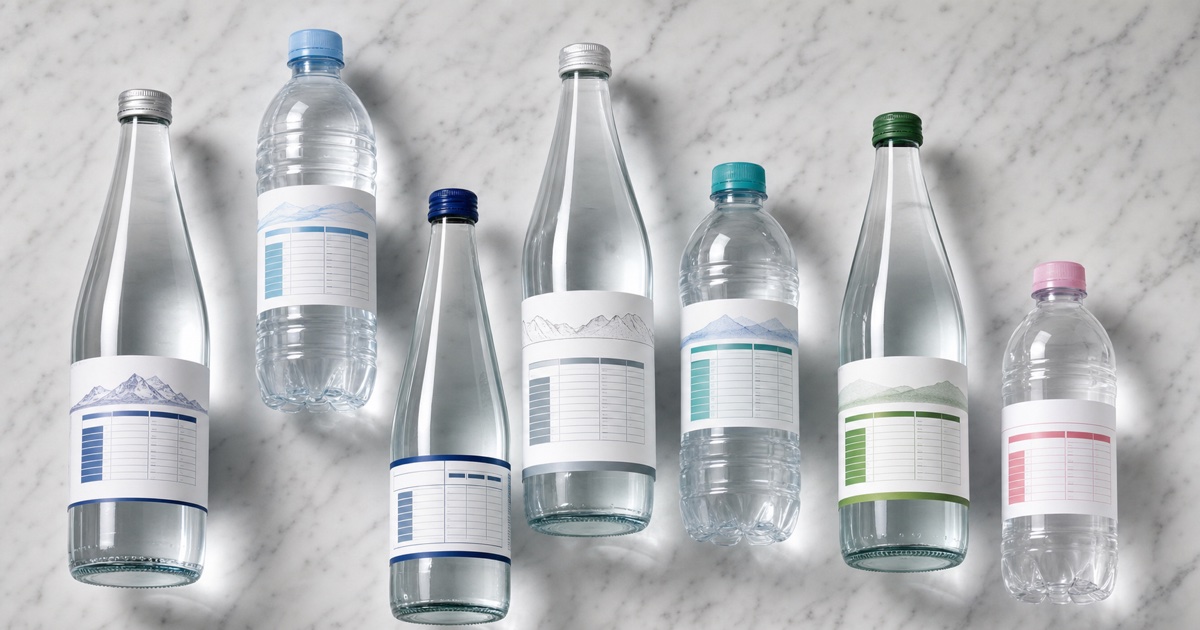
Pick up a 1L glass bottle of Bad Vilbeler Römer Brunnen, turn it around, and you’ll see a small mineral analysis table. It might list eight to ten items: sodium, potassium, calcium, magnesium, chloride, sulfate, bicarbonate, total minerals. If it’s the full SGS Institut Fresenius report, the list expands to 30–40 items, including elements you’ve never seen on a beverage label: strontium, lithium, silica, boron, rubidium, caesium…
We were trained from a young age to read nutrition facts — grams of protein, grams of fat, milligrams of sodium. But a mineral water analysis is a different language: it isn’t telling you “how many calories this bottle has.” It’s telling you what the rock formations beneath this well look like.
This article is here to unpack that language.
Group One: Physical Parameters — The “Appearance” of the Water
Open the analysis table and the top usually has three physical parameters: TDS, hardness, pH. These three give you a quick read of the water’s overall character.
TDS (Total Dissolved Solids)
The single most important indicator. It represents how many milligrams of mineral substances are dissolved in one litre of water. Standard international tiers:
| Tier | TDS Range | Example |
|---|---|---|
| Low | < 500 mg/L | Evian (357), Volvic (109) |
| Medium | 500–1,500 mg/L | Vittel (841) |
| Medium-High | 1,500–3,000 mg/L | Rosbacher (1,840), Pellegrino (1,109) |
| High | 3,000–5,000 mg/L | Römer Brunnen (4,912), Vichy Catalan (3,052) |
| Very High | > 5,000 mg/L | Vytautas (7,309), Heppinger (5,800) |
TDS tells you the “weight class” of the water at a glance. Most Taiwanese convenience-store water sits in the 100–300 mg/L range, so an imported water at 4,912 mg/L tastes much “heavier” than expected.
Hardness
Hardness equals the total of calcium + magnesium, usually expressed as mg/L CaCO₃ equivalent. German and Japanese labels often list “Härte” or “硬度”. International tiers:
- Soft: < 75 mg/L (most tap water)
- Medium-hard: 75–150 mg/L
- Hard: 150–300 mg/L
- Very hard: > 300 mg/L
Rosbacher Power Sparkling has a hardness of 974 mg/L CaCO₃ (per bottle label) — very hard; Römer Brunnen is around 1,900. Hardness directly determines the water’s “creaminess” (cremig) — soft water tastes like water; hard water has “weight.”
pH
7.0 is neutral. Mineral waters commonly fall between 5.5 and 8.5:
- 5.5–6.5: Slightly acidic (often from dissolved CO₂; most sparkling waters land here)
- 6.5–7.5: Near-neutral (most still mineral waters)
- 7.5–8.5: Slightly alkaline (high sodium bicarbonate waters)
Rosbacher Power Sparkling has pH 6.3 (label) — typical for a sparkling water; highly alkaline waters (Evian 7.2, Fiji 7.5) feel rounder on the palate. pH is not “the more alkaline, the better” — human stomach acid is pH 1.5–3.5, and any alkaline water you drink is neutralised the moment it enters the stomach. The whole “alkaline water cures acidity” narrative is marketing.
Group Two: The Four Cations — The “Personality” of the Water
Physical parameters show appearance. The four cations (Ca, Mg, Na, K) show personality. The absolute values and ratios among these four shape a water’s “flavour identity.”
Calcium Ca²⁺
The main component of bones and teeth. The calcium in mineral water is “ionic calcium,” more easily absorbed by the gut than calcium in food. WHO recommends 1,000 mg of calcium per day for adults, 1,200 mg for older adults.
- Rosbacher 750ml: 233 mg/L
- Römer Brunnen 1L: 550 mg/L
- Vytautas: 552 mg/L
A 250 ml glass of Römer Brunnen ≈ 138 mg of calcium, equivalent to one serving of dairy. But this is “natural intake,” not a recommendation to replace calcium pills (keep eating your dairy and leafy greens).
Magnesium Mg²⁺
Involved in muscle, nervous system, and energy metabolism. Daily recommendation: 300–400 mg. Mineral water magnesium is also ionic, with high absorption.
- Rosbacher 750ml: 111 mg/L
- Römer Brunnen 1L: 127 mg/L
- Vytautas: 240 mg/L (highest)
Ca:Mg Ratio — More Important Than Absolute Values
The body needs magnesium to absorb calcium. The ideal ratio is 2:1 — this is the core selling point of the entire Rosbacher line. Ratios far off 2:1 reduce absorption efficiency:
| Water | Ca:Mg Ratio | Assessment |
|---|---|---|
| Rosbacher 750ml | 233:111 ≈ 2.10:1 | Near ideal ✓ |
| Rosbacher Power Sparkling | 224:101 ≈ 2.22:1 | Near ideal ✓ |
| Vytautas | 552:240 ≈ 2.30:1 | Near ideal ✓ |
| Römer Brunnen | 550:127 ≈ 4.33:1 | Calcium significantly dominates |
| Contrex (France) | 468:74 ≈ 6.32:1 | High calcium, low magnesium |
Next time a water claims “high calcium,” check the magnesium too — if magnesium is too low, calcium absorption takes a hit.
Sodium Na⁺
Electrolyte; affects salinity and blood pressure. WHO recommends < 2,000 mg of sodium per day. Mineral water sodium is usually well below this threshold, but very high mineralisation waters (Vytautas 1,727 mg/L) deliver about 432 mg of sodium in a 250 ml glass — worth watching for those with hypertension.
Potassium K⁺
Also an electrolyte, but mineral water usually carries little (< 10 mg/L). Römer Brunnen’s 55.4 mg/L is exceptionally high — one of the fingerprints of a Heilwasser-class water.
Group Three: The Four Anions — The “Balance” of the Water
Cations need anions to maintain ionic balance (total positive charge = total negative charge). The four anions are HCO₃⁻, Cl⁻, SO₄²⁻, F⁻.
Bicarbonate HCO₃⁻
The most important anion. It is the water’s “buffer,” giving it a round, alkaline mouthfeel (alkalisch). It’s also a product of dissolved CO₂ — sparkling waters tend to have higher HCO₃⁻.
- Rosbacher 750ml: 1,236 mg/L
- Römer Brunnen 1L: 2,849 mg/L (extremely high)
The HCO₃⁻ to Cl⁻ ratio is also a key reading indicator — a high ratio (bicarbonate-dominant) means an alkaline, round-feeling water; a low ratio (chloride-dominant) means a salty, salivation-triggering water.
Chloride Cl⁻
Source of saltiness. Most mineral waters are below 250 mg/L; extreme waters (Vytautas at 3,480 mg/L) feel distinctly briny. Cl⁻ tends to track with Na⁺ — waters from ancient seabed geology run especially high.
Sulfate SO₄²⁻
Gives water its “mineral” feel (mineralisch) and a dry finish. German Heilwasser regulations have a special category for high-sulfate waters (> 1,200 mg/L), traditionally used for digestive support.
Fluoride F⁻
Related to dental health. WHO recommends 0.5–1.5 mg/L of fluoride in drinking water as optimal for teeth; excess causes dental fluorosis. Taiwan’s tap water is not fluoridated, so fluoride from mineral water provides some additional benefit.
- Rosbacher 750ml: 0.06 mg/L
- Römer Brunnen 1L: 0.44 mg/L (near the WHO recommended lower bound)
Group Four: Trace Elements — The “Fingerprint” of the Water
This is the layer where insiders dig in. Trace element concentrations are tiny (mg/L or below), but each water source’s trace element combination is a unique “geological fingerprint.”
Lithium Li⁺
Naturally present in waters running through lithium-bearing rock formations. German Heilwasser regulation uses 0.5 mg/L as the “lithium-water” classification threshold. Most mineral waters have < 0.1 mg/L; German high-lithium healing waters reach 5–13 mg/L.
- Rosbacher 750ml: 0.11 mg/L (SGS-certified)
- Römer Brunnen 1L: 1.1 mg/L (more than 2× the Heilwasser threshold)
- Bad Mergentheimer Albertquelle: 13.0 mg/L (highest known mineral water lithium worldwide)
⚠ Taiwan regulatory note: This article presents objective mineral content and international classification only. It does not constitute therapeutic claims.
Strontium Sr²⁺
A divalent cation similar to calcium, related to bone health. Japanese “deep-sea water” often features high strontium as a selling point. Mineral water typically contains 0.1–10 mg/L.
- Rosbacher 750ml: 0.36 mg/L
- Römer Brunnen 1L: 3.5 mg/L
Silica H₂SiO₃
Dissolved from silicate rock formations. Most mineral waters contain 5–30 mg/L. Traditionally associated with skin, hair, and connective tissue, but scientific evidence is still accumulating.
Boron B
From boron-bearing mineral deposits. Boron > 1 mg/L is common in European waters (Römer Brunnen ~1.6 mg/L). The EU drinking water limit is 1 mg/L, with separate regulations for mineral water.
So How Do You Use This Framework?
Back to specifics. The next time you pick up a bottle:
- Check TDS first — judge the weight class (< 500 soft, 500–1,500 medium, 3,000+ high, 5,000+ extreme)
- Look at pH — around 6.5 is the daily-drink zone; < 6.5 is usually sparkling; 7.5+ is highly alkaline
- Calculate Ca:Mg ratio — close to 2:1 is optimal for electrolyte absorption; far off means one element dominates
- Look at HCO₃⁻ / Cl⁻ ratio — high = round; low = salty/stimulating
- Check for trace element highlights — high lithium, strontium, or silica usually means a water source with a “story”
Using the three waters from the previous article, here’s the full comparison (per litre):
| Indicator | Rosbacher 750ml | Römer Brunnen | Vytautas |
|---|---|---|---|
| TDS | 1,840 | 4,912 | 7,309 |
| pH | n/a | n/a | 6.3 |
| Calcium Ca | 233 | 550 | 552 |
| Magnesium Mg | 111 | 127 | 240 |
| Ca:Mg | 2.10:1 | 4.33:1 | 2.30:1 |
| Sodium Na | 83.5 | 649 | 1,727 |
| Potassium K | 4.0 | 55.4 | 32 |
| Chloride Cl⁻ | 141 | 610 | 3,480 |
| Sulfate SO₄²⁻ | 9.2 | 39 | 989 |
| HCO₃⁻ | 1,236 | 2,849 | 300 |
| Fluoride F⁻ | 0.06 | 0.44 | n/a |
| Lithium Li⁺ | 0.11 | 1.1 | n/a |
You don’t need to memorise any single number. You only need to know: this table represents three completely different geological structures, sitting in your hand.
Closing: A Mineral Water Analysis Is Not Nutrition Facts — It’s a Geological Time Stamp
Before working on this brand, I never read mineral water labels. I thought water was just water.
But after three months of poring over SGS Institut Fresenius reports, I came to understand what these tables are saying — calcium 233, magnesium 111 are not just numbers. They are the slow accumulation of decades of groundwater passing through calcium- and magnesium-rich basalt layers across the plate fractures of the Upper Rhine Graben in Hessen. Lithium 1.1 is not just a trace. It is proof that a 287-metre well punched into ancient strata brought a lithium-bearing mineral deposit to the surface.
A mineral water analysis is a geological time stamp. One table — behind it, tens of thousands of years of plate movement and rock weathering.
The next time you’re in a convenience store or supermarket, scanning past the water aisle by reflex — try stopping. Pick up a bottle you’ve never tried, turn it around. See what that piece of land sent you this time.
Notes · Sources
Primary Documents (Downloadable)
All mineral analysis data in this article comes from first-hand source documents — SGS Institut Fresenius DAkkS-accredited laboratory reports, provided by Hassia Mineralquellen. Full PDFs available:
- 📄 Rosbacher Klassisch 0.75L SGS Laboratory Report (Prüfbericht 6886143, 2024-05-21)
- 📄 Bad Vilbeler Römer Brunnen 1L SGS Laboratory Report (Prüfbericht 4740147, 2020-03-30)
- 📄 Hassia Group 2007 Press Release: Römer Brunnen Inauguration
International Standards & Regulations
- Classification standard: Fine Waters - International Water Tasters’ Guild
- WHO drinking water standards: Guidelines for Drinking-water Quality (4th ed.)
- German Heilwasser classification: BfArM Federal Institute for Drugs and Medical Devices
- EU mineral water labelling regulations: Directive 2009/54/EC
- Taiwan food regulations: Act Governing Food Safety and Sanitation, Article 28
Next Article Preview
Next up —
“Why Are the Water Lists in European Restaurants Longer Than the Coffee Menus?” From Italy’s Pellegrino, France’s Evian, Spain’s Vichy Catalan to Germany’s Gerolsteiner — how five countries’ waters pair with five styles of cooking.

💬 Comments
Loading...