
TL;DR: Kyoto University Professor Emeritus Toshio Moritani said at the sarcopenia symposium that EMS can engage fast-twitch muscle fibers without demanding strenuous effort from older adults, and may protect the brain through lactate and BDNF, a protein that helps neurons survive. The muscle-brain connection has observational and exercise-trial support in humans. The mechanism by which lactate acts inside the brain comes mainly from mouse studies. The human evidence for EMS protecting the brain is early-stage: the study cited at the symposium tracked blood markers in 14 people, and the other human studies I found were likewise small and short-term. The strongest current case for EMS is as a tool for training the muscles of people who cannot move.
The speaker on stage is 76 years old. He has studied muscle electrical stimulation for forty-five years.
This was Saturday, October 31, on the fourth floor of Taipei Medical University’s Xingchun Building: the Third International Sarcopenia Symposium, covering sarcopenia, cachexia (severe wasting and muscle loss caused by serious illness), and frailty. It was co-organized by Wanfang Hospital, Shuang Ho Hospital, TMU Hospital, and TMU itself. The speaker was Kyoto University Professor Emeritus Toshio Moritani, who holds a doctorate from the University of Southern California. He stepped to the podium just before noon. Twenty-nine minutes later, near the close of his talk, a slide appeared: “Muscle is the organ for preventing and improving brain atrophy and dementia.”
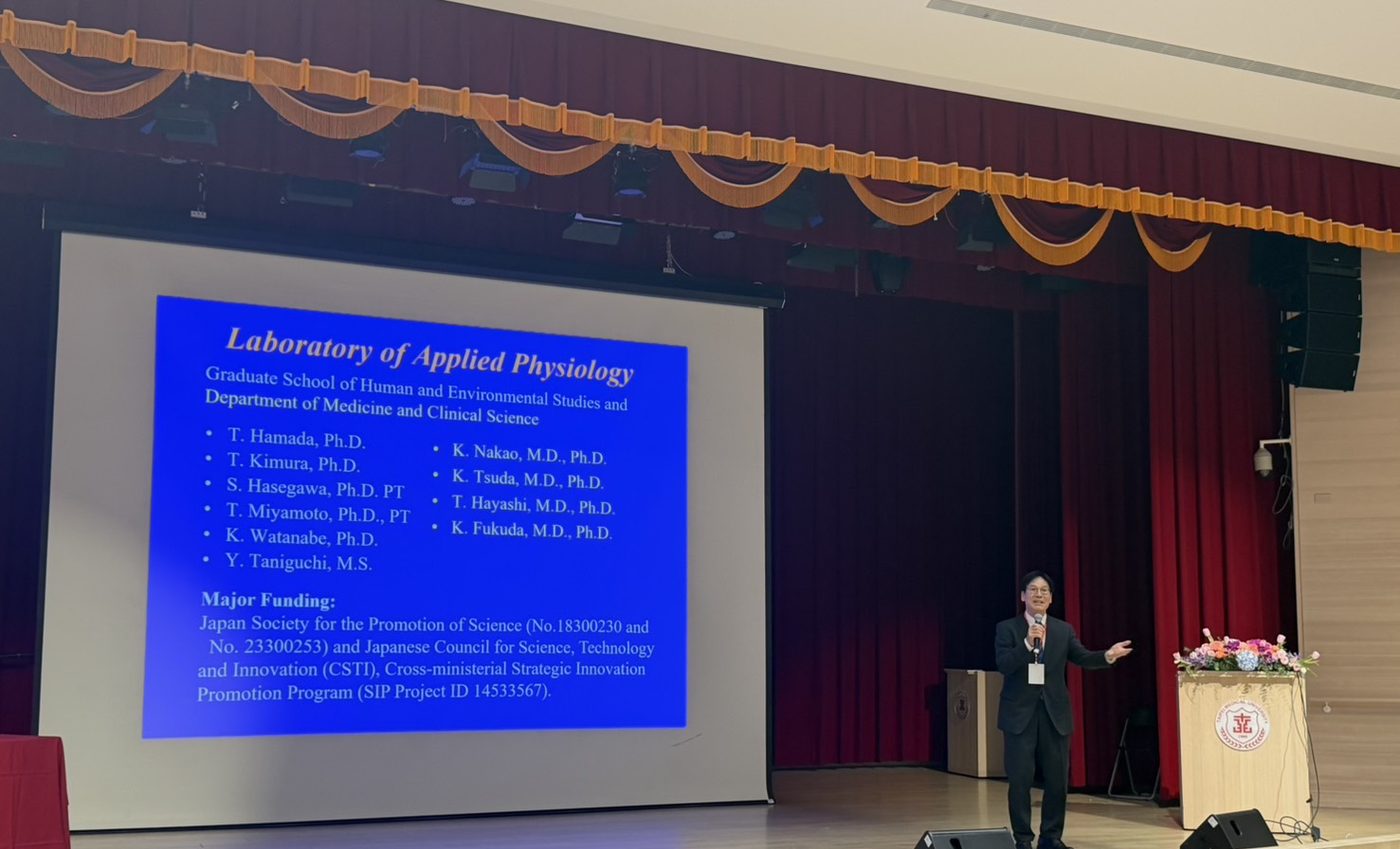 October 31, Third International Sarcopenia Symposium.
I took 56 photographs from the audience. During the lunch break I handed them to an AI and asked it to identify every paper cited on each slide, then read each original. Having read them, I found that sentence worth taking seriously, and worth looking at layer by layer. The speaker drew on his own team’s research, work from other countries’ teams, mouse experiments, and hypotheses still under investigation. Each sits at a different point in the research pipeline. In his concluding slide, Dr. Moritani used the phrase “great potential.” This article maps out how far that potential has been tested.
This piece is part of the “Reflection and Memory” section on health and the body. It can also be read as an extension of “50 Is 29,” which calculated that whether life runs to 70 or 120, health pays. This article follows that thread down to the muscle.
Why Is Sarcopenia So Hard to Reverse?
Dr. Moritani did not open with the machine. He opened with a well-known problem that has resisted easy solutions. Obesity, type 2 diabetes, heart disease, sarcopenia, and cognitive decline are all rising. The standard medical advice is exercise. The hard part is getting people to start. He went on to say that EMS “may provide an alternative and more efficient solution,” because it can deliver higher exercise doses, more efficiently, than people are likely to achieve through exercise.
How large is the problem? The symposium’s program cited a 2017–2020 survey by the National Health Administration: sarcopenia prevalence among adults 65 and older was 34.1%. That figure comes from calf circumference screening (less than 34 cm for men, less than 33 cm for women). Apply a stricter diagnostic standard that also measures muscle mass, grip strength, or gait speed, and the number drops considerably: a study of 731 older adults in Yuanshan Township, Yilan County, estimated 6.8%.
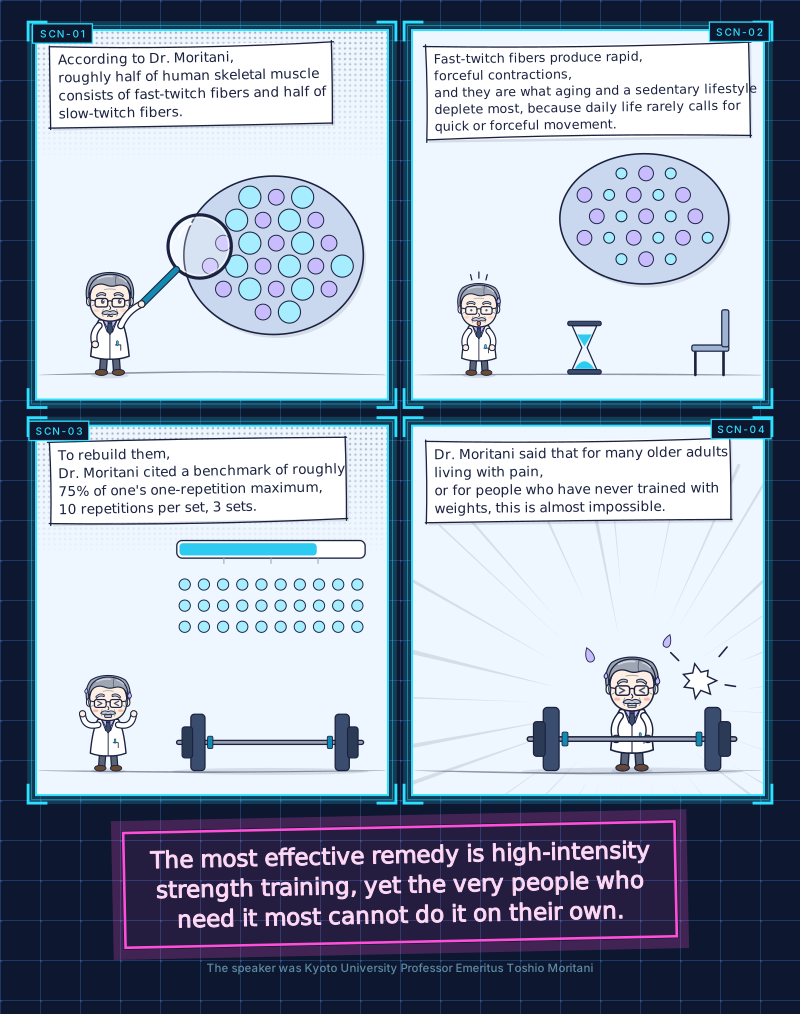
He then explained why recovery is so difficult. According to Dr. Moritani, roughly half of human skeletal muscle consists of fast-twitch fibers and half of slow-twitch fibers. Fast-twitch fibers produce rapid, forceful contractions, and they are what aging and a sedentary lifestyle deplete most, because daily life rarely calls for quick or forceful movement. To rebuild them, Dr. Moritani cited a benchmark of roughly 75% of one’s one-repetition maximum, 10 repetitions per set, 3 sets. Dr. Moritani said that for many older adults living with pain, or for people who have never trained with weights, this is almost impossible.
This is sarcopenia’s central frustration: the most effective remedy is high-intensity strength training, yet the very people who need it most cannot do it on their own. EMS attracts interest because it promises to bypass this barrier, letting an electric current do the “lifting.”
Why Can EMS Reach Fast-Twitch Fibers? Two Schools of Thought
Dr. Moritani said the single most important point in his entire talk was this: voluntary contraction and electrical stimulation recruit muscle in opposite orders.
A quick definition first. A motor neuron together with the muscle fibers it controls is called a motor unit; when the neuron fires, those fibers contract together. During voluntary effort, the body follows the “size principle,” dispatching smaller motor units first (the slow-twitch fibers) and calling on larger units, the fast-twitch fibers, only when greater force is needed.
He explained that EMS reverses this sequence. The nerve fibers leading to fast-twitch motor units are larger in diameter, have lower electrical resistance, and are more readily activated by an externally applied current, so fast-twitch fibers fire first. In his words, EMS recruits motor units “in reverse order,” and he concluded that it targets exactly the fibers aging erodes. He also noted that early electrical stimulators fell out of favor because stimulation was painful; newer technology can produce strong contractions without discomfort.
Not everyone in the field agrees on the mechanism. American physical therapy researchers Gregory and Bickel, in a 2005 paper, argued that EMS activates motor units in neither the normal nor the reversed order. Their account: current is non-selective with respect to fiber type, it activates whichever fibers are nearest to the electrodes (spatial fixedness), and those fibers contract in synchrony with the current’s rhythm (temporal synchrony). A small 2007 experiment reached a similar conclusion, and Bickel and colleagues revisited the question in a 2011 review.
Even under this account, though, fast-twitch fibers still get involved without the muscle generating much force. During voluntary exercise those fibers are called in only when effort is high; applied current can bring them into contraction at much lower force levels. For people who cannot train at intensity, that practical point matters more than the question of recruitment order.
The Nine Papers on the Slides: Which Ones Came from the Speaker’s Own Team?
The slides cited a total of nine papers. Reading each original, I sorted them into three groups.
Two came from his own team. One was a study on anterior cruciate ligament reconstruction: 20 patients randomly assigned to groups, with the EMS group beginning stimulation on the second day after surgery and continuing for four weeks. By week four, the EMS group showed increased thickness in the outer thigh and calf muscles, while the control group’s muscles had thinned; at three months, the EMS group also recovered knee-extension strength more fully. The second paper, a type 2 diabetes study from his team, comes up in the brain section below.
Four papers were clinical studies from other countries’ teams: a multi-center older-adult study led mainly by an Austrian group; a spinal cord injury training study from a US team; a pre-sleep protein study from a Dutch team; and a female urinary incontinence study from a South Korean team. The three brain-related references consisted of two review articles and one mouse experiment. There was also one case report of Guillain-Barré syndrome (an acute condition in which the immune system attacks peripheral nerves, causing limb weakness) from his own team, without a listed publication citation.
When presenting other teams’ research, he made clear whose work it was; for the older-adult study, for example, he used “they.” The grouping itself carries no judgment about research quality; it simply shows where each study sits. Below is a closer look at the studies that bear directly on what EMS can do.
The first is the older-adult study. After nine weeks of training, the original paper concluded that EMS and leg-press training produced comparable improvements in muscle strength and physical performance.
The study was small. The leg-press group had 9 participants and the EMS group 16, and the paper does not mention random assignment. The leg-press group also started from a higher baseline: on the timed up-and-go test (rise from a chair, walk a short distance, sit back down; lower is better), it averaged 6.16 seconds against 8.42 seconds for the EMS group, a difference in starting points worth keeping in mind when comparing the two.
The authors also argued that EMS was better at limiting age-related muscle loss: biopsies showed more and larger fast-twitch fibers, increased satellite cells involved in muscle repair, and no signs of muscle damage or inflammation. The participants performed EMS at home three times a week, and the authors framed this as a safe, home-based option. The advantages of EMS that Dr. Moritani emphasized on stage are borne out in the biopsy data.
The second is the pre-sleep protein study. The original paper’s abstract describes the protocol: 20 healthy men averaging 69 years old rested in bed for one day; one leg was electrically stimulated for 70 minutes in the evening, after which the participants consumed 40 grams of protein before sleeping. That protein had been labeled with an isotope tracer to track its destination. The electrically stimulated leg incorporated 18% more amino acids from that protein into muscle compared with the other leg.
The spinal cord injury section was, to my mind, the most compelling part of the talk. The protocol, assembled by a US team, targeted people with complete motor loss from long-standing spinal cord injury: EMS caused the knee to extend, 4 sets of 10 repetitions, twice a week, with progressive ankle weight added as tolerated, up to 9.1 kg. After three to six months, muscle volume increased by an average of 30 to 40 percent. For muscles the patient has no voluntary control over, EMS is one of the few methods that can make those muscles bear a load and receive training stimulus.
How Might Muscle Protect the Brain? Where the Evidence Stands
The final ten minutes of the lecture moved from muscle to the brain. This section requires layered reading, because each layer sits at a different stage of evidence.
The first layer is whether muscle, exercise, and the brain are connected at all, and here human evidence exists. The following three papers are not from the slides; I found them separately. A 2020 meta-analysis pooled data from 15 observational studies and found that, after adjusting for other factors, people with sarcopenia had a substantially higher likelihood of cognitive impairment (odds ratio roughly 2.25). This is correlational; it cannot establish cause and effect. Exercise trials in humans also support a brain benefit: a 2011 randomized trial of 120 older adults found that one year of aerobic exercise grew hippocampal volume by roughly 2%. Those who gained more volume also showed larger rises in blood BDNF and greater memory improvements. Resistance training has parallel evidence: a 2017 randomized trial of 100 adults over 55 with mild cognitive impairment found that six months of high-intensity resistance training improved cognitive function, and those improvements tracked with muscle strength gains rather than with changes in cardiorespiratory fitness.
BDNF is brain-derived neurotrophic factor, a protein found in the brain. A 2002 review cited by Dr. Moritani summarized animal research showing that BDNF supports neuron survival and learning and may protect against cognitive decline.
The second layer is lactate. A 2019 study from the Lebanese American University found that lactate released by muscles during exercise crosses the blood-brain barrier (the brain’s filter that blocks most substances in the blood) and induces BDNF in the hippocampus, with associated improvements in spatial learning and memory retention. The authors described lactate as one ingredient in an “exercise pill.” This study was conducted in mice.
In humans, the research has reached the bloodstream but not yet the brain. Two papers I found: a small 2011 study infused lactate intravenously into 8 young men at rest and measured a rise in blood BDNF; a 2025 study from a Swedish team found that after lactate infusion, what rose was pro-BDNF, the unprocessed precursor form, while mature BDNF, the active form, showed no significant change. After the talk, Dr. Moritani shared a human study he had left out on stage for lack of time: a 2020 experiment by teams at Brock University and Wilfrid Laurier University in Canada, in which 8 young men did moderate-intensity running, vigorous-intensity running, and sprint intervals. The higher the intensity, the more blood BDNF rose, with sprint intervals producing the largest increase. Changes in lactate also showed a weak to moderate correlation with changes in BDNF; the authors noted that the lactate peak may have been missed in the moderate and vigorous sessions, a point further research will need to confirm. The exercise here was running, not EMS. Whether lactate does the same thing inside the human brain remains unproven.
The third layer involves Alzheimer’s disease. A 2017 review by MacPherson at Brock University in Canada sketched a possible pathway: exercise-induced BDNF may promote α-secretase activity while suppressing β-secretase. Both enzymes cleave the same precursor protein, but they cut differently. The β-secretase pathway yields amyloid-beta, the main component of the plaques found in Alzheimer’s disease; the α-secretase pathway does not. If BDNF tips the balance toward α-secretase, amyloid-beta production might be reduced. On the mechanism slide, the intermediate steps were marked with question marks, and Dr. Moritani acknowledged that part of the pathway remains unclear.
Then comes EMS. Dr. Moritani linked these findings into a chain: EMS activates fast-twitch fibers, fast-twitch fibers produce lactate, lactate induces BDNF. His reasoning: many older adults cannot exercise at the intensity needed to generate lactate; EMS can get them there.
For the first segment of that chain, from EMS to blood BDNF, the human evidence cited on stage came from his team’s type 2 diabetes study. Fourteen patients averaging 63 years old completed a randomized crossover trial: the same individuals went through two periods, one with EMS and one without, and served as their own controls. The EMS period involved bilateral leg stimulation for 40 minutes per session, five days a week, for eight weeks.
Body-fat percentage fell more and blood BDNF changed more favorably during the EMS period than the control period (BDNF actually declined during the control period), and fasting glucose also showed a significant difference. On the other hand: HbA1c, reflecting average blood glucose over two to three months, showed no significant change, nor did lipid levels. Lean soft tissue mass, a common proxy for muscle mass, increased by roughly 0.8 kg on the slides, but with a p-value of 0.13, which does not meet the conventional 0.05 threshold for statistical significance.
On blood glucose, there is a contrasting result I found separately. A team at the University Hospital of Caen, France, presented a crossover trial at the 2023 Francophone Diabetes Society annual meeting: 32 sedentary adults with type 2 diabetes cycled through three six-week periods (no EMS, EMS three times per week, and EMS five times per week), with each session stimulating the quadriceps for 20 minutes. Continuous glucose monitoring over six days showed nearly identical average glucose across all three periods, and the researchers concluded that EMS offered no benefit. A news report cited this as evidence that EMS cannot yet be positioned as an exercise substitute. This trial had no exercise group, and I have not found a published paper; its sessions were also shorter (20 minutes vs. 40) and the intervention ran for 6 weeks rather than 8, so direct comparison with the Moritani team’s findings is not straightforward.
So for the first link in the chain, from EMS to blood BDNF, the human evidence cited on stage is a 14-person study. The other human studies I found independently were also small and short-term: a 2019 experiment with 11 healthy men found that 20 minutes of quadriceps EMS raised blood BDNF more than a voluntary contraction matched for force output. The second link, lactate entering the hippocampus and improving memory, rests mainly on mouse experiments. Whether EMS can protect the brain or prevent dementia still awaits direct human trial evidence.
Who Is EMS Actually For? My Assessment
The muscle-brain connection is worth taking seriously. Observational studies and exercise trials in humans already support it. Starting resistance training in middle age gains another reason: muscle may matter not just for preventing falls, but for staying cognitively sharp. For anyone building a life plan that runs to 120, this belongs in the calculation.
I started building an exercise habit in 2016 and began tracking my own physiological data around the same time, such as weight and body fat, so muscle mass has been on my radar for a while, and I have a clear sense of how much it affects daily life. In early October I visited Dr. Moritani in Tokyo and tried the device his team developed firsthand, which deepened my curiosity about this field.
The strongest current case for EMS is for people who cannot move: post-surgical patients who cannot bear weight, people with spinal cord injuries, older adults confined to bed or in too much pain to train. For them, EMS is one of the few methods that can make inactive muscles contract and receive training stimulus. Both the ACL and spinal cord injury research support this. The speaker’s team frames EMS similarly in their diabetes paper: an option for people who cannot get enough voluntary exercise. Asked in the Q&A how long it takes to see results, Dr. Moritani said that in his studies, significant changes appear after a minimum of about eight weeks, though patients feel that moving around is much easier after just a couple of weeks of training.
For people who can still move, the older-adult study is 9 versus 16 participants, nine weeks, with no mention of random assignment. Establishing that EMS can replace voluntary exercise will require larger trials.
Widening the lens, other research tells a similar story. A 2005 systematic review of 35 trials found that EMS beat no exercise for quadriceps strength, but voluntary exercise outperformed EMS in most comparisons, with the caveat that overall trial quality was poor. A 2016 German randomized trial had 48 sedentary middle-aged men complete 16 weeks of whole-body EMS or high-intensity resistance training: lean mass and leg strength improved in both groups with no significant difference between them; the authors noted EMS saves time but is not cheap. For patients too ill for whole-body exercise, a 2016 Cochrane review pooling 18 studies and 933 patients with advanced chronic lung disease, heart failure, or thoracic cancer found that where results could be combined, EMS produced roughly 1.1 kg more quadriceps strength than controls, though the evidence quality was rated low. A 2025 meta-analysis found that healthy individuals who added EMS to resistance training gained slightly more strength and muscle than those who trained alone.
These studies used different devices and stimulation protocols. EMS outcomes depend on electrode size and placement, frequency, intensity, and session duration. The German trial used whole-body EMS suits; the French trial stimulated only the quadriceps; Dr. Moritani mentioned during the talk that he developed a large-electrode device roughly 20 years ago, using a special belt-style electrode that covers entire muscle groups.
In the Q&A he added that the belt electrodes make the quadriceps on the front of the thigh and the hamstrings on the back contract together, so the knee joint does not have to move; that is why stimulation can begin two days after ligament reconstruction surgery. He also called stimulation frequency “the most important part,” something seen in both animal studies and experiments on isolated muscle fibers: constant stimulation at around 10 Hz shifts muscle fibers toward a slow-twitch, endurance profile, while stimulation at around 30 Hz, close to the rate at which human motor units fire during maximal voluntary contractions, increases muscle protein synthesis and moves fibers toward fast-twitch characteristics. Positive and negative results from these varied protocols cannot simply be applied to every form of EMS. Determining which design works better would require head-to-head comparisons between devices, and I have not found such studies yet.
In Taiwan, the Ministry of Health and Welfare states that muscle electrical stimulators are medical devices requiring Food and Drug Administration review for safety, efficacy, and quality before sale. People with implanted cardiac pacemakers or defibrillators must not use them. Before purchasing, search for the product in the FDA’s approved-license database, and consult your doctor. My earlier piece “How to Verify a Stem Cell Advertisement” describes the same approach: check every claim against official records.
This experience also gave me a more refined way to read research presentations: separate what the speaker’s own team found, what other teams found, and what the speaker is inferring from those combined findings. Dr. Moritani’s inferences rest on forty-five years of research. Getting from “great potential” to “demonstrated” will require larger human trials. For another line of sarcopenia research, I covered cord-blood cell approaches in “Umbilical Cord Cells Take on Sarcopenia.”
The Handshake at Seventy-Six
Near the end of his talk, Dr. Moritani said: many older people cannot exercise at the intensity needed to generate lactate. Electrical stimulation can get them there.
The first half of that sentence describes a reality many older adults face every day. The second half is the question he has spent forty-five years trying to answer. Research has supplied part of the answer. The rest waits for larger human trials to fill in.
I have spent time with Dr. Moritani in private, and I enjoyed it; his handshake was firm. I admire a researcher who, at seventy-six, still carries forty-five years of work onto a stage and lays the problem out clearly for an audience.
The question he raised deserves more research to answer it.

💬 Comments
Loading...