
When reading an AI regulatory dispute, I first want to distinguish who is speaking, what material can be checked, and which part is my own judgment. Understanding technology need not begin by deciding the other side does not.
“Not hearing the music” can remind me to acknowledge unfamiliarity, but cannot determine regulators’ psychology. I retain the metaphor while separating statements, evidence, and inference.
1. Return the event to the statement’s date
In its June 12, 2026 statement, Anthropic said it received an export-control directive concerning Fable 5 and Mythos 5 access and explained its decision to disable both for all users to comply. This records the company’s account that day.
The government directive, complete demonstration report, and test methods were not obtained here. That statement therefore cannot become a complete account of the government’s reasons, nor can I determine the only legally available response.
That day’s statement is not today’s service status. This essay does not infer that both models remain disabled or newly test their current availability.
2. Keep the speaker attached to technical explanations
The statement offers the company’s explanations of vulnerability severity, other models’ abilities, and its own safeguard tests. These are company judgments and reports, not independent verification merely because they appear on an official website.
It also acknowledges that perfect jailbreak resistance may not be possible and universal jailbreaks may be found later. Not finding a failure in existing tests does not establish proven safety.
This essay omits strongest-safeguard claims, testing hours, and zero-case comparisons. Comparing risks would still require subjects, methods, conditions, and reviewable results; that work was not completed here.
3. Defensive use and risk examination can coexist
Reading code, finding defects, and helping repair them can be discussed in defensive work. A task name alone, however, cannot determine a demonstration’s complete risks, legality, and use boundaries.
I therefore no longer describe the dispute as “only reading code, so there can be no danger,” or infer that government merely misunderstood technology because a company disagrees with the action.
Understanding technology and investigating risk are not mutually exclusive. I want discussion to accommodate both and allow judgment to remain open when key material is missing.
4. Disagreement still needs missing material identified
A company can offer its policy position, and readers can question an action’s reasons and scope. But judging whether a procedure follows principles requires corresponding material, not only one party’s dissatisfaction.
No legal-procedure review was conducted here. Nor does the essay declare an industry’s first confrontation or claim that one incident proves institutions cannot understand intelligence. Those conclusions go beyond the material checked.
If service interruption might affect work, I would treat that as another planning question: retaining information, alternatives, and unfinished items. That is a hypothetical work requirement, not newly checked private invoices or usage experience.
5. Four questions for reading regulatory disputes
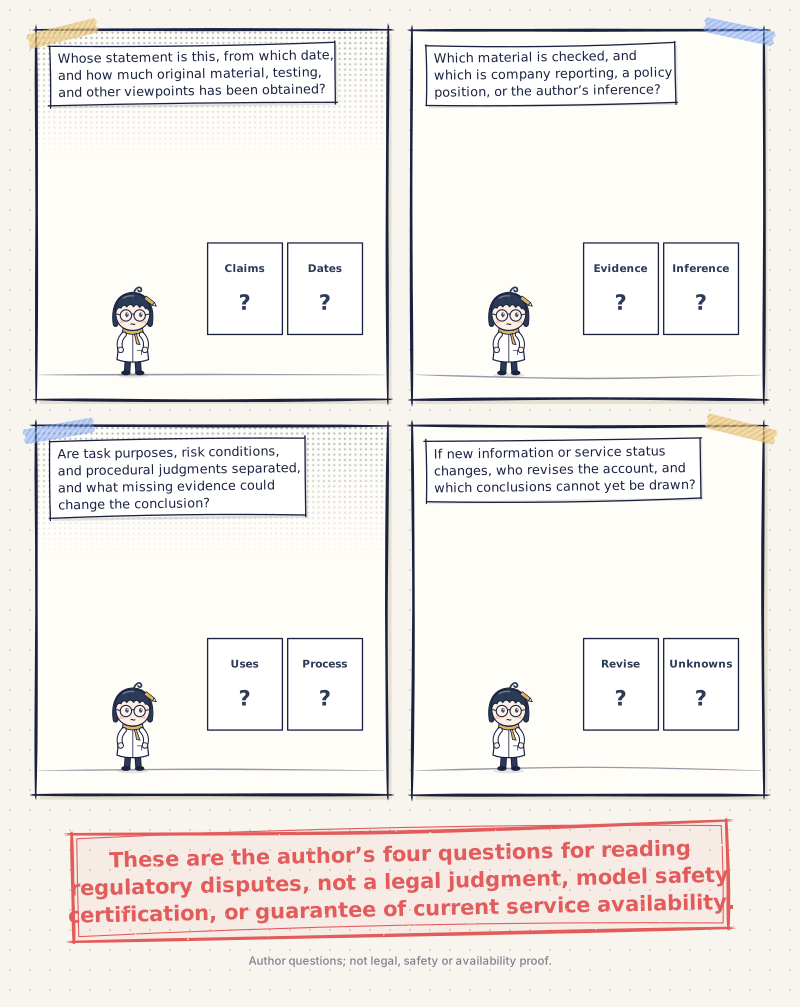
- Whose statement is this, from which date, and how much original material, testing, and other viewpoints has been obtained?
- Which material is checked, and which is company reporting, a policy position, or the author’s inference?
- Are task purposes, risk conditions, and procedural judgments separated, and what missing evidence could change the conclusion?
- If new information or service status changes, who revises the account, and which conclusions cannot yet be drawn?
These are the author’s four questions for reading regulatory disputes, not a legal judgment, model safety certification, or guarantee of current service availability.
6. Let metaphors remind me rather than characterize others
I still like music and dance as metaphors for distance in understanding. They should first remind me that I may have heard only a fragment. Familiarity with tools does not let me supply motives for another document I have not read.
One can value room to create and use technology while requesting risk explanations. One can criticize an action while acknowledging insufficient evidence for judgment. Those positions need not cancel each other.
I want curiosity retained in discussion. Establishing who said what and what remains unknown creates a better chance for people with different responsibilities to talk.
Materials and revision scope: Revised November 4, 2026. Necessary text in Anthropic’s June 12, 2026 statement was directly read, supporting only its dated account and reporting qualifications. The government directive, complete demonstration report, test methods, and current availability were not obtained or tested. Another policy proposal was not used as a legal standard. Earlier regulator motives, general legality and no-risk conclusions, comparison figures, private invoices, interruption details, photographic location, and quotation attribution were removed; earlier events are not declared nonexistent. Music is the author’s metaphor. The questions and alternative-workflow suggestions are not newly completed legal or model assessments.

💬 Comments
Loading...