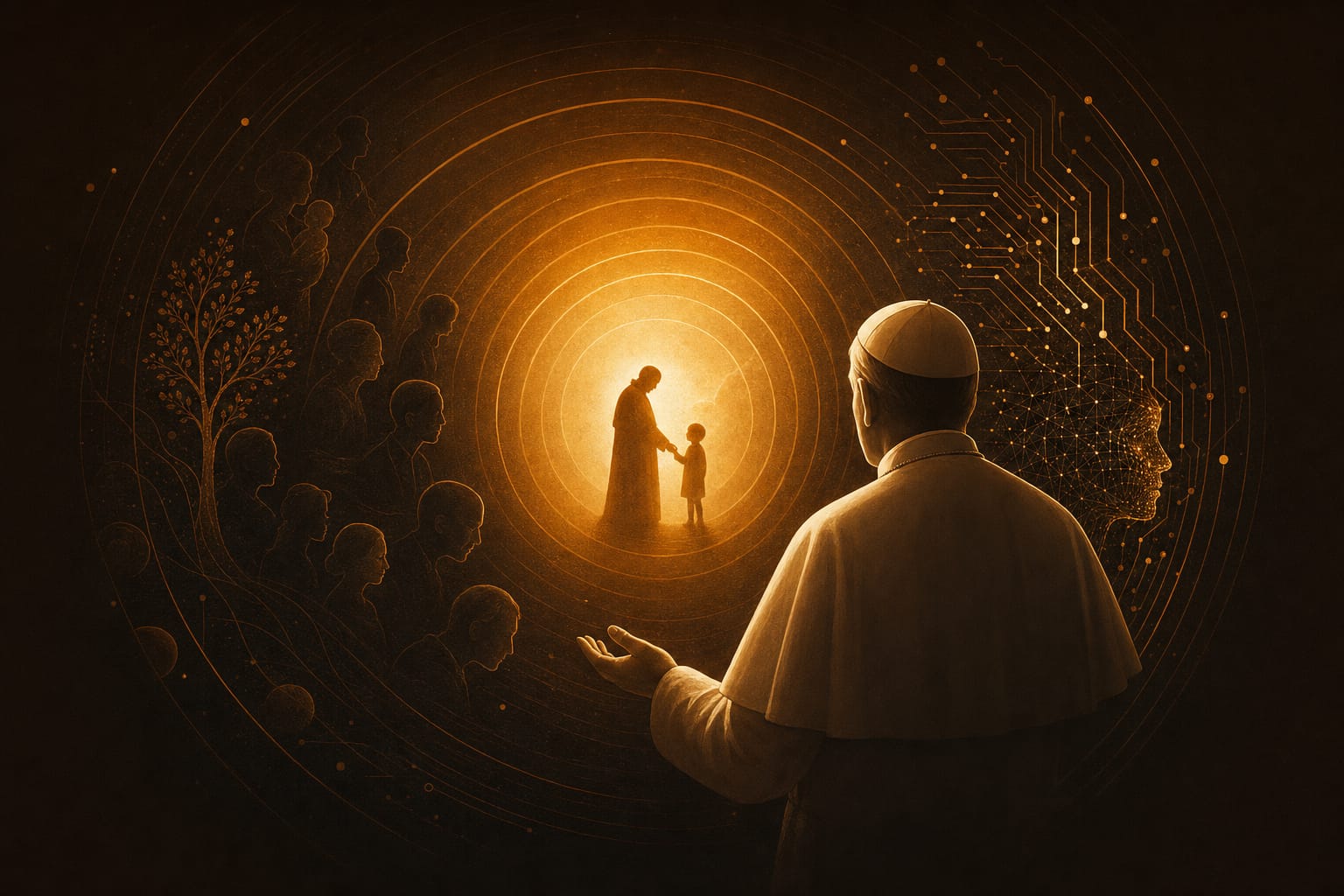
TL;DR — In May 2026, Pope Leo XIV’s first encyclical, Magnifica Humanitas (Latin for “Magnificent Humanity”), is given over entirely to AI. It does not argue over whether AI is evil; its weight rests on that sentence in paragraph 9: technology is never neutral. A tool picks up the fingerprints of those who made it, fed it, governed it and used it. It took me three articles to feel my way toward this question; the Church’s highest teaching, coming down 135 years of the Rerum Novarum tradition, arrived at the same place.
On 15 May 2026, Pope Leo XIV signed the first encyclical of his pontificate. He chose that day, and it was no coincidence.
An encyclical is a formal teaching document the Pope uses to respond to a major question of the age. It is not an ordinary address, nor a passing comment. In other words, it repositions AI within the tradition of social teaching, rather than merely leaving behind a remark.
On the same day 135 years earlier, another Leo, Leo XIII, signed the encyclical Rerum Novarum (Rerum Novarum), responding to the way the Industrial Revolution was crushing workers. That encyclical opened the whole tradition of Catholic social teaching. When Leo XIV took this name, he had already said the thing he faced was another industrial revolution, this time AI.
A pope’s first encyclical usually reveals how he understands his age. Leo XIV placed his first encyclical on AI. That alone is a signal: AI is no longer only a subject for engineers, entrepreneurs and policymakers. It has become a subject about the human being.
Its subtitle is: Guarding the Human in the Age of Artificial Intelligence. So it does not read like a technology-ethics commentary; it reads more like carrying AI back into the Church’s tradition. The whole text runs in five chapters, from the foundations and principles of social teaching, through technology and domination, truth and work and freedom, and lands finally on the culture of power and the civilization of love. Human dignity, labor, data, power are all in there.
Even if you are not a Catholic, this document is worth reading. Because what it addresses is not whether the Church should accept AI, but how we are still to understand “the human” as AI begins to rewrite work, knowledge, power and human relationships.
It Is Not Scolding AI
Before I opened Magnifica Humanitas, I had assumed I would read a typical Church document about technology: cautious, weighty in tone, standing outside the door to warn the world not to run too fast. It is not that. What it really addresses is that sentence in paragraph 9:
Technology is never neutral, because it takes on the characteristics of those who devise, finance, regulate and use it.
A food-delivery platform looks like just a matching tool, but how it counts time, how it penalizes lateness, how it assigns orders will change the bodily rhythm of the rider. A search engine looks like it is just helping you find information, but what it ranks on the first page will change what people believe. AI is the same. A model is not a blank mirror; it has a direction it was trained into.
A tool is not a blank pipe. It carries the fingerprints of those who made it, those who invested in it, those who regulate it, those who use it. So the question is not only “is AI good,” but: who wrote their values into the system? Whose voice was amplified? Whose experience was silenced? And in the end, who bears the consequences? Marshall McLuhan had a line: “the medium is the message.” What changes society is not only the content the medium carries, but the form, speed, scale and sensory structure of the medium itself, which is already changing how we understand the world. Technology is the most important medium now, and technology itself is changing how we perceive the world.
In “The Real Crisis of the AI Age Is That We Gave Up on Slowness” I cited a study: most people expect AI to bring in a religious perspective when it answers ethical questions, yet in almost every model’s default, religion is absent. My phrasing then was “the default is not neutral, and faith is silenced.” The Pope’s sentence is the universal version of the same thing: no default fell out of the sky; every default is the choice of certain people.
The Five Points I Read
There is a fair amount here. Reading it through, five points stood out that I want to share with friends.
One, technology is not neutral. That is the sentence above. It is the bedrock of the whole encyclical, not just a fine phrase. Because technology carries human fingerprints, to talk about AI you cannot talk only about the algorithm; you also have to talk about the design behind it, the sources of funding, the people who regulate it, and the structures of power.
Two, human worth is not proven by efficiency. This was the passage I felt most strongly, in the section on human dignity. The Pope opposes an ideology: the suggestion that everyone must earn, must prove their own worth. Earned to the end, the person with higher efficiency and greater output seems to be worth more. In an age where everything gets measured against AI for productivity, this is the most dangerous point: if human worth equals efficiency, then the person overtaken by the machine seems to depreciate along with it. What the encyclical does is put human worth back where efficiency cannot reach. This is the same thing that the Lausanne piece on imago dei, the image of God, which I cited earlier, was saying.
Jensen Huang has a line that has traveled widely (Milken Global Conference, 2025): AI will not replace people, but people who use AI will replace people who do not. As career advice, the line is not wrong; if you do not learn to use the tools, you will indeed be pushed to the margins of the labor market. But hidden inside it is an unstated inference: to be replaced is to lose worth. This is exactly the smuggling the encyclical means to expose: a person’s worth should not be bound to whether they can be outdone by AI users in the labor market. You can agree that “one should learn to use AI” and at the same time reject the inference that “those who do not are worth less,” and the two do not contradict each other. The former is about surviving in the market; the latter is about how much a person is actually worth. What the encyclical means to make clear is precisely this difference of two levels.
The encyclical pushes this criticism a step further, toward transhumanism and posthumanism. What it really fears is a way of looking at people: treating the human as “a defective product awaiting an upgrade.” Once you look at people that way, the slow, the sick, the old, the inefficient are easily sorted into the category of “can be sacrificed.” What the encyclical means to guard is exactly the opposite: a human being is imperfect and still whole; limitation and weakness are not errors to be edited out.
Three, how AI changes work. The encyclical does not treat AI’s impact on labor as a side matter; it gives a whole chapter to it. It grants that AI can raise productivity and take over the repetitive and dangerous work. But it also warns that once the design logic of a system serves only performance and profit, the result reverses: workers are forced to chase the machine’s speed, are gradually deskilled, are put under automated surveillance, and finally become a part in a process. The encyclical points out that such a “new way of working” is not necessarily better, because it wears away, bit by bit, the worker’s agency. What it wants is to design the system around the human, letting the tool fit the person, not making the person fit the tool.
Four, data colonialism is a new colonialism. In this passage the encyclical connects AI to a very old word: colonialism. It says today’s colonialism has changed form: it no longer only dominates bodies, but has begun to seize data, turning a person’s life into information that can be exploited. Health data, disease profiles, genetic maps, demographic information are called by the encyclical power’s new “rare earths.” Whoever holds this data can train predictive models, steer investment, anticipate crises, even decide who and what counts. And so the encyclical says: if the power to decide over data is not returned to people, the digital age will not be post-colonial, but colonialism in another form.
Five, ethics cannot stop at slogans. The encyclical does not stop at the safe line “everyone should be ethical.” It wants legal frameworks, independent oversight, informed users, and a politics that cannot push responsibility onto the system. This is much like what Rerum Novarum did in its day: in 1891 the Church did not oppose the machine; it demanded just working conditions and the right of workers to organize. In 2026 it is the same move, with the object changed from the steam engine to large models.
That the Pope raised this does not mean we can be too optimistic. A Brookings expert panel looked at it from the policy world, and the warning was very practical: the encyclical states the problem clearly, but stating it clearly is not the same as making it land. Nicol Turner Lee quoted the civil rights leader John Lewis on the extractive nature of AI: “if you’re not in the kitchen, you might end up as a dish on the menu.” Elham Tabassi held that the encyclical’s contribution is to reframe AI as a question of governance, not only of technology. But both warned: these arguments now sit at the level of advocacy, still far from legislation. To really land, it needs political will, parties willing to sit at the negotiating table, and enforceable standards, and the encyclical itself cannot supply these.
Nor is it the whole answer. The encyclical’s function is not to directly solve platform monopoly, data exploitation, the concentration of compute, or military AI. It is more like a reminder: do not hand human responsibility over to the system. Its most important function is to help us rename the problem: at its core, AI is not only technology but human beings, power and responsibility.
The Tools Keep Changing, but the Question We Face Is Very Old
Over the past few weeks I wrote three pieces on faith and AI. The first began with the Royal Society of 1665 and worked its way to “in the AI age, where should judgment stay.” The second was about the Church’s rhythm and landed on “the default is not neutral” and “sovereignty over one’s rhythm.” They took the road of secular analysis plus first-person experience; from my own experience as a believer who uses AI intensely every day, I wanted very much to work this line out in myself.
Then I read this encyclical and found that the Church’s highest teaching, coming down a different road, arrived at the same place: technology is not neutral, worth does not rest on efficiency, judgment cannot be outsourced wholesale. The encyclical attends to all of these.
At first I thought this was only coincidence; on second thought, it was not. These intuitions are old. In 1662 the Royal Society cast “on the word of no one” into its motto; in 1891 Rerum Novarum responded to the Industrial Revolution; in 2026 this encyclical responds to AI. All are a rerun of the same moment: a powerful new tool appears and forces people to answer again the oldest question, to whom will the human hand over judgment and the definition of worth. The tools keep changing; the question stays old.
I felt my way toward this line in the course of using AI every day and asking questions with my faith. The Pope saw the same line from within the Church’s two thousand years of tradition. We stand in different places, but we see the same question: as the tools grow stronger, does the human still keep judgment? Human worth, can it really be handed over to efficiency to be priced?
It Pulls AI Back to the Question of “the Human”
So the value of this encyclical is not that it is “anti-AI.” It says plainly that technology is not evil, and not an enemy.
Its value is that it raises AI from a question of technology policy to a question of anthropology. Silicon Valley asks “what can this model do, how fast, how cheap.” The encyclical asks another set of questions: what is a human being, where does human worth lie, who has the standing to define it. When a tool grows strong enough to start forcing these questions, it is no longer only a tool; it becomes a mirror held up to the human.
New York Times reporter David Streitfeld read it from another angle on the day it was released: over these last few years Silicon Valley has talked about AI in language increasingly like theology, with words like redemption, transcendence and creation everywhere; he read the encyclical as a rebuttal, aimed at Silicon Valley’s posture of standing beyond public challenge. I half agree with this angle. That Silicon Valley borrows theological words to describe its products is precisely proof that AI was never a purely technical question. The encyclical asks “who has the standing to define the human”; and Silicon Valley has, in its own language, already answered once.
But if you stop at “old religion versus new religion,” seeing the world through a binary, the question gets read too small. Who wins this narrative war is not the point; neither the Church nor Silicon Valley should be the one who alone gets to call how human worth is reckoned.
The Church may not answer better than Silicon Valley. But it at least clearly knows this is the question being asked. It is trying to answer this question with two thousand years of tradition.
This Time, the Church Was Not Behind
Leo XIII’s Rerum Novarum is still read 135 years on, still cited. How long it will take to know the weight of Leo XIV’s, we will wait and see.
This time the Church did not wait until the technology had done its full damage before adding a moral comment. Before the world’s norms for using AI had set, it put human dignity, judgment and institutional responsibility on the table first.
Technology is never neutral. So the real question is not only how strong AI will grow, but what kind of values and faith we carry into it each time we use it, procure it, deploy it, believe it.

💬 Comments
Loading...