
Summary: A late-night delivery turned my attention from the platform back to my own AI usage habits. The two situations are not equivalent, but both invite a question: are the numbers helping me achieve a purpose, or are they gradually becoming the purpose? I use the “box” as a metaphor for self-reflection, not as a diagnosis of addiction or a conclusion about a rider’s choices.
At one in the morning, I ordered a Meituan delivery.
After asking the front-desk attendant how to place the order, I tapped a few times. Skewers, flatbread, and two bottles of freshly brewed beer from that day arrived about thirty minutes later. That was one consumer experience I had at the time. With the food spread across a table in the hotel lobby, the first thing I felt was convenience.
Later, another side of the experience occurred to me: receiving the meal did not mean that I understood the person who delivered it.
That thought also made me picture myself watching an AI usage dashboard. I enjoy the efficiency the tools provide, and sometimes I am pleased to see the number rise. But does that pleasure come from completing something important, or simply from watching a number advance?
One Late-Night Meal Does Not Reveal the Whole Workplace
The convenience was real, but my observation was limited. I did not know how many orders the rider had accepted that night, how he arranged his work, or how important this particular order was to his income. A delivery made after midnight does not allow me to infer his motives, feelings, or room for choice.
When discussing platform labor, income needs, dispatch and rating rules, traffic risks, rest, and worker protections deserve separate questions. The impression of one customer receiving a meal cannot answer them.
The article I originally cited, “Beyond Control: Platform Workers’ Alternative Digital Practices”, also reminded me to look in the opposite direction: focusing only on platform control may obscure workers’ lives, negotiations, and ways of using technology. That is a perspective developed in a specific study, not a conclusion about every region, platform, or person.
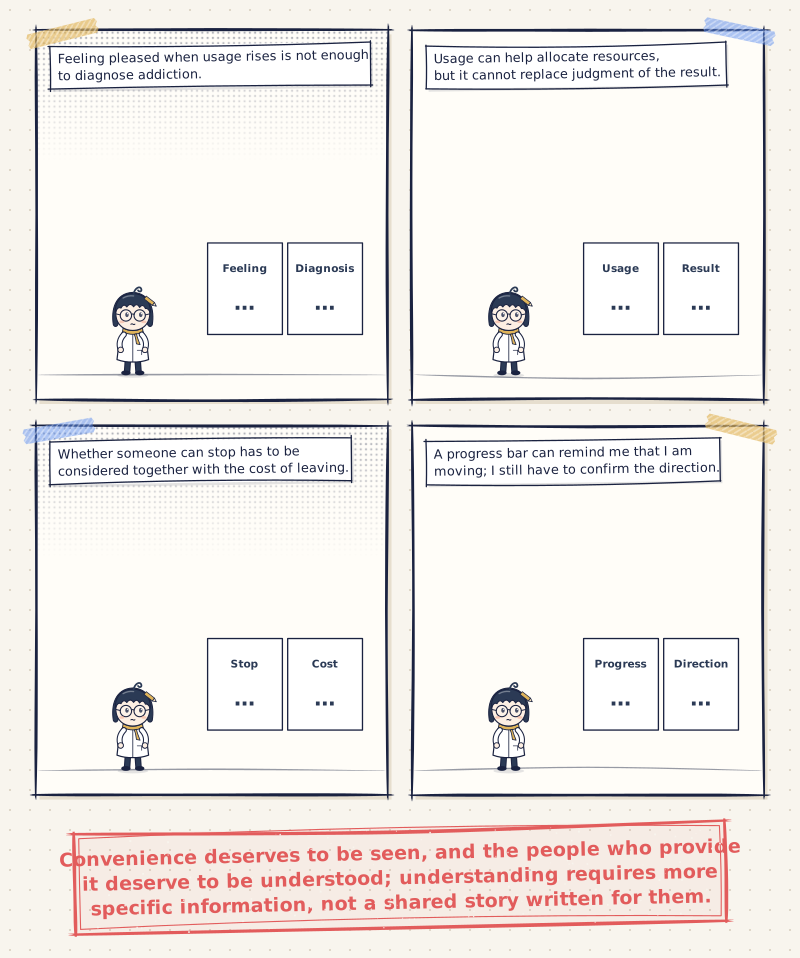
Convenience deserves to be seen, and the people who provide it deserve to be understood; understanding requires more specific information, not a shared story written for them.
“Voluntary” Does Not Mean Free from Pressure
A person choosing to keep working does not mean that external conditions are absent. Conversely, being constrained does not mean that person has no judgment or capacity to act.
I want to retain the phrase “voluntary cage” because it reminds me that choice and pressure can coexist. It is not a way to accuse workers of refusing to leave, nor does it mean that they can simply stop whenever they wish. Income, responsibilities, and alternative work opportunities may all shape the choices available to someone.
Nor should I equate my use of AI with a rider who depends on delivery work for a living. The income risks, physical burdens, and exit conditions are different.
The same metaphor can raise a question, but it cannot flatten different living conditions.
For me, becoming someone who can work more independently is worth pursuing. But if “continuous upgrading” never includes a moment to stop and examine the direction, it can become a demand without an endpoint.
The Box Is a Question, Not a Diagnosis
I once used the “Skinner box” to describe the feeling of always wanting to do a little more. I retain it here as a metaphor: when feedback becomes highly visible, do I begin arranging my life around the feedback itself?
But an uncertain reward alone is not enough to identify a particular reinforcement schedule, let alone prove that a platform is especially addictive. An analysis of the actual mechanism would need to establish how rewards occur, which behaviors they are connected to, and what observations support the claim.
Feeling pleased when usage rises is not enough to diagnose addiction.
That distinction matters. My reflection concerns how I view my tools and myself. It is not a psychological diagnosis of readers, riders, or every platform user.
For the same reason, I no longer compress the different ideas of Marx, Heidegger, and Camus into one explanation. A more direct approach for this personal note is to ask my own questions: Why do I continue? What am I giving up? Can I change the way I work?
What Did the Increased Usage Accomplish?
When I wrote the original essay, a browser tool showed that my weekly usage had reached 30 percent. That was what the interface displayed at the time. It is not today’s allowance, nor proof of output quality or an actual token count.
I did complete a number of things then. Looking back, however, the number itself cannot explain which results were useful, which had to be redone, and which merely made me feel busy.
Usage can help allocate resources, but it cannot replace judgment of the result.
I therefore want to return my attention to several concrete questions. Whose problem did this work solve? Was the result checked? How much correction remains? Could another approach produce an equally suitable result with less time?
Those questions do not come with an attractive progress bar, but they are closer to why I used the tool in the first place.
Leave Room to Change the Pace
For me, part of freedom is retaining the ability to reconsider my pace: closing the dashboard, stopping unnecessary retries, or admitting that the work in front of me is already good enough.
That is a requirement I place on my own AI use, not a measure of anyone else’s freedom. Whether another person can stop may depend on conditions I have not experienced.
Whether someone can stop has to be considered together with the cost of leaving.
I still want to enjoy the capabilities these tools provide, and I remain grateful for the late-night meal that was delivered. But the next time the number rises, I want to ask first: which worthwhile thing did it make better?
A progress bar can remind me that I am moving; I still have to confirm the direction.

💬 Comments
Loading...