
At the market, I sometimes pass someone sitting by the roadside, begging. Whenever I notice them, I want to give them whatever coins I have on me.
I know the amount is small, and there is only so much it can help. I don’t know what they have been through, and I wouldn’t dare claim to understand their suffering. But in the brief moment we cross paths, the pain of a person who is hurting deserves a moment of my attention.
These encounters also make me think about my own life. I spend my days working, handling things, keeping up with new knowledge and technology, looking for opportunities, trying to secure a better future. I want to move faster and do things better.
Yet the person in the market corner shows me a different kind of time. Some hardships won’t be solved just because the world speeds up. Some people have already spent every ounce of energy simply trying to keep up with life.
As we keep talking about progress, are these people’s circumstances being included in how we imagine the future?
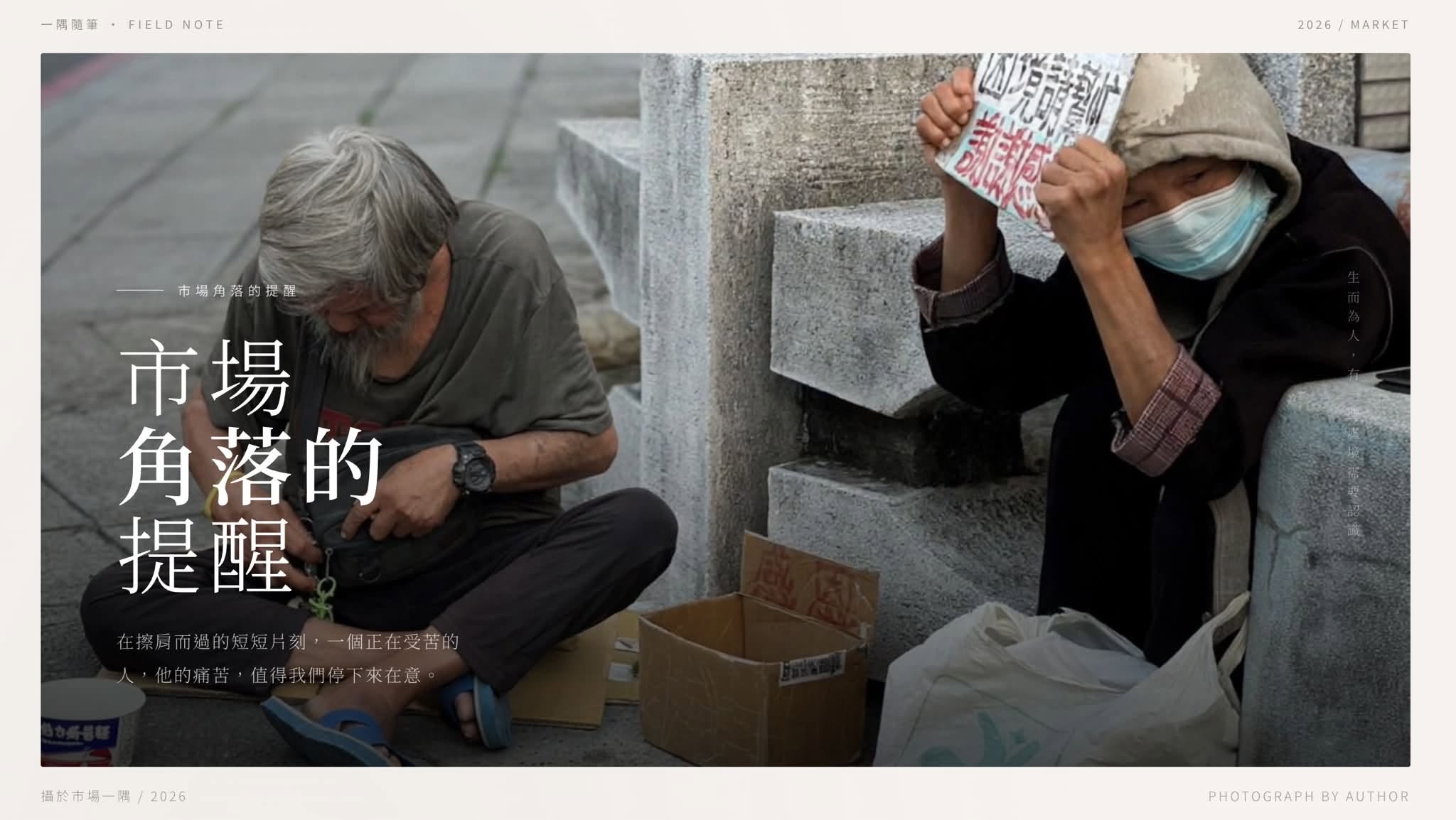
When Even Stopping Feels Uncomfortable
I am increasingly convinced that a life driven by capital and efficiency is pushing suffering out of our field of vision.
This pressure often arrives wearing a reasonable face. Work has deadlines, life has expenses, new tools need learning, and opportunities don’t wait. We tell ourselves we have to take care of ourselves first before we can help anyone else. All of that makes sense. But it can also turn “once I have more capacity” into a moment that never arrives.
In The Burnout Society, Byung-Chul Han argues that modern society is increasingly driven by achievement and performance. People treat themselves as a project that must be constantly managed, voluntarily demanding greater efficiency and more output. Han suggests that this self-drive carries the feeling of free choice, yet it may be harder to stop than when acting under external orders. When a person finally can’t keep going, they tend to turn the failure back on themselves. The pressure to achieve becomes self-exploitation, and exhaustion cannot be explained away as a simple lack of personal resilience. An excerpt from the English translation of The Burnout Society
This analysis makes me think that when we grow accustomed to pushing ourselves forward without pause, we may start applying the same standard to others. If every hardship is understood as insufficient effort, we easily overlook those who, no matter how hard they try, may not be able to get through alone. In a world where AI keeps raising the efficiency bar, I worry that our expectations of capability keep climbing while the space we leave for human vulnerability and suffering keeps shrinking.
Tools make work faster. But the time saved doesn’t necessarily stay in our lives. Once higher efficiency becomes the new baseline, people must produce even more just to avoid falling behind. Will we become so practiced at looking for solutions that we gradually lose patience for sitting with what cannot be solved right now?
A few coins won’t end poverty. One moment of care won’t change someone’s circumstances. The person at the market corner confronts us with that helplessness. But if only solvable problems deserve attention, then many people’s suffering never has a chance to enter our lives at all.
I pursue efficiency too. I calculate time. That is exactly why I need these encounters to remind me: some things are still worth responding to, even when no visible result follows.
When We Stop Trying to Understand a Person
Over the past few days I have been reading reports about Jensen Huang’s extramarital affair, and watching wave after wave of condemnation and mockery on social media. Related reporting from CNA
Some of the criticism was asking about accountability. But some of the reactions left me feeling that people very quickly settled into a rhythm of collective denunciation. The harm inside a relationship became material for trading opinions, expressing anger, even entertainment.
I thought of the figures people walk past in the market.
Their resources, power, and responsibilities are entirely different from those of a public figure in the news. The connection I see is in how onlookers so swiftly close the door on understanding: one person gets filed under “not worth noticing,” another under “someone we can condemn together.” Once the category is assigned, it seems there is nothing left to know.
The person by the road gets passed over. The person in the news gets talked about. The crowd can be very quiet or very loud. Understanding may be absent in both cases.
A crowd watching someone does not necessarily mean that person is truly seen.
If what we care about is harm, then the injured partner and family need to stay in view. They have their own lives to continue, their own decisions to make. Holding someone accountable should also mean refusing to treat that person’s circumstances, and their family’s, as public entertainment.
This brought me back to a question for myself: when I join in criticism, am I concerned about who was hurt and how things should be handled, or am I standing in the crowd because it makes it easier to feel certain I am right?
When We Stop Trying to Understand a Person
some things are still worth responding to, even when no visible result follows.
Play the narrated animation
Before Picking Up a Stone
John 8 records that the scribes and Pharisees brought a woman caught in adultery to Jesus and made her stand before the crowd. They told him that the law of Moses commanded stoning for such a woman, and asked what he would say. The text notes that they meant this as a trap, hoping to find grounds to accuse him.
Jesus bent down and wrote on the ground with his finger. When they kept pressing him, he stood up and said:
“Let anyone among you who is without sin be the first to throw a stone at her.”
One by one, beginning with the eldest, they walked away. Jesus asked the woman whether anyone had condemned her. She said no one had. He replied:
“Neither do I condemn you. Go, and do not sin again.”
This passage is John 8:1-11. For me, it asks those ready to condemn to face themselves first. It also gives the woman space to continue living and to change, even as she remains accountable. I want to carry that reminder into my own judgments.
Today, a single comment or a retweet is enough to join a sweeping condemnation. Before I press send, I need to ask: how much do I actually know, and what am I adding to someone else’s life?
The passage also reminds me of this: even when I oppose a crowd’s shaming, I cannot conclude I am more righteous than those doing the criticizing. I am just as capable of reaching a verdict before I have understood anything.
Leaving Room for Relationships to Change
I have no way of knowing what happened inside the relationship in the news, and I cannot explain why he concealed it. The situation raises a broader question for me: when feelings change, do we leave room for honesty and renegotiation?
Shared lives can span decades. Over that time, people’s understanding of themselves, their needs for intimacy, and the ways of living they can sustain may all shift. I believe intimate relationships need more room to hold these fluctuations, so that those inside them can voice confusion and face the reality that the relationship has become something different.
If any deviation from the original form risks a wholesale rejection of a person’s character, then speaking honestly becomes much harder. What concerns me is a society that holds only one fixed expectation for intimate relationships, rushing to punish any transgression without trying to understand human contradiction or the complexity of the world, and without caring how a relationship might honestly end or repair. That pressure may push people to cling more tightly to appearances.
Making room for change also means giving a partner space to know, to choose, and to refuse. How a relationship continues is something those inside it must decide together. The person who has been hurt is free to leave, and is not obligated to forgive just to meet other people’s expectations of magnanimity. Understanding someone’s difficulty still requires taking seriously the cost their choices impose on another person.
When public discussion fades, the people inside the relationship still have to keep living. When we talk about ethics, I hope we are willing to care about how they can move forward honestly, not only to deliver a verdict on what went wrong.
What I Have Was Built With Others’ Help
Back at the market, I still don’t know what the person sitting there has been through.
I don’t know how hard they tried, or at what point their life became impossible to sustain. That not-knowing keeps me from drawing easy conclusions about their life.
Thinking about this, I am struck by how fortunate I am. What I have is not only the product of my own effort. It includes conditions I did not choose, and support that others gave me along the way. My life reaching this point has never been my work alone.
Acknowledging that makes it harder for me to explain away someone else’s circumstances as simply not trying hard enough. When I measure a person by achievement, I also need to remember that life includes vulnerability, loss, and times when even our best efforts may not be enough to get through alone.
A single act of giving cannot substitute for systems that protect people from poverty. Passing someone without giving is not enough to judge a person’s goodness. Everyone has limits, and people may care for others in different ways.
For me, handing over the coins in my pocket is a way of pausing in the middle of a busy day. I still have things to do. The other person’s situation may not change much. But at least in that moment, I am willing to acknowledge: his need has something to do with me.
I Hope My Children Can Still See
What I am afraid of is becoming accustomed to things that once troubled me, without even noticing the change.
Looking away once seems insignificant at the time. But if I keep setting aside other people’s pain, using busyness as the reason, I may eventually stop feeling that it has anything to do with me. Indifference takes root in these small, unremarkable daily moments and gradually becomes a habit.
I believe God gives us seeds through encounters like these. Each time we are willing to notice, willing to respond, that seed grows a little. The person in front of me has their own life and their own needs. And in responding, I am also learning to know suffering, to feel with those in pain, to understand life more fully.
I hope my children will have knowledge and capability, that they can care for themselves well, and that they won’t have to spend all their energy proving their worth. I hope that as they move forward, they can still see the people beside them. That when they meet a situation they don’t understand, they will pause a little longer. That when they encounter someone else’s failing, they will remember, before judging, that everyone has their limits.
I cannot prepare my children in advance for every answer life will ask of them. What I can do is practice these choices in my own life.
The next time I walk through the market and pass someone sitting by the road, I think I will still give them whatever coins I have. There is little I can do. But in that brief moment, I want to remember: their life does not become unworthy of attention just because I still have things to take care of.
Appendix: Sources and Reading Notes
Byung-Chul Han and The Burnout Society
The discussion of achievement society and self-exploitation is my own summary of an excerpt from the English translation of The Burnout Society, not a verbatim quotation. Han examines how people turn external demands into self-imposed pressure and exhaust themselves in pursuit of achievement. My reflections on AI acceleration, how we see people in the market, and the culture of public spectatorship extend from that analysis; they should not be read as Han’s direct conclusions about these particular situations. Read the excerpt, “Beyond Disciplinary Society”
John 8:1–11
The Chinese biblical quotations in the original article use the Chinese Union Version. The passage describes a woman caught in adultery; it does not identify her occupation, so it does not establish that she was a prostitute. As I read this story, I see both Jesus interrupting the crowd’s condemnation and his call for the woman to change how she lives. Mercy leaves room for change; taking responsibility seriously need not come at the cost of humiliating someone. Read the full passage in Chinese
News Sources and the Scope of This Essay
The news discussed here takes public reporting by Taiwan’s Central News Agency as its starting point. I cannot know the full history, agreements, or circumstances of the relationship between those involved, nor do I infer anyone’s reasons for concealment. My concern is whether we can ask for accountability while leaving room to understand human complexity. Allowing for changes in a relationship always includes a partner’s rights to know, choose, refuse, and leave. A person who has been hurt has no obligation to forgive. Read the CNA report
💬 Comments
Loading...