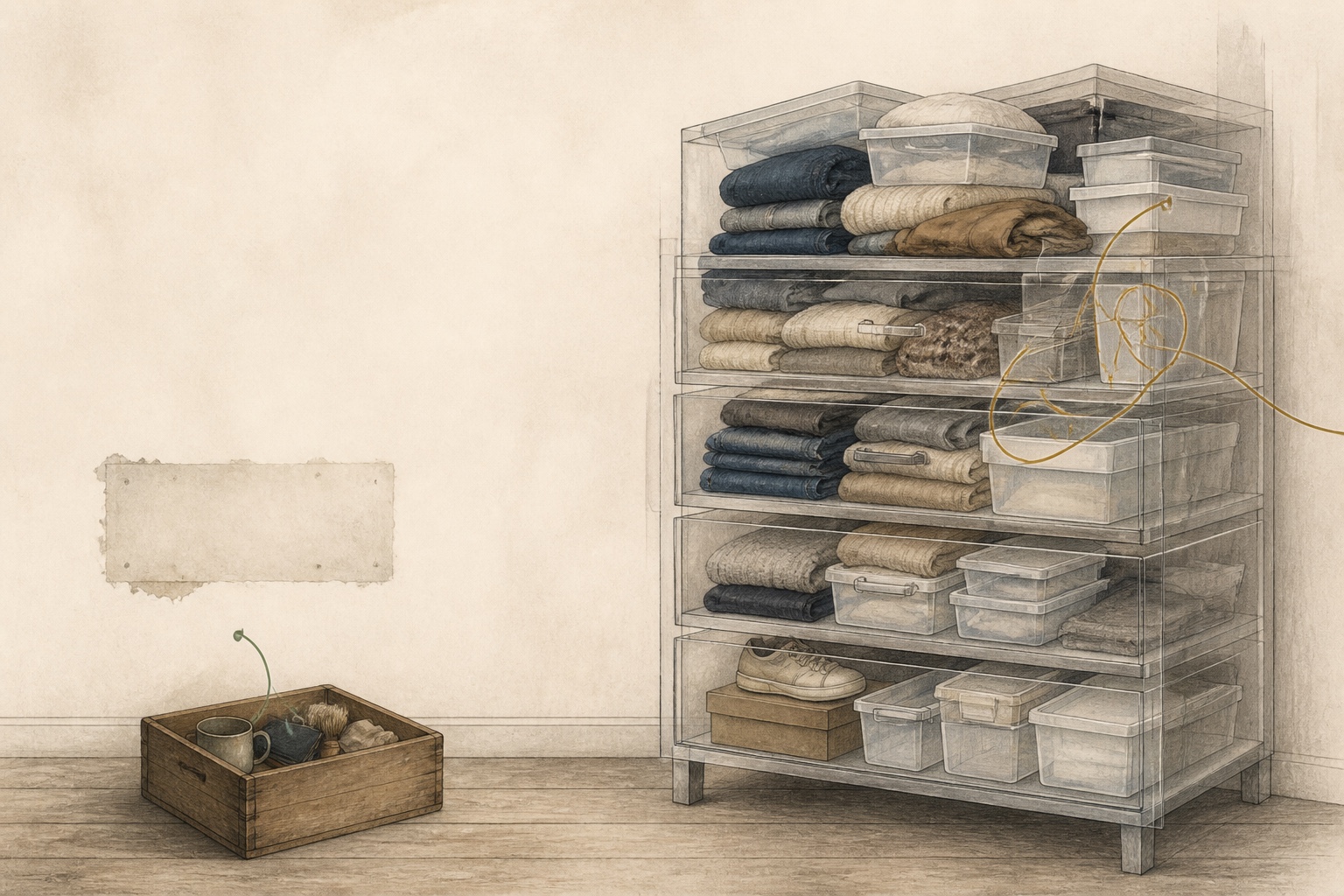

When a space becomes messy, buying storage products is a very natural reaction. Seeing a desk piled with objects, one wants a box; seeing a wardrobe that will not close, one wants another set of drawers. Containers have their uses, but one thing is often overlooked: a storage product is itself a new object.
It has materials, dimensions, packaging, shipping, and a price, and it also needs a place to sit. When we use something new to hold something old, the space may look neater on the surface while the household’s total volume of things may still increase. This does not mean storage products should never be bought. It is a reminder that a container belongs after judgment, not before it.
A container cannot decide for you what stays
A box can gather objects together, but it cannot answer whether those things are still in use. It cannot restore an expired product’s shelf life, make ill-fitting clothes fit, or suddenly make a mistaken purchase worth keeping.
If the contents are not dealt with first, a container often makes the problem harder to see. Things are sorted and lidded; the view is clean, yet the next time they are needed they cannot be found. Or one meant to keep only a few items, and because the box still had room, similar things were kept as well. A slower filling of space does not mean inflow has stopped.
The source material includes an important judgment: before tidying, ask the user, not the house. A room has no standard answer that fits everyone. Some people need frequently used objects within arm’s reach; some need children’s things at a height children can reach themselves; others need a staging area that can be cleared quickly. A container’s size and form should serve these paths, not force people to fit the container’s limits.
Reduce first, then test, then decide whether to buy
The first step is to put like with like and know how much one actually owns. The action can be uncomfortable, because once the quantity appears, a vague “I should need this” becomes a stock that can be compared. Then keep only what is truly in use now, reachable, and assigned a clear place.
The second step is not to order at once, but to test for a while with cardboard boxes, bags, or empty drawers already in the home. What is being tested is not appearance, but whether taking things out, putting them back, and cleaning remain easy. If a stand-in container already makes the path clear, a new purchase may not be needed; if it truly solves a recurring problem, then choose by size and frequency of use.
Only the third step is buying. A few more questions help: How much can it hold? Will it make frequently used objects harder to reach? If it is unused later, can it be passed on or recycled? Is a set cheaper only if one buys more than will actually be used? The value of a storage product is not only how tidy it looks at the moment of purchase, but whether later it makes objects easier to use and to leave.
Maintenance belongs in the test as well. Whether the container is easy to clean, whether a drawer hits nearby furniture when opened, whether other people in the household can understand the sorting: these are part of use. If only the buyer knows what each box holds, others may set things down outside it, and a new pile forms. A good container is not the prettiest or most complete set, but one that people in the household can use without repeated explanation.
Give containers an exit as well
Some storage products are durable and suited to long use; others lose their place quickly because the size is wrong or the need has changed. The source material also notes that the container market sometimes requires relatively large production quantities. That observation cannot be stretched into statistics for every product, but it makes a reality visible: a seemingly small tidying decision may still be connected to the scale of materials and production.
So reduce before buying, use well after buying, and when it is no longer needed pass it to the next person who needs it: that is closer to circulation. Effective storage is not stuffing more things into prettier boxes. It is letting what remains be seen, used, and, when necessary, given a way out.
If an unsuitable container has already been bought, it need not stay forever because it was “a wrong purchase.” First check whether it can be used elsewhere in the home, or ask people nearby whether they have a fitting need. If not, set out the material, condition, and acceptable way of handing it over, then decide to pass it on or send it into the appropriate process. Letting a container leave does not deny the original wish to tidy; it returns the object to a more suitable path of use.

💬 Comments
Loading...