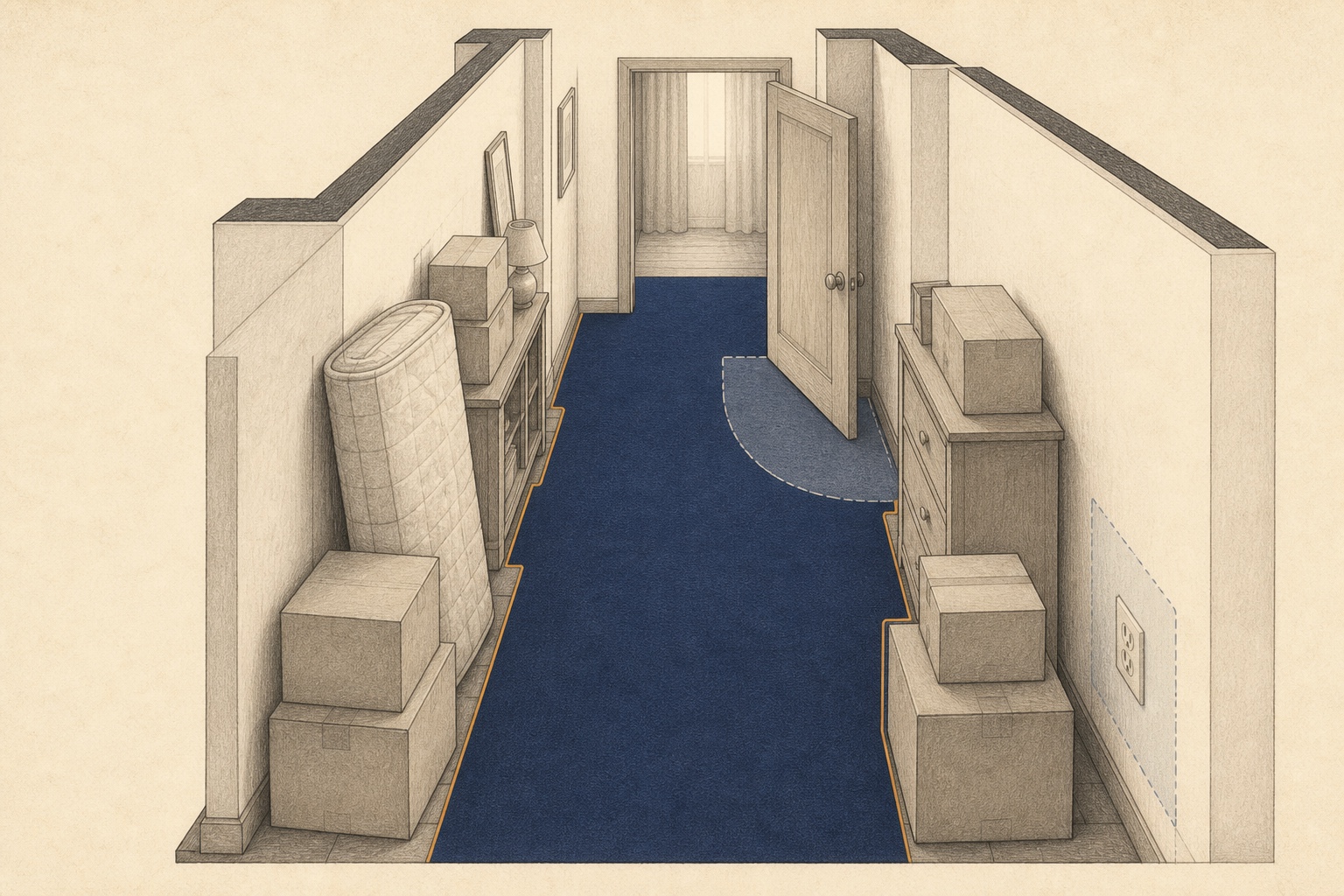

Some people dislike tidying because they think it is only a pursuit of looking good. Neatly lined-up objects seem to exist for better photos; a messy pile is often read as a lack of self-discipline. Both views turn space into a matter of taste too quickly, and miss a more practical cost of clutter: it can make daily life harder to operate.
A narrowed hallway means turning sideways while carrying hot food. Everyday items placed high mean stretching on tiptoe or dragging over a chair. Boxes on the floor delay cleaning and inspection. These are not abstract standards of neatness. They are whether walking, reaching, cleaning, and handling sudden situations still go smoothly each day.
Look at circulation first, not at judging the household
The same space does not carry the same risk for every person. Where there are older adults, young children, people with limited mobility, or someone under caregiving strain, a path that only “needs a little detour” can mean a heavier operational burden. That does not mean clutter in a home will necessarily cause an accident, and a single tidying case cannot be used to infer falls, allergies, or other health outcomes. A more cautious approach is to list conditions that can be observed directly.
Start with five questions: Can the main walkways be passed through naturally? Can everyday items be reached without standing on tiptoe or moving heavy objects? Is there enough light at night? Can floors and corners be cleaned regularly? In a leak, a power cut, or a need to leave quickly, can exits still be found? If the answer to any one question is poor, that is already enough to set a tidying priority. There is no need to wait for an incident.
Safety is not emptying everything
Tidying for safety does not mean turning a home into a display space with no trace of living. Toys a child is using, supplies a caregiver needs within reach, and tools needed for work all have reasons to stay. The point is that they should not block the most important paths, and that a temporary placement should not become permanent stock.
Three kinds of items can be handled first. First, things already blocking passage or a doorway: move them out of the main circulation. Second, things that are reached often but stacked in unstable places: rearrange height and weight. Third, things long unused that still occupy floor or work surfaces: confirm whether they can be handed on, repaired, recycled, or withdrawn.
This order has a benefit: it does not require judging the value of every object at once. It first lowers the most direct operational risks. When paths are clear, remaining objects are easier to see, and easier to discuss in terms of use and destination.
When checking, actually walk the usual routes rather than only looking from the doorway. Carry water, a plate of food, or trash, or pass through after turning on the lights at night, and obstacles that a flat photo would miss become visible. Whether a door can open fully, whether a drawer can be pulled out without first moving something else, and whether combustibles are stacked near outlets are also worth recording separately. These are observations of living conditions, not scores of a resident’s ability or attitude toward housework.
If objects are heavy, placed high, or require dismantling appliances and furniture, do not treat “emptying” as the only goal. Ask someone who can handle the work safely for help, and when needed seek corresponding professional advice in fire safety, building, occupational safety, caregiving, or medicine. Tidying itself carries moving and construction risks. Improving one risk need not be traded for another.
Arrange a safe next stop for objects
The clutter problem still leads back to the flow of objects. Things not in use for now, without a fixed time to look at them again, stay beside the passage. Things meant for donation, without a confirmed way to receive them, can form another pile by the door. Materials meant for recycling, without sorting and a way to hand them over, only stay longer in the home.
So a safety check is not about throwing things away faster. It is about letting the space become passable, reachable, cleanable, and ready to respond first, then confirming a use for what stays and an exit for what leaves. The premise of circulation is not that objects are never retired. It is that each decision to keep or withdraw no longer treats the household’s safety conditions as an invisible cost.
Moving one object that blocks a door today may matter more than finishing a whole room at once. When safety conditions are seen, it also becomes easier for family members to shift from “why are you piling things again” to “how do we restore this path.” That kind of low-conflict shared check is what gives objects a chance to have their next stop discussed, instead of leaving the responsibility parked on one person.
💬 Comments
Loading...