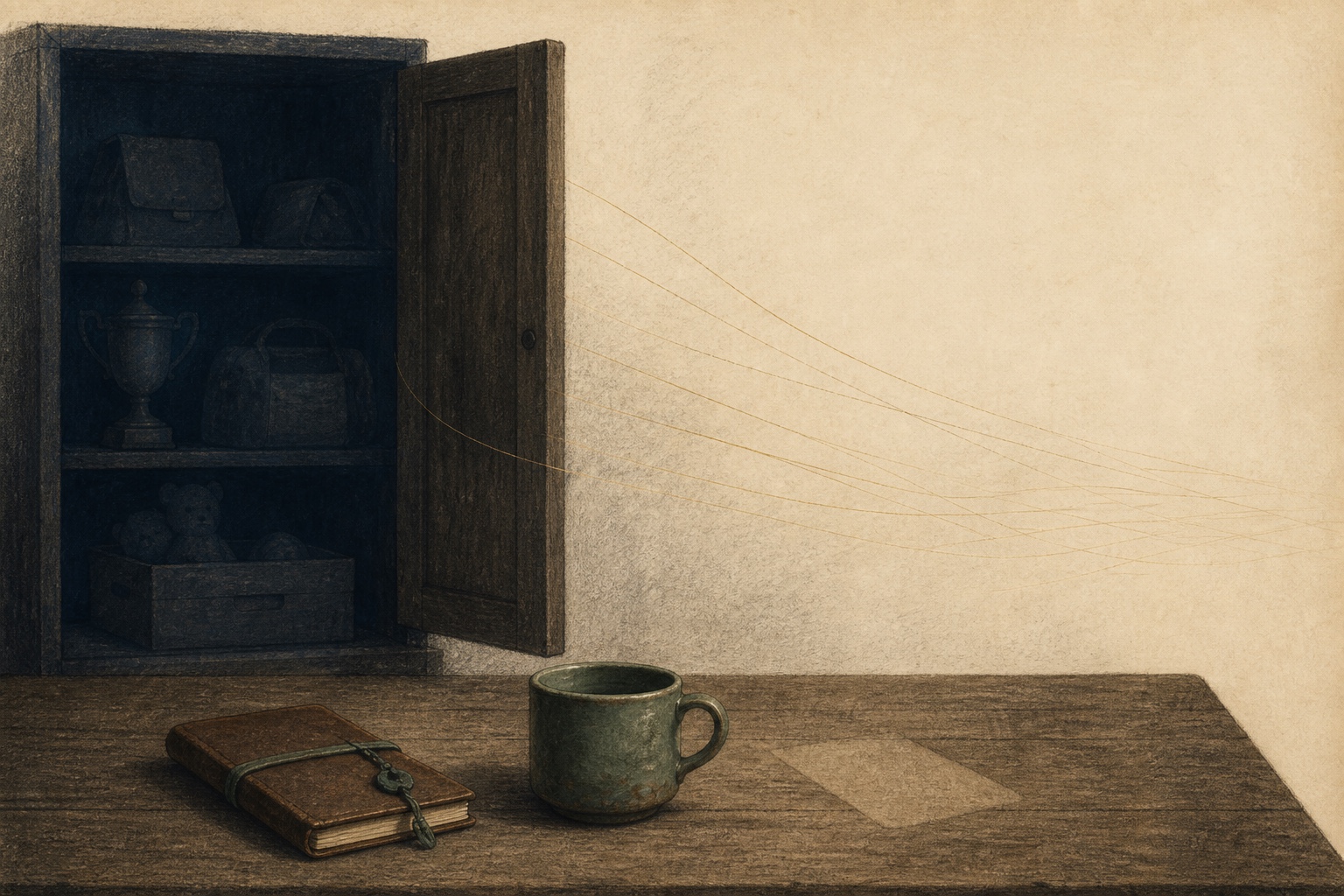

Some objects are bought not only because we like them, but because they can speak for us: I have worked hard, I am capable, I have not shortchanged my children, or I have a style of my own. At particular moments these objects can indeed bring comfort. The problem is not that they have symbolic meaning. It is whether we need to keep adding objects for that explanation to remain effective.
In the source material, a mid-level manager at work had collected a full cabinet of designer bags over many years. At the time, each bag felt like a reward for effort, and in work and social settings it stood for a certain image. Later she moved away from her original city, her work became remote, and occasions that required presenting herself became fewer. Most of the bags stayed in the cabinet. This is one case and is not enough to infer anything about all collectors, but it makes the issue clear: when the audience and the setting disappear, the function the objects once carried can leave with them.
This is not only a vanity problem
If this kind of behavior is labeled vanity and nothing more, the advice usually shrinks to “don’t buy,” without understanding why the purchase felt so useful at the time. The source material places that pressure in the context of social evaluation. In this essay it is only one interpretive thread; it does not mean every purchase is caused by the same pressure. Objects sometimes offer immediate affirmation and can briefly steady a sense of self when one is being judged, compared, or feeling uneasy. A tidying essay should not be treated as a psychological diagnosis, and a single case should not be used to conclude anything about all buying.
A more useful question is: is this object still being used? Is it here so I remember an experience, or so that other people will believe an image? If the outer occasion disappeared, would I still want to keep it? The answer need not lead at once to discarding. It can turn a vague reluctance to let go into a judgment that can be looked at again.
“Proof” can also be split into different needs. Some objects remind us that we once finished something. Some are for daily use. Some wait for an uncertain occasion. All three needs can be real, but they need not be carried long-term by the same object. When an object is left with only a display function, one can ask again: does this display still belong to present life? If the answer changes, the object’s place and destination can change too.
Objects can also fill in a family story
The source material also includes a father whose childhood household had limited goods, and everything had to be shared with siblings. After becoming a parent, whenever one child wanted a toy, he bought the same for the other two as well. Assembled toys piled up to twenty or thirty boxes, some still unopened. What he wanted to make up was not only toys, but a sense of fairness missing from his own childhood.
Another homeowner treated a room as an extension of personal style, spent for a long time on in-game purchases, and had almost no monthly surplus, until the room was filled with objects and equipment and the relation between consumption and life became visible again. These cases have different motives. They cannot stand in for one another, and they should not become labels for a type of person. What they share is that objects were used to testify to a self-description.
Keeping a memory is not the same as keeping every piece of evidence
The real divide is not necessarily quantity. It is whom the object is proving something for. What is kept so that one can remember can usually name the experience it stands for, and can accept keeping one piece or a few. What is kept so that others will believe more easily needs continual replenishment, because outside standards change, and evidence that once seemed enough soon is not.
That is also the difference between commemoration and liability. Commemoration can be looked at again in living. Liability keeps charging space, money, and attention. Once a life role changes, former evidence can become stock that only takes up room.
One does not have to deny past effort in order to sort present objects. One can first keep the part that best represents that experience, so the story remains; then check whether the rest can be handed on, used again, or sent through an appropriate exit. Glory and worth need not stay lodged in objects. When objects no longer need to speak for us, they have a chance to return to use and circulation themselves.
This judgment need not be finished in a single tidy-up. One can give representative objects a clear place, keep a convenient path for objects still in use, and set a review date for things that are still uncertain. On that day, if something still has not been used and still cannot say which memory it is meant to keep, there is one more reason to hand it on or let it go. Leaving a small, clear story is often closer to the life one wants now than letting an entire space keep proving the past.

💬 Comments
Loading...