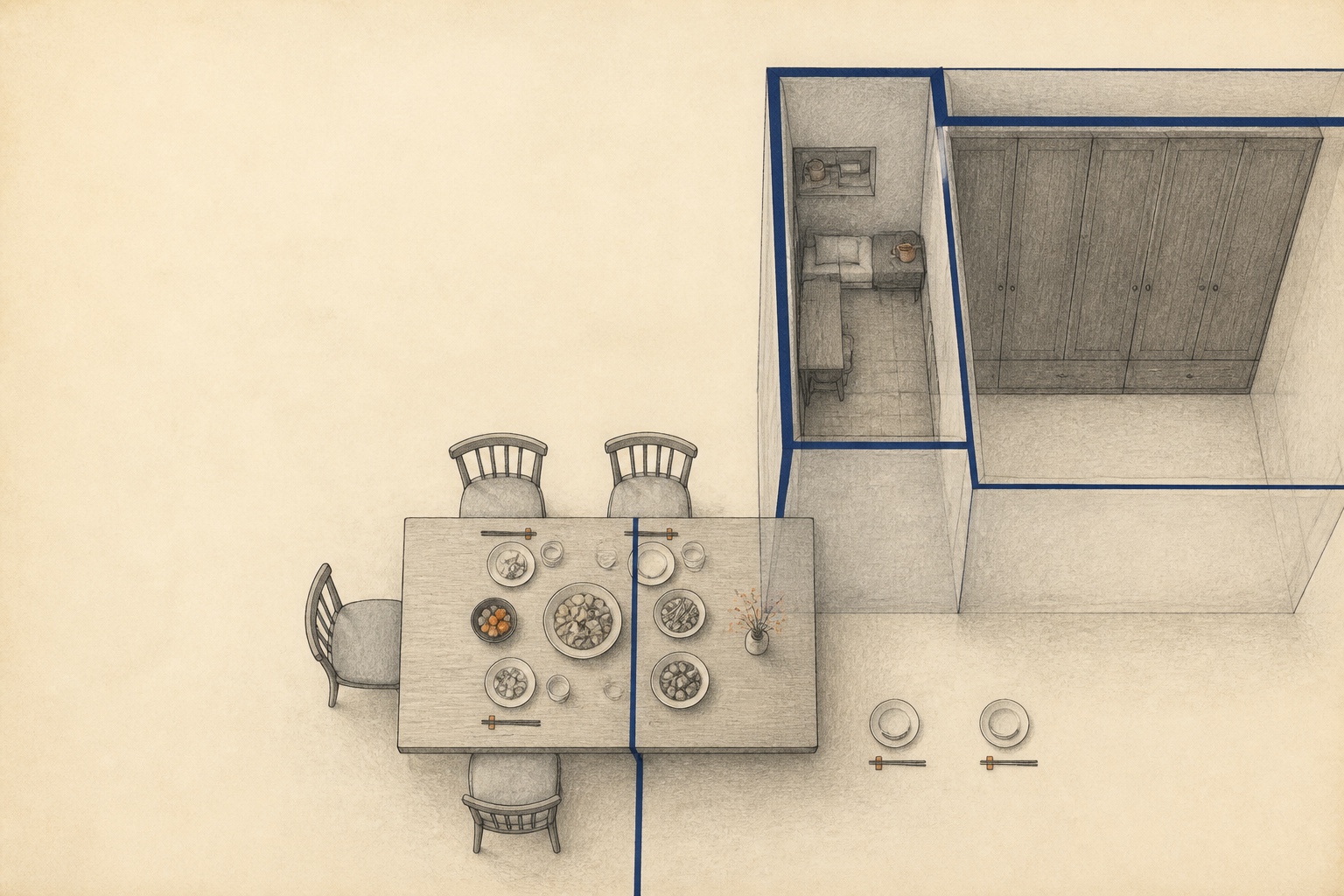

When people talk about home decluttering, space is easily treated as a neutral container: when there is too much stuff it will not fit, and when it will not fit you find a way to put it away. In a home where several people live together, space is in fact a resource that has to be allocated. Who has a room, who may use only a drawer, whose things must retreat into the hallway—these arrangements are not only storage outcomes. They also show who is allowed to keep a place in the household.
Some families live for a long time with not enough seats and shared cabinets that cannot be adjusted, until no one treats that as a problem worth discussing. On the surface it looks like furniture and room layout. Behind it, some people’s needs may always be ranked last. What is at issue here is everyday negotiation and actual use, not real-estate ownership or legal disposal rights. Draw that line first, so the conversation does not become another round of blame.
The person with the least space is not necessarily the one with the fewest needs
If someone’s belongings are packed into a small room, it is not always because they pile things up. Shared space may already have been given over to other people’s lives. When the living room must stay empty, or certain cabinets are treated as immovable, clothes, tools, and memories can only keep being pushed back into that person’s room.
Asking them then to “tidy up a bit more” turns a shared allocation problem into one person’s duty. Things are moved away, but no extra place appears. The house looks briefly clearer; the actual relationships have not changed. If decluttering only follows whoever has the most say, the people most easily decluttered are often those with the least space and the least decision-making power.
So the first step in decluttering is not necessarily sorting. It is bringing the users back. Whoever lives here every day should be able to say what matters to them and what makes daily life stall. Others can raise shared needs for safety, cleanliness, or passage. They cannot treat the other person’s silence as consent, or treat their own taste as a rule for the whole household.
Places that cannot be moved are also a kind of rule
Decision-making power in a family also shows up in what is allowed to be discussed. Some cabinets are designated immovable. Some objects cannot be dealt with even after years of disuse. Some rooms may be decided only by certain people. Rules may have history, emotion, or care behind them; they need not be dismissed without context. Once rules are made by only one side, though, others can hardly take part in rearranging space.
Before decluttering, three questions can be asked first: Who uses this spot? Who can decide whether an object stays or goes? If something is to be moved or released, who needs to be told and accompanied? The three questions are not meant to find who is right or wrong. They put the decision-making power hidden in cabinets and furniture back on the table.
Change decluttering from correction into collaboration
If family members want to help, the opening need not be “everyone wants you to throw things away.” It can be “let’s put your space in a shape you can actually use.” When initiative returns to the user, it becomes more possible to say clearly what should stay, what should move, and what can go to the next user.
Collaboration also includes real time and information. When large objects have to be moved, family members can take them apart and carry them together, and confirm how they will be handed on or how materials will be handled. Collaboration is not deciding in the other person’s place. It is supplying the conditions needed to finish a decision.
If shared space still cannot be reallocated, start with one small spot rather than demanding that the whole household change at once. Let each person point to one place they use every day but cannot easily put things back, then confirm together its use, what may stay, and how it might be adjusted. Concrete negotiation in a small range is often easier to begin than an abstract argument over who needs more space.
Fair allocation of space does not mean everyone gets the same floor area. It means each person’s living needs are seen. When users can take part in what stays and what goes, what remains is more likely to be used well, and what no longer fits can leave without humiliation. Look first at who is sitting and who can only stand, and you often see how a household assigns places.

💬 Comments
Loading...