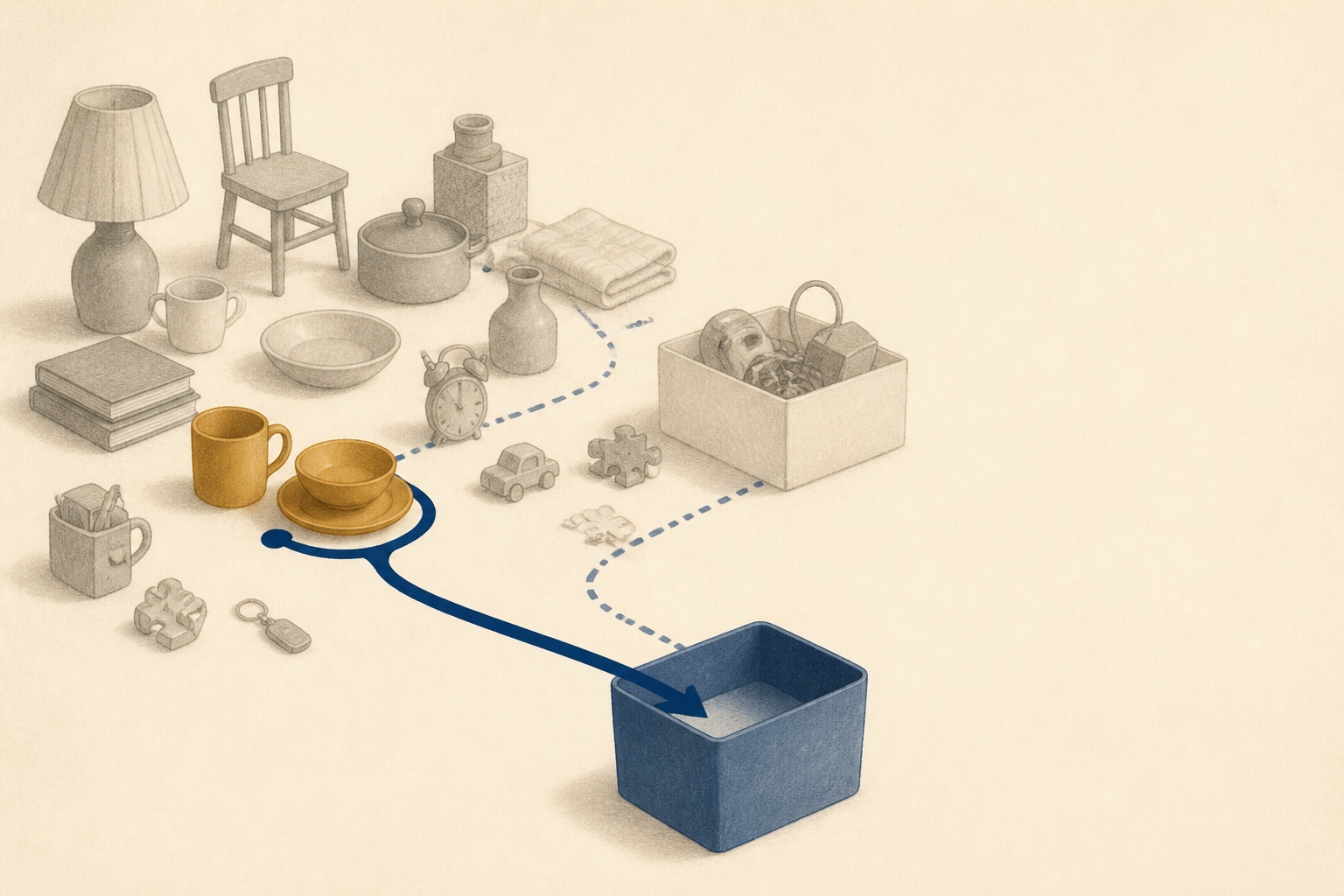

Standing in a space full of mixed objects, people often already know they need to declutter. What they do not know is the first thing to do. Pick something up, and you may first have to identify it, then decide whether to keep it, then think where it should go. If it never had a fixed place, the judgments keep branching. When the day’s usable energy is small, that workload is enough to leave someone standing still.
Calling this laziness misses a place that can be redesigned: too many decisions at once. Redesign does not ask for more force. It shrinks the problem so the action in front of you has a range, a direction, and an endpoint where you can stop.
Start with work that needs only one kind of judgment
In a low state, decluttering can first be split into a few categories. Round one looks only for trash. Do not judge recycling, donation, or an object’s value at the same time. Put packaging and obviously damaged items into one bag; stop when the bag is full or the round is over. Round two looks only for dishes. Bring scattered dishes back to the sink; washing need not finish in the same round.
Round three looks only for clothes. Clean, worn, and to-be-washed items go first into the laundry basket; sorting can wait. Round four handles only things that already have a home: books back to the shelf, the remote back to its usual place. Round five handles objects whose place is truly unknown. All of them go into one staging box; keep-or-go is not decided yet.
These five rounds are not a list that must be finished in one sitting, and not a standard answer for every household. Their use is to swap “should I keep this?” for “is this this category?” for a while. When each step asks only one question, the start-up cost may be lower. That is a reasonable inference about work design; it does not mean there is before-and-after data proving it works for everyone.
The endpoint has to be visible
Trash into a bag, dishes into the sink, clothes into the laundry basket: each is a visible close. Stop at the step you reached. Success does not require “the whole room is done.” The same approach works for one drawer or one desktop: choose one category, set one endpoint, then decide whether to start the next round.
The staging box for unknowns matters too. It does not hide the problem forever. It admits that high-cost trade-offs are a poor fit when energy is low. The box needs a later review plan, and it must not block main circulation. When there is more complete time, or someone who can confirm ownership and destination together, then handle keeping, handing on, repair, or withdrawal.
This method has clear limits
A single-category flow addresses starting. It does not automatically reduce the total volume of objects, and it will not empty a packed cabinet by itself. When walkways, the bed, the area around a stove, a door, or an escape route are already affected, the first priority is safety and appropriate help, not further optimizing the sorting flow. If the task already exceeds one person’s capacity to carry or to judge, bring in the collaborators who are needed.
Circulation is also not “the more you throw away, the better.” Items with known homes return first to a usable place; unknowns are held first. Only then is there a chance to judge what can stay in use, be repaired, handed on, or reallocated. One fewer misplacement and one fewer repeat purchase may sit closer to a change daily life can sustain than emptying everything at once.
So when energy is low, do not start with “why isn’t it finished yet?” Ask instead: which one category today? Where is its endpoint? What can wait, and which safety issues cannot wait? Being able to take a small step today is not the same as solving every problem. It may still be the start of getting choice back.
After one round, you can also note which category stalls most easily. If you always stop at “I don’t know where this goes,” the problem may be in how places are designed. If new objects keep interrupting, the problem may be at the entrance and in buying. If even carrying is impossible, splitting the task finer will not handle it. Leave the stall points for the next check, so decluttering can shift from a one-time exertion toward a living system that can be adjusted.

💬 Comments
Loading...